What does high cortisol mean?
Cortisol rises in everyone several times a day: in the morning on waking, and with exertion, illness or fear. This is a normal temporary rise. What doctors mean by hypercortisolism is the body being exposed to excess amounts of it for weeks and months, whether the body made it or it came from a medicine.
When the elevation continues, a group of distinctive signs appears, called Cushing's syndrome. If the cause is specifically a tumor in the pituitary gland, it is called "Cushing's disease." The syndrome produced by the body itself is relatively rare, but that produced by cortisone medicines is far more common.
It is important to distinguish this medical condition from what is said on social media about "high cortisol from stress." Chronic stress does disturb the cortisol rhythm and harm health, but it does not usually cause the full Cushing picture, and it is not treated the same way.
What are the symptoms of chronic high cortisol?
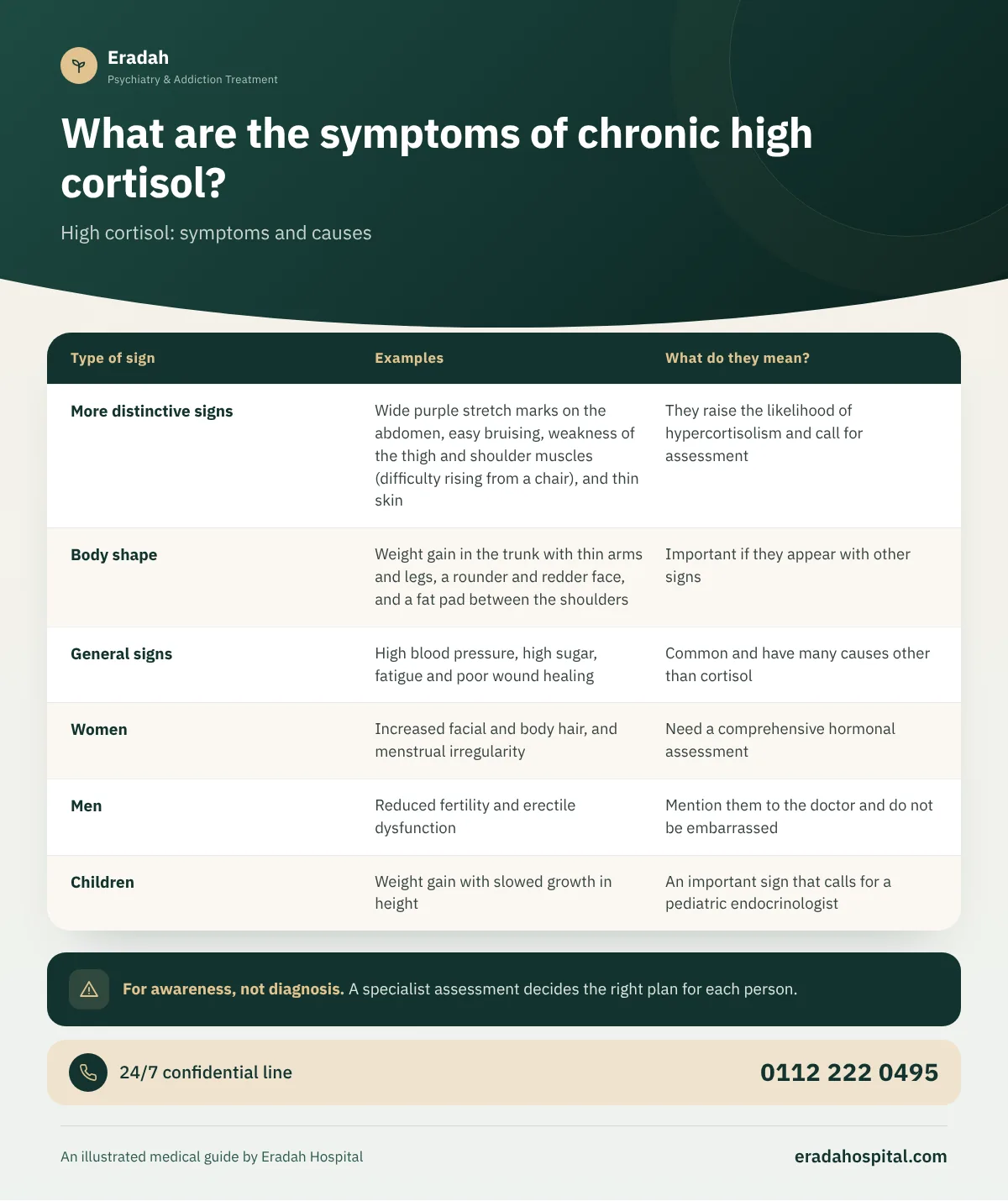
Symptoms appear gradually and may be noticed by family or by comparing old photos before the person notices them. Some are distinctive and raise suspicion, and some are common in many conditions:
| Type of sign | Examples | What do they mean? |
|---|---|---|
| More distinctive signs | Wide purple stretch marks on the abdomen, easy bruising, weakness of the thigh and shoulder muscles (difficulty rising from a chair), and thin skin | They raise the likelihood of hypercortisolism and call for assessment |
| Body shape | Weight gain in the trunk with thin arms and legs, a rounder and redder face, and a fat pad between the shoulders | Important if they appear with other signs |
| General signs | High blood pressure, high sugar, fatigue and poor wound healing | Common and have many causes other than cortisol |
| Women | Increased facial and body hair, and menstrual irregularity | Need a comprehensive hormonal assessment |
| Men | Reduced fertility and erectile dysfunction | Mention them to the doctor and do not be embarrassed |
| Children | Weight gain with slowed growth in height | An important sign that calls for a pediatric endocrinologist |
Psychological changes also appear in a large proportion of patients: mood swings, irritability, anxiety, depression, sleep disturbance, and poor concentration and memory. The patient may see the psychiatrist first, which is why an alert doctor asks about physical signs when they come together with an unexplained psychological change.
What causes high cortisol?
Doctors divide the causes into those from outside the body (medicines) and those from inside it, in addition to conditions that raise it without being a glandular disease:
| Cause | How does it happen? | Notes |
|---|---|---|
| Cortisone medicines (the most common) | Long use of tablets or injections, and sometimes strong creams or inhalers in large amounts | Treatment is by adjusting the medicine gradually with the doctor, not by stopping it suddenly |
| A benign tumor in the pituitary gland (Cushing's disease) | Releases excess ACTH, which drives the adrenal glands to release excess cortisol | Accounts for about 8 in 10 cases not caused by medicines |
| A tumor in the adrenal gland | The gland releases cortisol without commands from the brain | Usually benign, and sometimes malignant |
| A tumor outside the pituitary that releases ACTH | Tumors in the lung, pancreas or elsewhere that release the stimulating hormone | May be malignant and needs careful investigation |
| "Cushing-like" conditions | Excess alcohol, severe depression, anxiety, severe obesity and uncontrolled diabetes | Cortisol rises without comparable long-term harm, and usually improves with treatment of the cause |
Do alcohol and depression raise cortisol?
Yes, and this is an important point for people with addiction and their families. Chronic excess of alcohol may raise cortisol and produce signs resembling Cushing's syndrome, and the US National Institutes of Health call this condition "pseudo-Cushing's syndrome." It usually improves after stopping drinking, so the doctor may ask for the tests to be repeated after a period of abstinence before a final judgment.
A similar thing happens in severe depression and chronic anxiety, where researchers observe a disturbance of the HPA axis in a proportion of patients. This explains why the endocrinologist asks about psychological state and drinking before interpreting the results, and why psychological and hormonal treatment sometimes complement each other. The details of cortisol's relationship to drugs and withdrawal are on the page on cortisol and addiction.
What are the complications of high cortisol if untreated?
High blood pressure, and an increased risk of strokes and heart attacks over time.
Insulin resistance and the appearance of diabetes or difficulty controlling it.
Weakened immunity, more infections and slow wound healing.
Osteoporosis and fractures that can happen with minor injuries, and muscle weakness.
Depression, anxiety, sleep disturbance and poor memory, which need follow-up even after treatment.
Slowed growth in height, which is one of the most important reasons to pay attention early.
Most of these complications improve gradually after the cause is treated, although some, such as osteoporosis, need time and follow-up. So early diagnosis spares the patient years of suffering.
How are high cortisol and Cushing's syndrome diagnosed?
Diagnosis goes through stages led by the endocrinologist, and does not rely on a single random blood test, because cortisol changes over the course of the day and with stress:
- Medication review first: the doctor asks about all forms of cortisone, including creams, inhalers and joint injections, because they are the most common cause.
- Initial screening tests: the Endocrine Society guidelines recommend one or more of three: free cortisol in a 24-hour urine collection, late-night salivary cortisol, or the low-dose dexamethasone suppression test (a medicine given at night, then cortisol is measured in the morning).
- Confirmation: if the results are abnormal, the test is repeated or another is added, because stress, alcohol, depression, pregnancy and birth control pills can change the results.
- Locating the source: the hormone ACTH is measured to find out whether the cause is in the pituitary, the adrenal glands or elsewhere.
- Imaging: an MRI of the pituitary gland or a CT scan of the adrenal glands depending on the results, and sometimes specialized tests to pinpoint the tumor.
Should cortisone medicines be stopped when signs of high cortisol appear?
No, and this is the most important warning on this page. In someone who has taken cortisone for a long time, the adrenal gland has "gone to sleep" because the brain stopped stimulating it. If the medicine stops suddenly, the gland has no time to wake up, so cortisol drops sharply, and a life-threatening adrenal crisis may occur.
The right way is to tell your doctor about the signs you have noticed, and he or she decides whether the medicine can be reduced or replaced or something added to protect the bones and stomach, and sets a gradual tapering plan that the doctor follows personally. The UK National Health Service advises people who take cortisone for a long time to carry a "steroid emergency card" that tells any doctor they are taking a medicine that must not be stopped suddenly.
How is high cortisol treated?
Treatment depends on the cause, and this is only a general overview of what the medical team may suggest:
- If the cause is a medicine: gradual reduction under the doctor's supervision or switching to alternatives depending on the underlying disease.
- Pituitary tumor: surgery through the nose is usually the first choice, with high success rates with an experienced surgeon, and radiation may be used if surgery is not enough.
- Adrenal tumor: surgical removal of the affected gland.
- Tumors outside the pituitary: removing the tumor, along with treating the tumor itself if it is malignant.
- Medicines that reduce cortisol production or block its effect: used before surgery or if it is not possible, and chosen by the endocrinologist alone.
- After surgery: the patient may need temporary hydrocortisone replacement until the glands regain their activity, and this is a normal part of recovery.
As for elevation linked to chronic stress and lack of sleep, it does not need these treatments, but benefits from the stress management explained in ways to lower cortisol naturally, along with treatment of any accompanying anxiety, depression or addiction.
Is the "cortisol face" spread on social media evidence of high cortisol?
Clips have spread attributing a puffy face or belly fat to "high cortisol from stress," and promoting drinks and supplements that "lower it." The truth is that the round face in Cushing's syndrome comes with other clear signs, and that a passing puffy face has many causes such as salt, lack of sleep and allergy. Diagnosing yourself from a photo may distract you from a real cause, or push you toward supplements you do not need.
When should you go to the emergency room for high cortisol?
- Chest pain or sudden shortness of breath, or swelling and pain in one leg (possible clot).
- Very high blood pressure with a severe headache, blurred vision or weakness on one side of the body.
- A big rise in sugar with severe thirst, frequent urination and drowsiness.
- An infection with a high temperature in someone who has taken cortisone for a long time.
- An acute psychological change or thoughts of death or self-harm: call the ambulance (123) or the mental health support line 16328.
- Vomiting, severe fatigue and dizziness after stopping cortisone: it may be an adrenal crisis.
Adrenal crisis (a sharp drop in cortisol): call the ambulance (123) immediately
- Sudden severe weakness or inability to stand, in a person with adrenal insufficiency or who has been taking cortisone for a long time and stopped suddenly
- Repeated vomiting or diarrhea that prevents keeping down the prescribed tablets
- Sudden severe pain in the abdomen, lower back or legs
- Severe dizziness or fainting, or coldness and pallor with a racing heartbeat (signs of low blood pressure)
- Confusion, unusual drowsiness, seizures or loss of consciousness
Call the ambulance (123) or go to the nearest emergency room immediately and do not wait for symptoms to improve. Tell the medical team that the patient is taking cortisone or has adrenal insufficiency, and show them the emergency card or the medication box. If the doctor has prescribed an emergency injection and trained you to use it, use it as you were taught, and call the ambulance as well. Do not try to treat the condition at home in any other way.
Ambulance 123 Mental health support line 16328