What is the role of cortisol in addiction?
People know that drugs release dopamine in the reward system, but the other half of the story takes place in the stress system: the HPA axis that ends in cortisol, and a network inside the brain that runs on the hormone CRH in the amygdala, the region responsible for fear and anxiety.
The researcher George Koob, the former director of the US National Institute on Alcohol Abuse and Alcoholism, describes addiction as "a deficit in reward and a surplus of stress." At first the person uses in search of a high, and with repetition the reward system weakens and the stress systems become active, so using becomes a way of escaping a bad feeling more than a pursuit of a good one. This shift from "positive reinforcement" to "negative reinforcement" is what makes addiction chronic and prone to relapse.
Cortisol here is not the villain; it performs its function in facing pressure. The problem is that chronic use and repeated withdrawal keep the alarm system on constant alert, and weaken the ability of the prefrontal cortex, the region of control and decision-making, to restrain the craving.
How do drugs and alcohol affect cortisol?
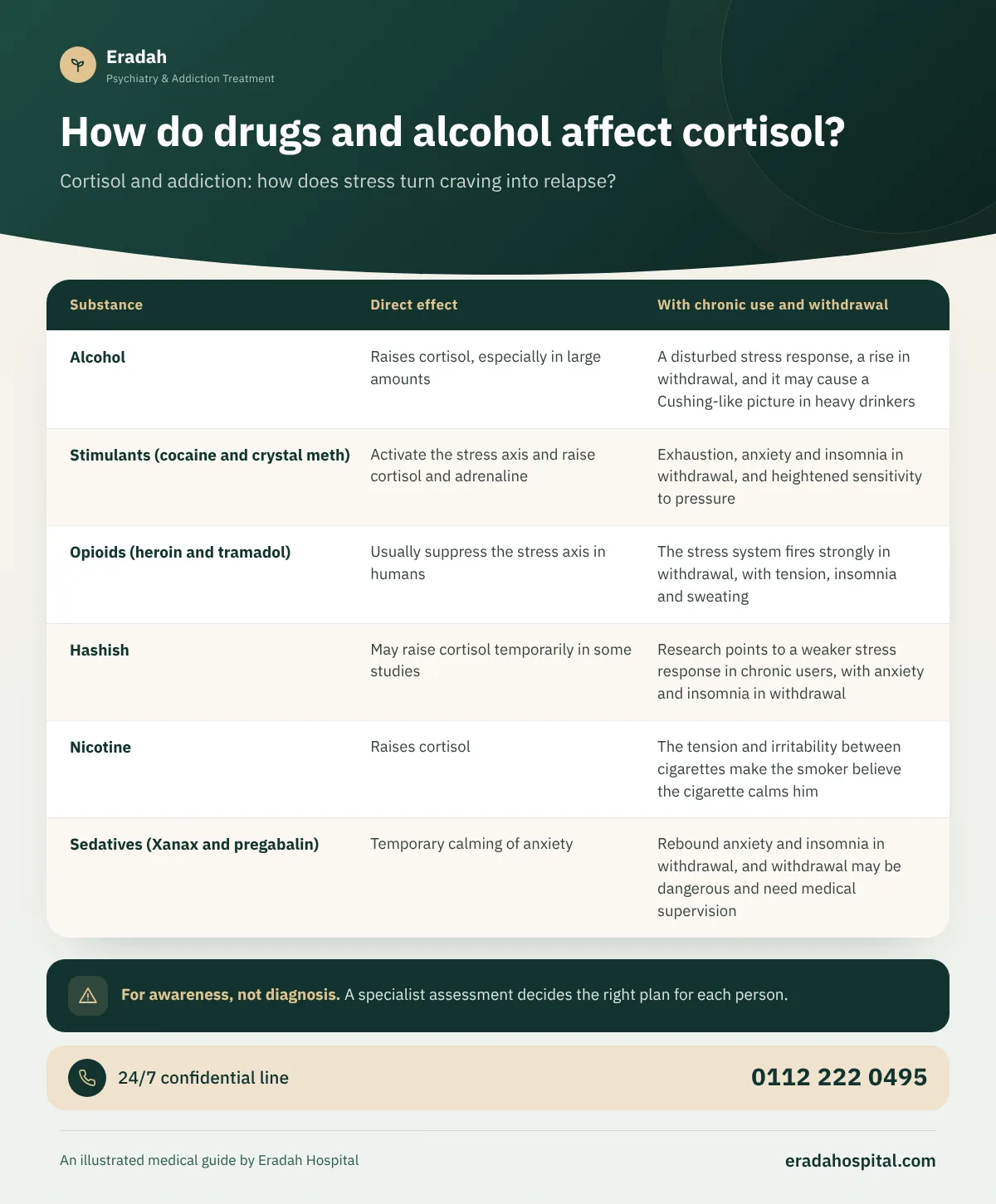
Substances differ in their direct effect, but the common thread is a disturbed stress system with chronic use and withdrawal. The table is a simplification of the results of multiple studies, and the effect differs from person to person:
| Substance | Direct effect | With chronic use and withdrawal |
|---|---|---|
| Alcohol | Raises cortisol, especially in large amounts | A disturbed stress response, a rise in withdrawal, and it may cause a Cushing-like picture in heavy drinkers |
| Stimulants (cocaine and crystal meth) | Activate the stress axis and raise cortisol and adrenaline | Exhaustion, anxiety and insomnia in withdrawal, and heightened sensitivity to pressure |
| Opioids (heroin and tramadol) | Usually suppress the stress axis in humans | The stress system fires strongly in withdrawal, with tension, insomnia and sweating |
| Hashish | May raise cortisol temporarily in some studies | Research points to a weaker stress response in chronic users, with anxiety and insomnia in withdrawal |
| Nicotine | Raises cortisol | The tension and irritability between cigarettes make the smoker believe the cigarette calms him |
| Sedatives (Xanax and pregabalin) | Temporary calming of anxiety | Rebound anxiety and insomnia in withdrawal, and withdrawal may be dangerous and need medical supervision |
Why does cortisol rise during withdrawal?
When the brain gets used to a substance, it resets its systems to work "normally" in its presence. If the substance suddenly disappears, this opposing adjustment is exposed: the stress systems activate, CRH rises inside the brain, and cortisol rises in many patients, especially in alcohol and opioid withdrawal.
The result is what people in recovery describe accurately: anxiety, irritability, insomnia, hypersensitivity to any pressure, and a feeling that the world is "heavy." This is a temporary biological state that has nothing to do with weak willpower, and it is one reason withdrawal without medical supervision raises the risk of returning to use just to stop the distress.
After acute withdrawal ends, a "protracted withdrawal" phase may continue for weeks or months in some people in recovery: disturbed sleep, mood swings and sensitivity to pressure. Knowing this in advance helps the patient and family avoid interpreting these symptoms as the treatment "not working."
How do stress and high cortisol lead to relapse?
The US National Institute on Drug Abuse identifies three main triggers of relapse: exposure to the substance itself, even once, cues associated with it such as places and people, and stress. Stress is the most dangerous because it cannot be completely avoided in life.
In a well-known study published in 2006 on people with cocaine addiction in treatment, the researchers exposed participants to imagined stressful situations and then followed them after discharge. They found that those whose craving and stress hormone response rose sharply relapsed sooner. In other words, the sensitivity of the stress system is a real indicator of risk and an important target for treatment.
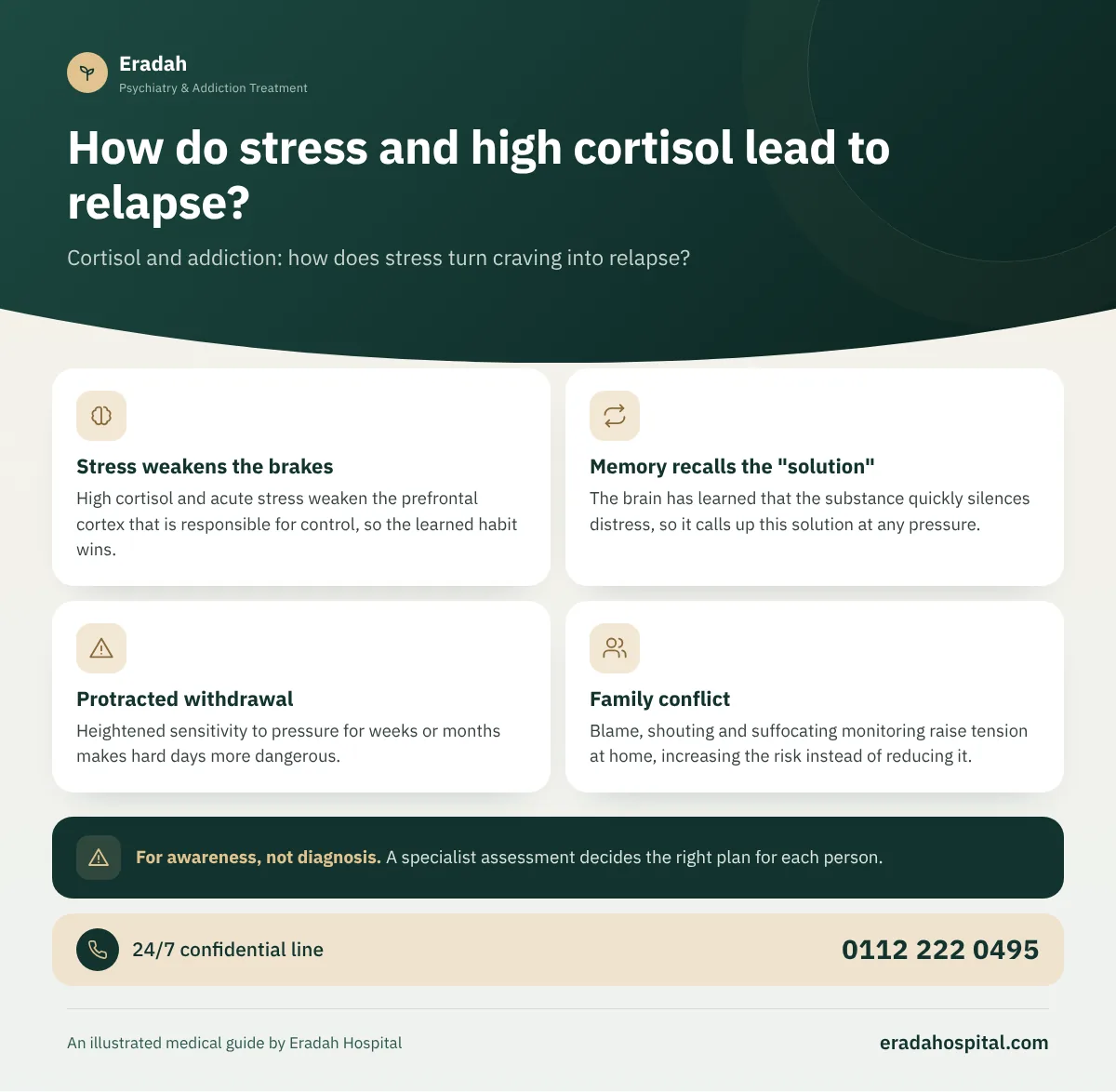
High cortisol and acute stress weaken the prefrontal cortex that is responsible for control, so the learned habit wins.
The brain has learned that the substance quickly silences distress, so it calls up this solution at any pressure.
Heightened sensitivity to pressure for weeks or months makes hard days more dangerous.
Blame, shouting and suffocating monitoring raise tension at home, increasing the risk instead of reducing it.
Do chronic stress and trauma increase vulnerability to addiction?
Yes, and the research is consistent on this. Childhood trauma, neglect, violence, extreme poverty and chronic stress are all linked to a higher risk of later substance use and addiction. Part of the explanation is thought to be the effect of these early stresses on the development of the stress system itself, so that it becomes more sensitive or less able to calm down.
This is clear in post-traumatic stress disorder (PTSD), which is often linked to addiction, as some people with it use substances to numb memories and anxiety. Here, treating the addiction alone is not enough; the patient needs integrated treatment for both conditions together, which is called dual diagnosis. This does not mean everyone who has faced stress will develop an addiction; family support and safe relationships are strong protective factors.
Cortisol and behavioral addiction: is escaping from stress an addiction?
The same mechanism appears in behavioral addictions: gambling, video games, mobile phone use and compulsive eating. Many people turn to them to escape the pressure of study, work or family problems, and feel a momentary relief that reinforces the behavior.
Temporary escape is not an addiction in itself, but it becomes dangerous when it turns into the only way of dealing with distress and continues despite harm. Treatment here also depends on building healthy alternatives for calming stress, not on prohibition alone.
Does cortisol return to normal after recovery?
The reassuring news is that the stress system can recover, as the reward system can. The brain has "neuroplasticity," the ability to reset itself over time with abstinence and treatment. Research on people recovering from alcohol suggests that HPA axis disturbances improve with sustained abstinence, though the improvement is gradual and varies from person to person.
We do not give specific timeframes here because research does not agree on them, and they vary by substance, length of use, age and psychological state. But what is certain is that regular sleep, physical activity, supportive relationships and treatment of accompanying anxiety and depression all speed this recovery, and the page on ways to lower cortisol naturally explains what can be done daily.
How does treatment help calm the stress system during recovery?
- Medically supervised detox: eases withdrawal symptoms and prevents their complications, reducing the distress that drives a return to use.
- Cognitive behavioral therapy and relapse prevention: teaches the patient to recognize high-risk and stressful situations and to set an alternative plan for each.
- Mindfulness-based relapse prevention programs: train the person to notice craving without acting on it.
- Treating co-occurring disorders: anxiety, depression, PTSD and insomnia are treated in parallel with the addiction.
- Organizing daily life: a steady sleep schedule, physical activity, regular meals and a routine that reduces surprises.
- Medicines: the doctor prescribes what the patient needs according to the substance and the condition, while medicines that target the stress system directly are still in the research stage and their benefit has not yet been proven.
At Eradah Center the treatment program is built on this understanding: stopping the substance is not enough, so we work with the patient on skills for coping with stress, we treat the anxiety or depression that accompanies addiction, and we involve the family so that the home environment becomes a calming factor rather than a source of tension.
Do cortisone medicines cause addiction?
Cortisone medicines (corticosteroids) do not cause the euphoria or craving that characterizes addiction, but the body becomes dependent on them after long use because the adrenal gland goes dormant, which is why they must not be stopped suddenly. This is "physical dependence," not addiction. At high doses they may cause mood swings, insomnia or, rarely, psychotic symptoms, so tell your doctor about any psychological change.
They must be distinguished from "anabolic steroids" derived from the male hormone, which are misused to build muscle and which may be linked to dependence, mood swings and aggression. The names are similar but the two classes are completely different.
How can the family help lower the stress of a person in recovery?
- Avoid blame and constant reminders of the past; feeling shame is one of the strongest triggers for returning to use.
- Expect hard days in the first months, and do not interpret irritability or insomnia as necessarily meaning relapse.
- Help build a calm daily routine: set times for sleep, meals and shared activity.
- Learn the early warning signs such as sudden isolation or going back to friends who use, and talk about them calmly.
- Take care of yourself too; an exhausted family cannot support, and family counseling sessions benefit everyone.
- If thoughts of death or self-harm appear, call the ambulance (123) or the mental health support line 16328.