What is glutamate?
Glutamate, or glutamic acid, plays two roles at once: it is an amino acid, a building block of the protein we eat and that builds our bodies, and it is also the most important excitatory neurotransmitter in the nervous system. In other words, it is the chemical message that tells the next nerve cell: “Fire and send the signal.”
Medical references describe glutamate as the most abundant excitatory transmitter in the brain, taking part in the great majority of excitatory signals between nerve cells. That is why it is found in almost every region of the brain and spinal cord, and it is involved in everything that requires “switching on” a neural network: attention, forming memories, sensation and movement.
Despite this importance, glutamate is less famous than dopamine or serotonin, because people do not link it to a specific feeling such as pleasure or happiness. It is closer to the electricity that runs the brain: you do not notice it when it works well, but any major fault in it shows quickly.
How does glutamate work in the brain?
When a nerve cell is excited, it releases glutamate into the tiny gap between it and the next cell (the synapse). Glutamate binds to receptors on the surface of the receiving cell like a key in a lock, opening channels that let in electrical charge and bring the cell closer to firing its own signal.
| Receptor | How it works | Its main role | Why it matters |
|---|---|---|---|
| AMPA | A fast channel that opens in fractions of a second | Carrying fast, everyday excitatory signals | The basis of speed of thought and response |
| NMDA | A channel that needs special conditions to open, and lets calcium in | Strengthening connections between cells during learning | Ketamine, alcohol and an Alzheimer’s medicine act on it, and its overactivation damages cells |
| Kainate | An excitatory channel | Regulating signals in some circuits | Linked to some types of seizures in research |
| Metabotropic receptors | Work through a chain of reactions inside the cell that is slower than the channels | Tuning signal strength and the amount of glutamate released | A target for research on treating addiction and anxiety |
After doing its job, glutamate must be cleared from the synapse quickly, or the cell keeps being stimulated. This task is carried out mainly by astrocytes, support cells that surround nerve cells. They take up glutamate and convert it to glutamine, then return it to the nerve cells so they can make glutamate again. This cycle is called the glutamate-glutamine cycle, and it is one of the body’s most precise recycling systems.
What does glutamate do in the body?
When an experience is repeated, glutamate strengthens the connections between the cells involved through NMDA and AMPA receptors. Scientists call this “long-term potentiation,” the cellular basis of remembering.
Its activity rises during wakefulness, and it helps maintain attention and focus.
Carries pain messages in the spinal cord and brain, and research points to a role in some chronic pain conditions.
Helps guide the formation of neural networks as the brain develops in childhood.
Nerve cells convert part of the glutamate into GABA with a specific enzyme, so the calming chemical comes from the stimulating one.
As an amino acid, it takes part in building protein and in energy production in cells.
So when doctors speak of a “glutamate problem,” they usually do not mean a deficiency to be made up through food, but an imbalance of signaling within specific neural circuits, which no food or supplement can fix.
What is the relationship between glutamate and GABA?
The simplest way to understand the brain is to imagine a car with a gas pedal (glutamate) and brakes (GABA). Safe driving does not mean pressing one of them all the time, but coordinating precisely between them from moment to moment.
| Point of comparison | Glutamate | GABA |
|---|---|---|
| Type of effect | Excitatory: pushes the cell to fire its signal | Inhibitory: calms the cell and prevents excess |
| The relationship between them | The raw material from which GABA is made | Made from glutamate inside nerve cells |
| What happens when the balance is lost? | Overexcitation: seizures, tension and, in severe cases, cell damage | Excess calming: drowsiness and slow breathing with sedative substances |
| Substances that affect it | Ketamine and alcohol suppress some of its receptors | Alcohol and benzodiazepines enhance its action |
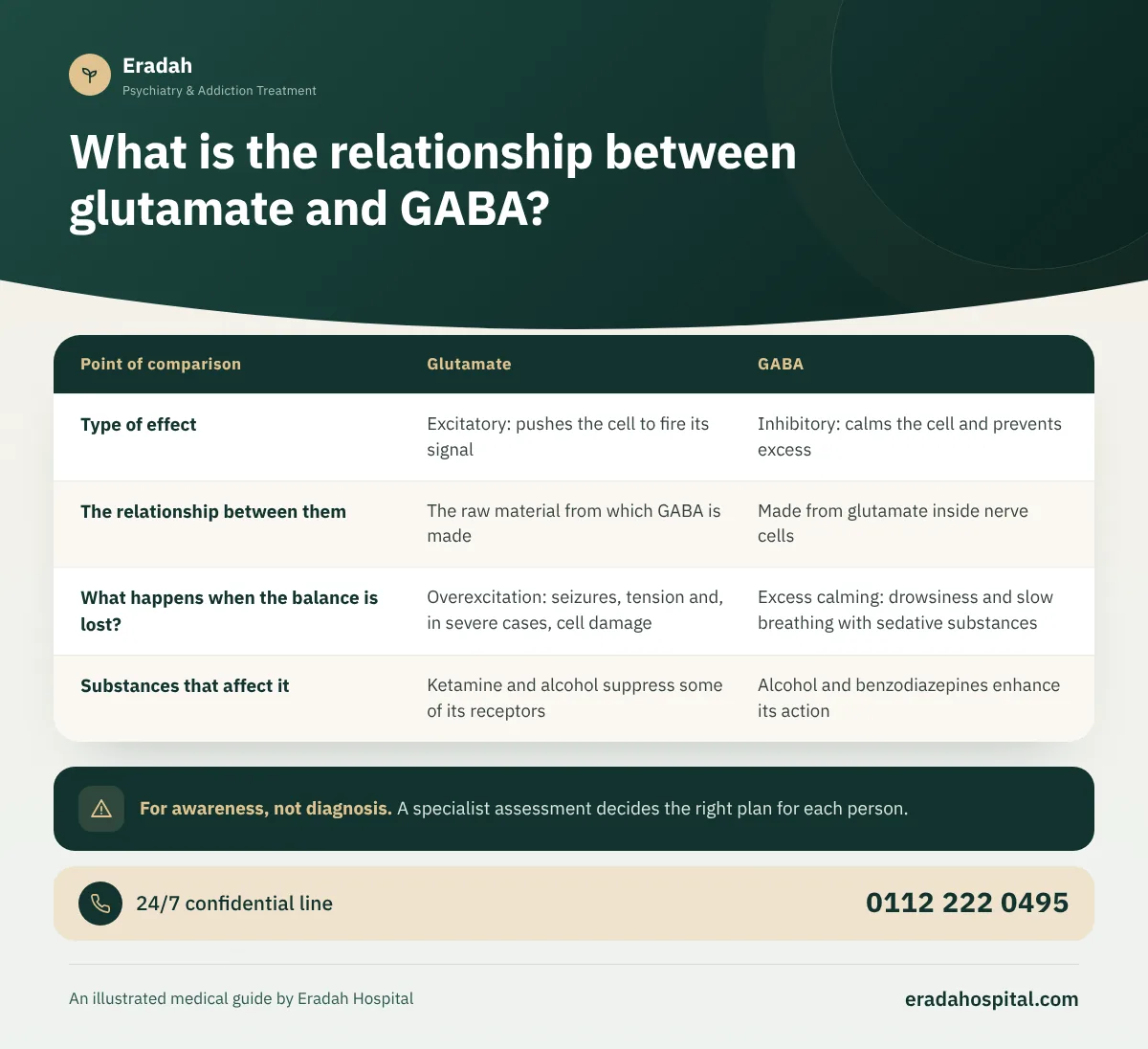
This balance explains important points in medicine and addiction. Alcohol, for example, presses the brake and eases off the gas at the same time, so over time the brain adapts by strengthening its glutamate system. When drinking stops suddenly, the gas stays strong and the brake weak, and tremor and seizures appear. We explain this on the page Glutamate and addiction.
Is MSG (monosodium glutamate) harmful to the brain?
Many people know glutamate through monosodium glutamate (MSG), popularly known in Egypt as “Chinese salt,” which is added to give food a savory “umami” flavor. For decades it has been linked to what was called “Chinese restaurant syndrome” of headache, numbness and flushing.
The reality, as presented by the US Food and Drug Administration, is that this substance is classed among additives “generally recognized as safe.” When people who say they are sensitive to it were given either MSG or a placebo without knowing which, researchers could not consistently provoke the symptoms. An independent scientific report noted that mild, temporary symptoms may appear in a few sensitive people who eat a large amount on an empty stomach, far more than a usual meal contains.
Most important for our topic, glutamate from food does not easily cross into the brain, because the blood-brain barrier tightly regulates its entry. The body also cannot tell chemically between added glutamate and the glutamate found naturally in tomatoes, aged cheese and meat; in fact, the amount we get from natural protein each day far exceeds what comes from additives. Even so, moderation in processed foods in general remains wise because of their salt and fat content.
Can glutamate be measured with a test?
Frankly: there is no blood or urine test that tells you the glutamate level in your brain. Glutamate is present in almost every cell of the body, and its blood level does not reflect what happens inside the synapses behind the blood-brain barrier. Medical references note that its wide distribution makes clinical measurement difficult.
Researchers measure glutamate in regions of the brain with a special MRI technique called magnetic resonance spectroscopy, but it is mostly a research tool and is not used to diagnose individuals in the clinic. So beware of any provider offering a “brain chemistry test” or a program to fix glutamate based on blood results.
Which medicines act on the glutamate system?
Because glutamate is involved in many neurological and psychiatric conditions, medicine has developed drugs that target its system in different ways. We list them here for information only; all are used with a prescription and medical follow-up and are not suitable for self-use:
| Medication or class | Its relationship to glutamate | Medical use |
|---|---|---|
| Memantine | Partially blocks NMDA receptors | Alzheimer’s disease in its moderate and severe stages |
| Riluzole | Reduces glutamate release | Amyotrophic lateral sclerosis (ALS) |
| Some anti-seizure medicines | Reduce glutamate-related excitation through different mechanisms | Epilepsy and some pain conditions |
| Ketamine and esketamine | Block NMDA receptors | Anesthesia, and esketamine for resistant depression under medical supervision |
| Acamprosate | Believed to restore balance to the glutamate system after alcohol | Helping prevent relapse in alcohol addiction |
The existence of these medicines does not mean glutamate alone “causes” those diseases; it is part of a bigger picture that includes genetic, immune and environmental factors. Do not start or stop any medicine without your doctor.
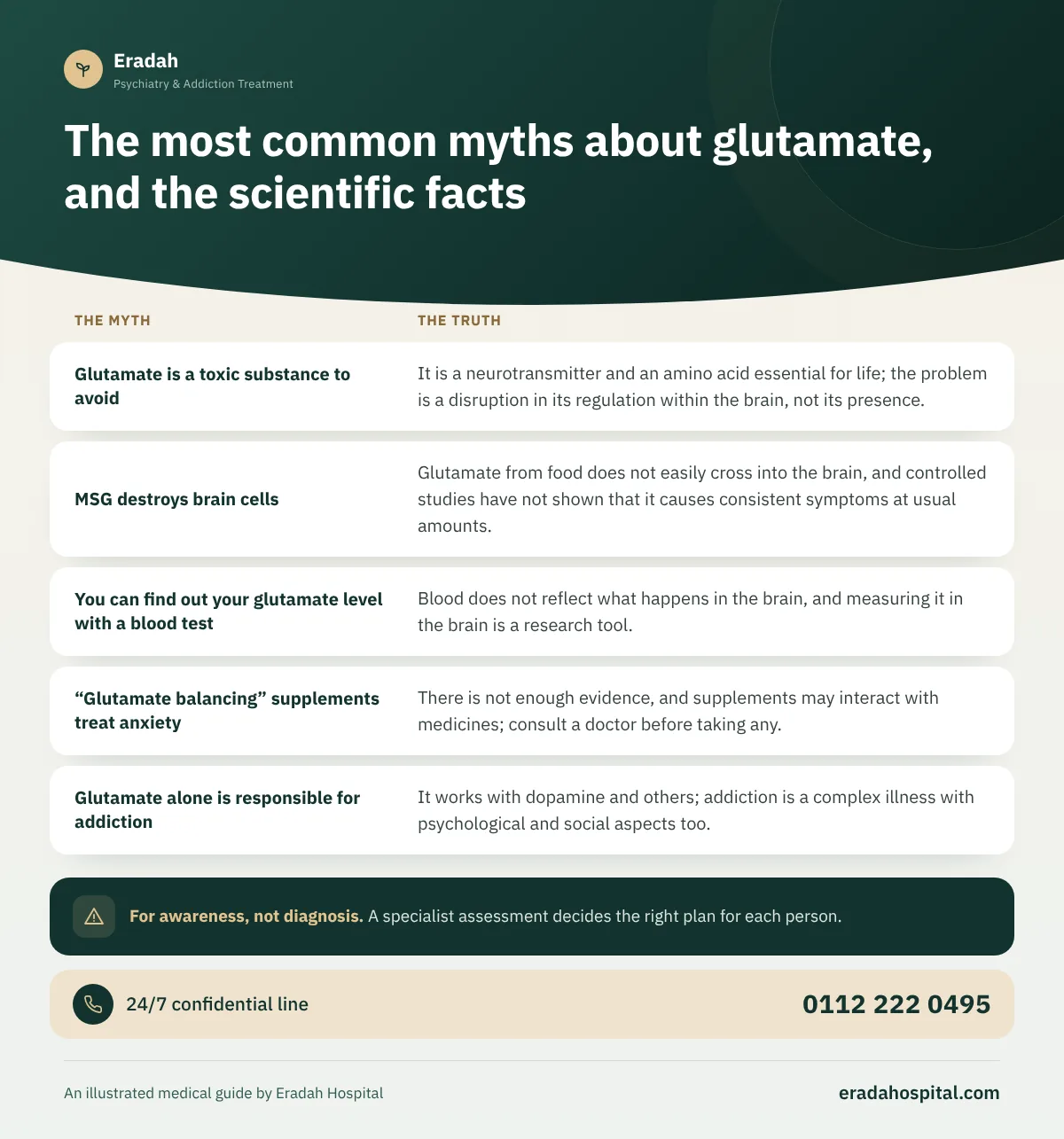
Glutamate myths and facts
| The myth | The truth |
|---|---|
| Glutamate is a toxic substance to avoid | It is a neurotransmitter and an amino acid essential for life; the problem is a disruption in its regulation within the brain, not its presence. |
| MSG destroys brain cells | Glutamate from food does not easily cross into the brain, and controlled studies have not shown that it causes consistent symptoms at usual amounts. |
| You can find out your glutamate level with a blood test | Blood does not reflect what happens in the brain, and measuring it in the brain is a research tool. |
| “Glutamate balancing” supplements treat anxiety | There is not enough evidence, and supplements may interact with medicines; consult a doctor before taking any. |
| Glutamate alone is responsible for addiction | It works with dopamine and others; addiction is a complex illness with psychological and social aspects too. |
Why does understanding glutamate matter for families and people with addiction?
Understanding glutamate changes how a family sees relapse and cravings. Many relatives ask: “Why does he still long for the drug when he stopped months ago?” Part of the answer is that glutamate stored the memories of use and tied them to places, people and feelings, so these triggers bring on the craving automatically. This is powerful neural learning that has nothing to do with morals, and it needs treatment and training.
Glutamate also explains why someone who drinks heavily or depends on sedatives must not stop suddenly at home without medical supervision, as they may suffer dangerous seizures. This simple knowledge can save a life.
Glutamate guide: everything you need to know
We have gathered everything about glutamate into 2 pages, each answering one question in detail. Choose what you are looking for:
High glutamate: symptoms and causes
What glutamate overactivity means, excitotoxicity after stroke, head injury and seizures, the diseases linked to it, how a doctor diagnoses and treats the causes, and when to go to the emergency department.
Glutamate and addiction: how drugs hijack the reward system
How glutamate turns memories of use into cravings, its relationship with alcohol, ketamine and stimulants, why relapse happens, and how the brain regains balance with treatment.
Seizures, signs of a stroke or delirium after stopping alcohol? Call an ambulance (123) immediately
- A seizure (shaking and stiffening of the body with loss of consciousness), especially if it is prolonged or repeats without the person recovering in between
- A sudden drooping of the face, weakness in an arm or leg, or sudden difficulty speaking (signs of a stroke)
- Severe confusion, hallucinations, tremor, sweating and a fast heartbeat within days of suddenly stopping alcohol or sedatives
- A sudden, severe headache unlike any before, or loss of consciousness after a head injury
- Thoughts of self-harm or severe despair during withdrawal or recovery
Call an ambulance (123) immediately and do not wait. During a seizure, move hard objects away from the person, do not put anything in their mouth and do not try to restrain them. When the seizure stops, place them on their side in the recovery position and stay beside them. With signs of a stroke, note the time the symptoms began, because every minute counts for treatment. If there are suicidal thoughts, call the mental health support line 16328.
Ambulance 123 Mental health support line 16328