What does high glutamate mean?
When doctors speak of high glutamate, they mean that a large amount of it stays in the synapses or that its receptors are activated more than necessary, so nerve cells stay in a state of overexcitation. This is completely different from a raised level of a substance in the blood, such as sugar or cholesterol.
This usually happens for one of three reasons: excess release from cells, the inability of astrocytes to clear it quickly, or increased receptor sensitivity after long adaptation to a suppressing substance such as alcohol. All three can combine in one case.
What is glutamate excitotoxicity?
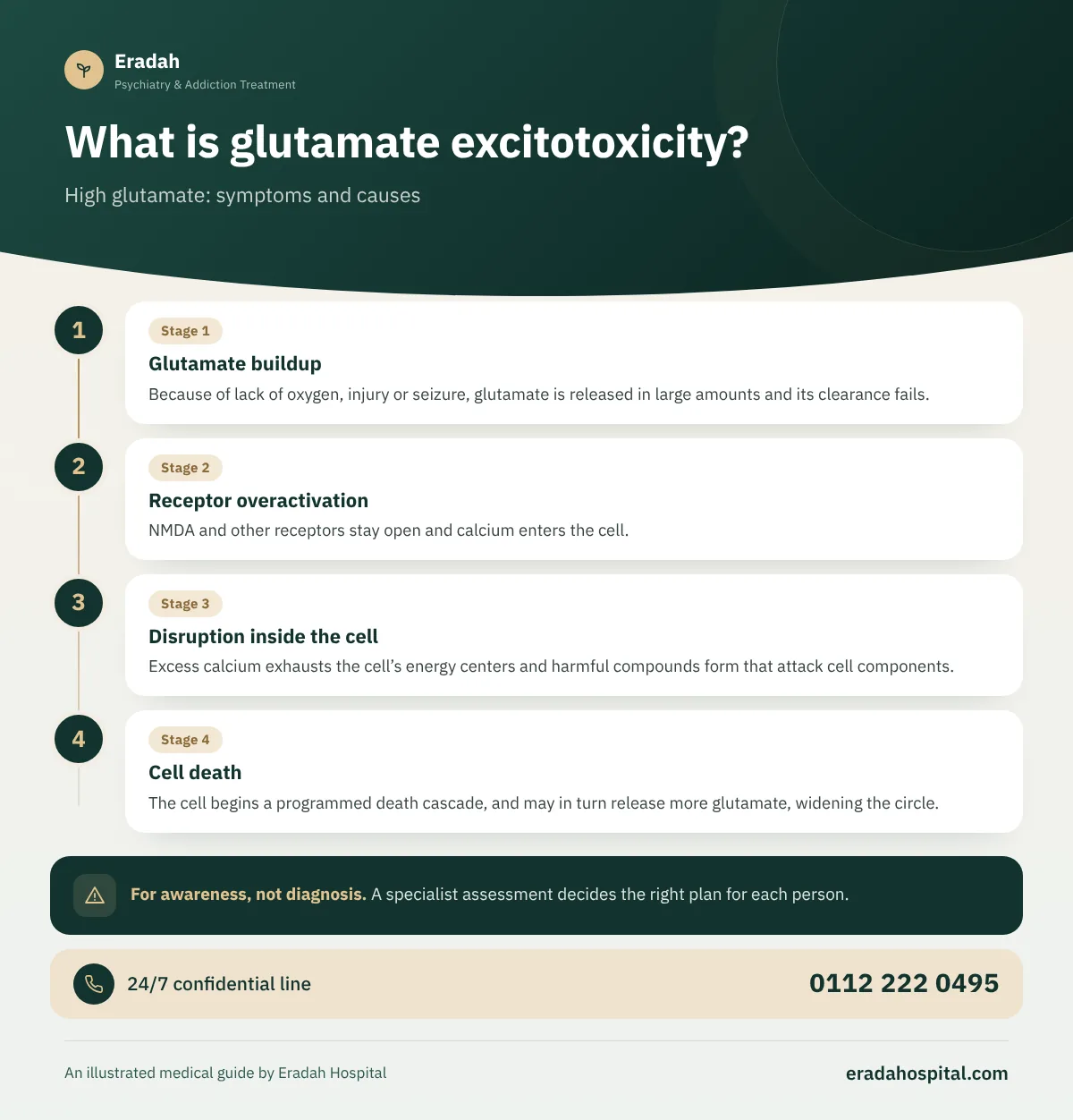
Excitotoxicity is the condition in which glutamate turns from a useful messenger into an agent of destruction. When nerve cells are exposed to a large amount of it for a long time, NMDA receptors open too much and calcium floods into the cell in amounts it cannot tolerate.
- Stage 1Glutamate buildup
Because of lack of oxygen, injury or seizure, glutamate is released in large amounts and its clearance fails.
- Stage 2Receptor overactivation
NMDA and other receptors stay open and calcium enters the cell.
- Stage 3Disruption inside the cell
Excess calcium exhausts the cell’s energy centers and harmful compounds form that attack cell components.
- Stage 4Cell death
The cell begins a programmed death cascade, and may in turn release more glutamate, widening the circle.
Scientific reviews regard excitotoxicity as one of the most important mechanisms of secondary injury after head injury and stroke, meaning the damage that continues in the hours and days after the first injury. That is why emergency and intensive care doctors work to protect the brain early by controlling oxygen, blood pressure, sugar and temperature.
What symptoms may be linked to glutamate overactivity?
There is no set of symptoms specific to glutamate alone, but conditions in which its activity rises share signs of nervous system overexcitation. Their severity varies with the cause:
- Seizures or epileptic attacks, the clearest form of nerve overexcitation
- Confusion and disorientation, with difficulty knowing place and time
- Agitation and severe tension, tremor and inability to settle
- Hallucinations, auditory or visual, especially in alcohol withdrawal
- Severe insomnia and inability to sleep with excessive alertness
- Increased sensitivity to pain, so that what was not painful before now hurts
- Severe headache and sudden neurological changes in stroke and head injury
Some research points to a role for glutamate imbalance in anxiety, obsessive-compulsive disorder (OCD), migraine and chronic pain, but these are research links that have not yet become a test or diagnosis a doctor uses for a particular person.
What causes high glutamate in the brain?
| Cause | What happens? | Level of danger |
|---|---|---|
| Stroke | Interruption of blood and oxygen disables glutamate clearance, so it builds up around the affected area | Emergency |
| Head injuries | The injury releases large amounts of glutamate and secondary injury begins | Emergency |
| Prolonged seizures and epilepsy | Overexcitation releases more glutamate in a vicious circle | An emergency if the seizure lasts long |
| Alcohol or sedative withdrawal | A brain that strengthened its glutamate system to offset the substance suddenly loses its brakes | May be dangerous |
| Lack of oxygen or severe low blood sugar | Energy shortage disables the pumps that clear glutamate | Emergency |
| Neurodegenerative diseases | Chronic fault in glutamate clearance or receptor sensitivity | Chronic and needing follow-up |
Note that food is not among these causes; eating foods rich in glutamate does not raise its level in the brain in healthy people, as we explain in our glutamate guide.
Why does high glutamate cause seizures on suddenly stopping alcohol?
Alcohol enhances calming GABA and suppresses glutamate’s NMDA receptors. With chronic drinking the brain adapts by increasing glutamate receptors and reducing GABA sensitivity so that it stays balanced despite the alcohol. When the person suddenly stops, the strengthened glutamate system is left without brakes, and the nervous system enters a state of overexcitation.
Medical references note that withdrawal seizures usually appear within about two days of the last drink, and that the more dangerous delirium tremens may appear after several days. Repeated withdrawal episodes also make the next ones more severe, a phenomenon doctors call “kindling.” That is why stopping alcohol or sedatives after dependence must be done under medical supervision. Details of the symptoms and timeline are on the alcohol withdrawal symptoms page.
Which diseases are linked to increased glutamate activity?
Linked to a fault in glutamate signaling, and a medication that partly blocks NMDA receptors is used in its moderate and severe stages.
Excitotoxicity is thought to play a role in damage to motor cells, and one of its medications reduces glutamate release.
Overexcitation is the core of seizures, and many medications work to reduce stimulating activity.
Excitotoxicity is a major part of the damage that extends beyond the first injury.
Studies are examining the role of glutamate in schizophrenia, depression and obsessive-compulsive disorder (OCD), and the results are still inconclusive.
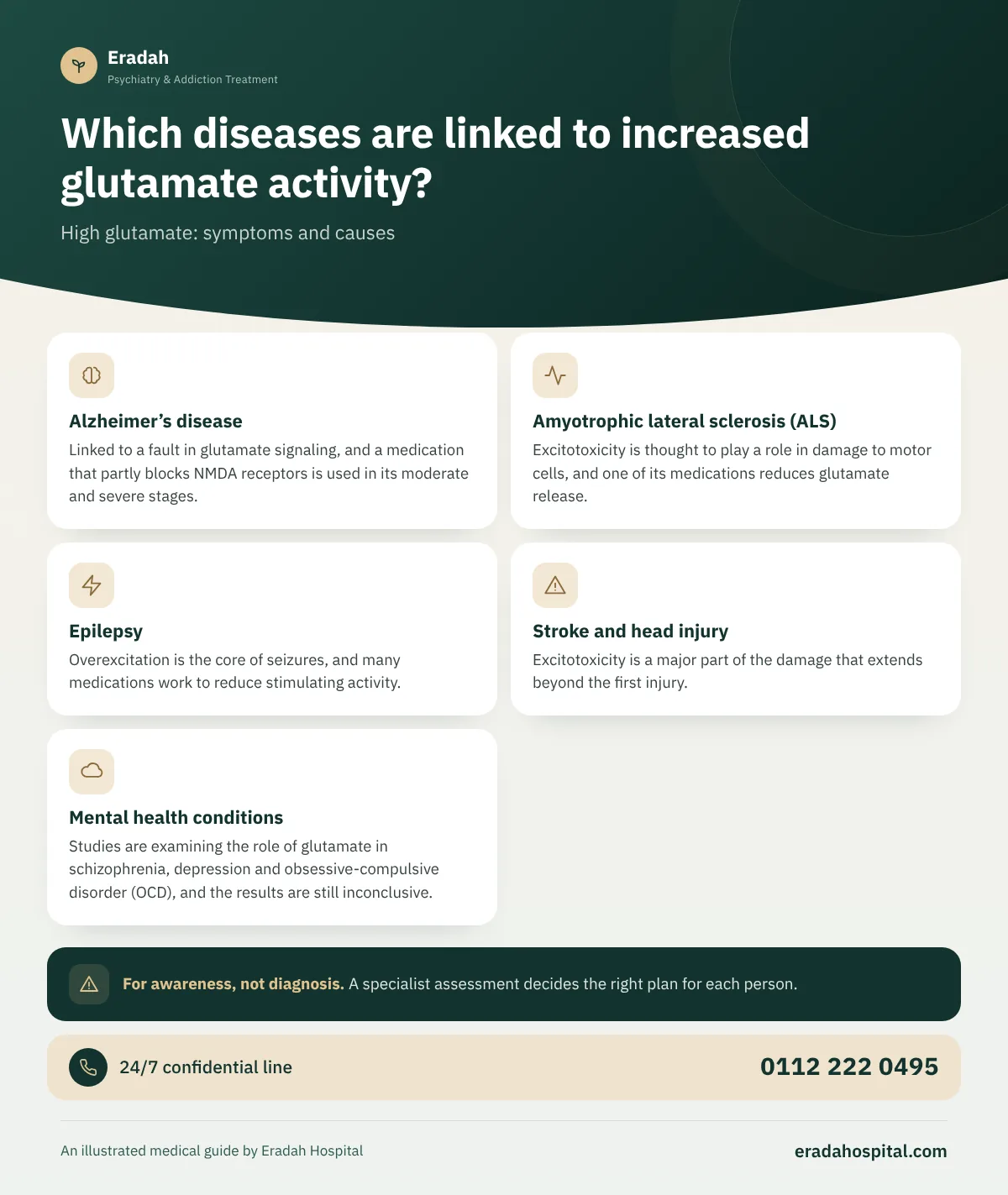
These diseases have multiple causes, and glutamate is one link in their chain, not the only cause. That is why no treatment of glutamate alone is enough to treat them.
How does the doctor diagnose conditions linked to high glutamate?
Because glutamate cannot be usefully measured in the blood, the doctor works in reverse: looking for the condition that causes the overexcitation and measuring its effects.
- Medical history: When did the symptoms begin? Did the person stop alcohol or a sedative medication? Was there a head injury?
- Neurological examination: Assessing consciousness, speech, movement and reflexes.
- CT or MRI of the brain to look for a stroke, bleeding or injury.
- Electroencephalogram (EEG) to detect seizure activity.
- Blood tests for sugar, salts, and liver and kidney function, because they affect brain excitability.
- Magnetic resonance spectroscopy is used in research to measure glutamate and is rarely requested for individual diagnosis.
How are conditions linked to high glutamate treated?
Treatment is always directed at the cause, while protecting the brain from continued overexcitation. We mention only the general categories here, since the choice and doses are the doctor’s decision alone:
| The situation | Focus of treatment |
|---|---|
| Stroke | Restoring blood flow as quickly as possible in an equipped hospital, and controlling blood pressure, sugar and oxygen |
| Seizures | Emergency medications to stop the seizure, then antiseizure medications according to the type of epilepsy |
| Alcohol or sedative withdrawal | Gradual medical detox with medications that temporarily restore balance, along with vitamins, fluids and monitoring of vital signs |
| Degenerative diseases | Medications that modify the glutamate system, with a comprehensive treatment plan and specialized follow-up |
| Chronic pain | A multi-part plan including certain neurological medications, physical therapy and psychological therapy |
Do not try to lower “glutamate” with supplements or harsh diets; they have not been shown to change its level in the brain, and they may interfere with epilepsy or psychiatric medications.
When should you go to the emergency room for symptoms linked to high glutamate?
Some cases of glutamate overactivity cannot wait, because every minute of continued seizure or interrupted blood flow to the brain means nerve cells being lost. Go to the emergency room or call the ambulance on 123 if any of the following signs appear:
- A seizure lasting several minutes, or back-to-back seizures without the person recovering in between.
- Signs of stroke: a drooping face, weakness in an arm or leg, or sudden slurred speech.
- Confusion, hallucinations, tremor, sweating and fever days after stopping alcohol.
- Repeated vomiting or unusual drowsiness after a head injury.
Seizures, signs of a stroke or delirium after stopping alcohol? Call an ambulance (123) immediately
- A seizure (shaking and stiffening of the body with loss of consciousness), especially if it is prolonged or repeats without the person recovering in between
- A sudden drooping of the face, weakness in an arm or leg, or sudden difficulty speaking (signs of a stroke)
- Severe confusion, hallucinations, tremor, sweating and a fast heartbeat within days of suddenly stopping alcohol or sedatives
- A sudden, severe headache unlike any before, or loss of consciousness after a head injury
- Thoughts of self-harm or severe despair during withdrawal or recovery
Call an ambulance (123) immediately and do not wait. During a seizure, move hard objects away from the person, do not put anything in their mouth and do not try to restrain them. When the seizure stops, place them on their side in the recovery position and stay beside them. With signs of a stroke, note the time the symptoms began, because every minute counts for treatment. If there are suicidal thoughts, call the mental health support line 16328.
Ambulance 123 Mental health support line 16328