What role does glutamate play in addiction?
To understand glutamate’s role in addiction, imagine the brain learning a new habit. Dopamine raises a sign that says: “This is important, pay attention.” Glutamate is the pen that writes the lesson and strengthens the connections between cells until the behavior becomes automatic.
In the brain of a person who uses drugs, three main regions connect to the reward center through fibers that use glutamate: the prefrontal cortex, responsible for planning and inhibition; the amygdala, which ties experiences to emotions; and the hippocampus, which stores context and places. With repeated use these drug-related connections strengthen, while the prefrontal cortex’s ability to say “no” weakens.
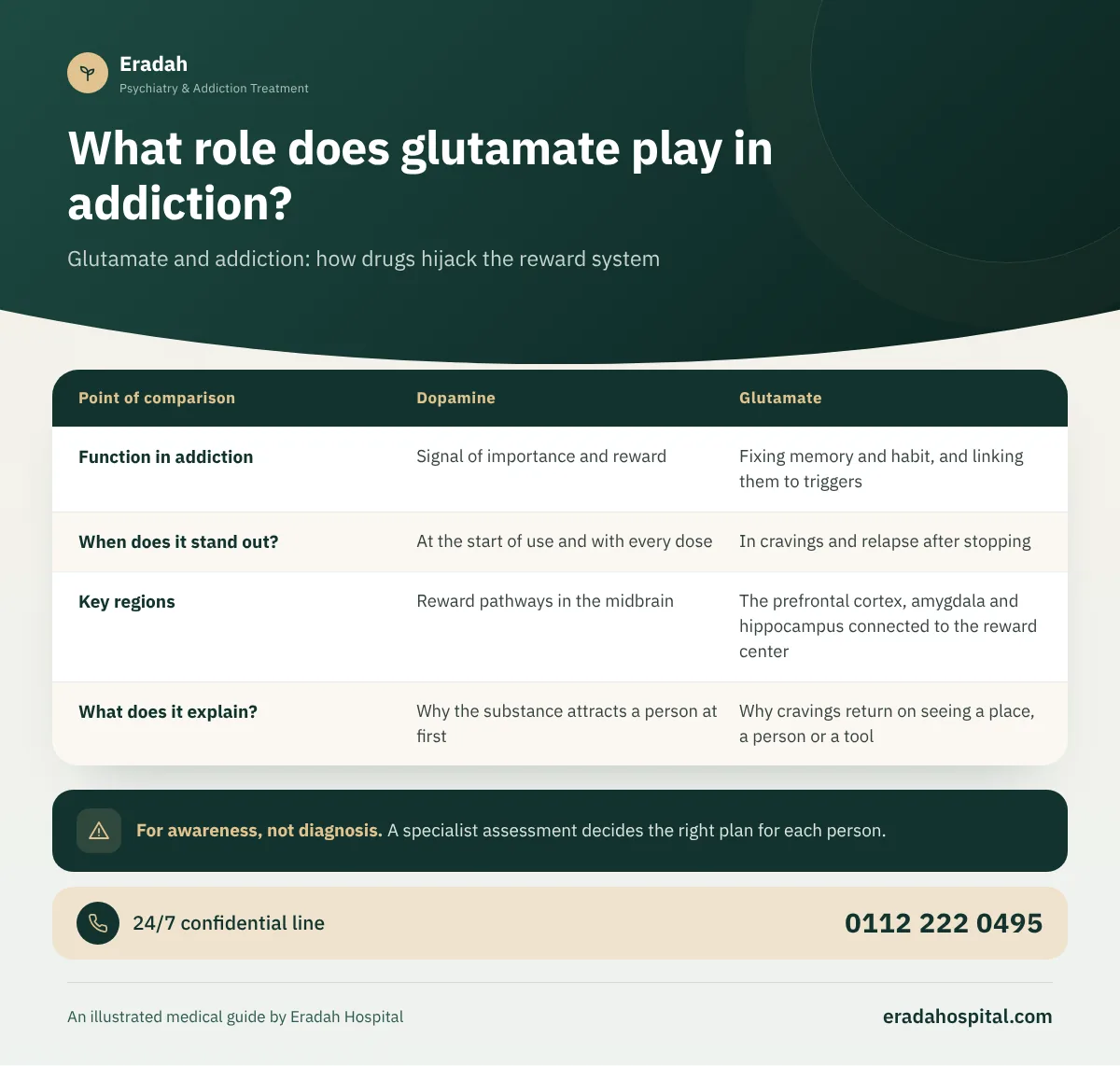
| Point of comparison | Dopamine | Glutamate |
|---|---|---|
| Function in addiction | Signal of importance and reward | Fixing memory and habit, and linking them to triggers |
| When does it stand out? | At the start of use and with every dose | In cravings and relapse after stopping |
| Key regions | Reward pathways in the midbrain | The prefrontal cortex, amygdala and hippocampus connected to the reward center |
| What does it explain? | Why the substance attracts a person at first | Why cravings return on seeing a place, a person or a tool |
How does glutamate turn memories of use into cravings?
When a person in recovery sees a place where they used to use, meets an old friend from that period, or goes through a distress they used to escape with the drug, these memories activate automatically. Fibers coming from the prefrontal cortex release glutamate in the reward center, and a strong craving fires before the person has consciously thought about it.
Addiction research institutions describe this phenomenon by saying that cues linked to drug use can ignite an uncontrollable craving even when the drug itself is absent. Animal experiments suggest that the response to these cues may grow in the first weeks after stopping instead of fading, a phenomenon scientists study to understand how risky the early period of recovery is.
A street, café or room associated with use.
Friends from the period of use, or even their voices on a phone call.
Distress, boredom, anger and loneliness were old triggers.
Thursday night, the end of the month, or after an argument.
A photo on the phone, a smell, or an item associated with the substance.
How do different drugs affect glutamate?
Each substance affects glutamate in its own way, but the common result is that the brain adapts and then pays the price for that adaptation when use stops:
| Substance | Effect on glutamate | What follows |
|---|---|---|
| Alcohol | Suppresses NMDA receptors and enhances GABA; over time the brain strengthens its glutamate system | Memory loss while intoxicated, and seizures and delirium on sudden stopping |
| Ketamine | Directly suppresses NMDA receptors | Detachment from reality and confusion, and memory problems with repeated use |
| Cocaine and crystal meth (shabu) | Both raise dopamine, and with repetition the glutamate balance in the reward center is disrupted | Strong cue-linked cravings and repeated relapse |
| Heroin and opioids | Changes in glutamate signaling with dependence | Contributes to cravings and some withdrawal symptoms |
| Pregabalin | Reduces the release of stimulating neurotransmitters, including glutamate | Sedation and dependence with misuse, and withdrawal that needs follow-up |
| Hashish | Affects glutamate release in memory regions | Impaired short-term memory and learning during use |
This table is for understanding only and is not a guide to any use. All of these substances carry a risk of addiction and harm, and there is no “safe” use for controlling brain chemistry.
Why is alcohol addiction linked to glutamate more than others?
Alcohol is among the substances with the greatest effect on glutamate. It suppresses NMDA receptors, which are essential for forming memories, and this explains the blackouts during heavy intoxication. With chronic drinking the brain responds by increasing these receptors to offset the alcohol, so the person comes to need alcohol to feel balanced, which is the essence of tolerance and dependence.
When drinking stops, these extra receptors are exposed, causing tremor, insomnia and tension, and in severe cases seizures and delirium. Research suggests that glutamate overactivity at this stage may harm some nerve cells, and that repeated withdrawal episodes make later ones more severe. That is why we always stress that stopping alcohol after dependence must be done under medical supervision, with details in alcohol withdrawal symptoms.
Ketamine: a medication that acts on glutamate and a substance that is misused
Ketamine is a well-known anesthetic that suppresses glutamate’s NMDA receptors and is used in operating rooms and emergency departments. One form of it, esketamine, has been approved for treatment-resistant depression together with another antidepressant, provided it is given in a medical facility and the patient is monitored afterward for possible confusion and raised blood pressure.
This controlled medical use is completely different from ketamine misuse outside medical care, which carries a risk of psychological dependence, memory problems, bladder damage, and accidents due to detachment from reality. The existence of an effective medication that acts on glutamate does not mean that self-medicating is a treatment for depression; it often makes it worse.
How does glutamate contribute to tolerance and withdrawal symptoms?
The brain is always trying to keep its balance. When a substance that calms it comes in, it responds by increasing excitation, and when a substance that stimulates it comes in, it responds by reducing it. Glutamate plays a central role in this adaptation, because it changes the number and sensitivity of receptors and the strength of connections between cells.
- Tolerance: The substance is needed in a larger amount to give the same effect because the brain has adjusted its system to resist it.
- Dependence: The new balance becomes tied to the presence of the substance, so the person feels unwell without it.
- Withdrawal: When use stops, the adjustments are exposed, and symptoms opposite to the substance’s effect appear.
- Cravings: The memories and connections tied to the substance stay active after physical withdrawal ends.
Why does the risk of relapse remain months after stopping?
One of the best-known theories in addiction science is what is called the glutamate homeostasis hypothesis. It says that chronic use, especially of stimulants, disrupts how glutamate is regulated in the reward center: its calm baseline level falls and the mechanisms that control its release weaken, so when a cue linked to the drug appears, glutamate surges and the urge to seek the substance fires.
As a result, a person may be completely sincere in their decision to stop, then find themselves in a situation that triggers a craving beyond their ability to resist in the moment. That is why “determination” alone is not enough; recovery needs practical skills, a supportive environment and a relapse prevention plan. This theory is backed by strong animal research, while in humans the evidence is still accumulating.
Does the brain regain glutamate balance after recovery?
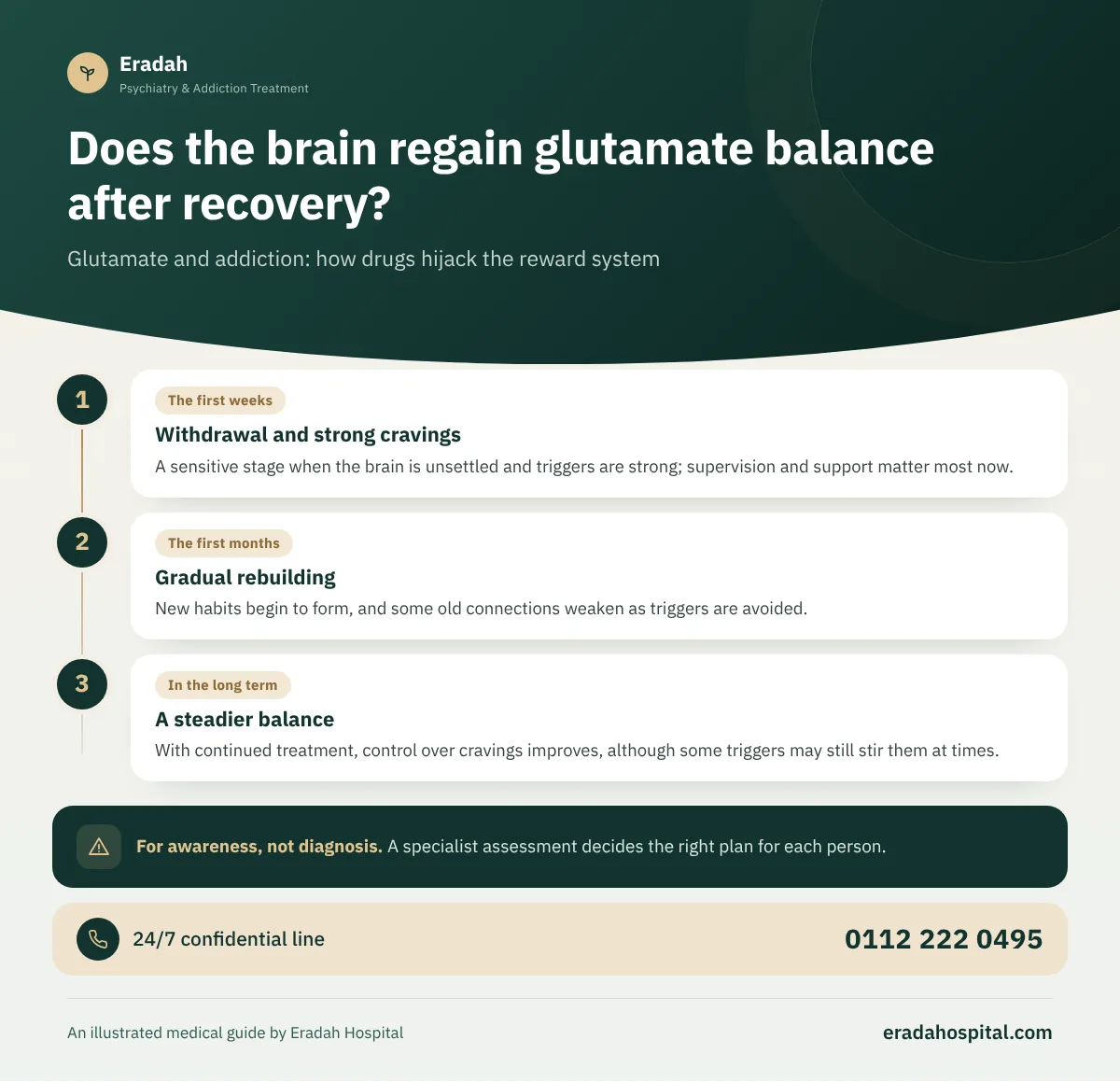
Yes, the brain can change and reorganize itself, a property called neuroplasticity. Glutamate itself is the tool of this plasticity: just as it helped fix the habit of use, it helps fix new habits when they are repeated regularly.
- The first weeksWithdrawal and strong cravings
A sensitive stage when the brain is unsettled and triggers are strong; supervision and support matter most now.
- The first monthsGradual rebuilding
New habits begin to form, and some old connections weaken as triggers are avoided.
- In the long termA steadier balance
With continued treatment, control over cravings improves, although some triggers may still stir them at times.
No fixed date can be given for glutamate to return to “normal”; it varies with the substance, the length of use, age, general health and whether there are accompanying mental health conditions. What matters is that the improvement is real and builds up over time.
Does glutamate play a role in behavioral addiction?
Behavioral addiction, such as gambling addiction and video game addiction, does not depend on a chemical entering the body, but it uses the same learning and reward circuits. Glutamate takes part in linking the behavior to its triggers, such as a notification sound or a betting ad, so that these cues can stir cravings.
But research on glutamate in behavioral addiction is far less than research on drugs, and so far no glutamate-acting medication has been approved to treat it. The main treatment is psychological and behavioral.
How does addiction treatment help reset glutamate?
It teaches the person to recognize their triggers and handle cravings without acting on them, so the old link weakens over time.
Identifying risky situations in advance and building practical alternatives for each one.
In alcohol addiction there is a medication believed to restore glutamate balance and reduce relapse, and other compounds are being studied to reduce cravings, with results that still vary.
Regular sleep and physical activity support the brain’s recovery and its ability to learn.
A supportive environment free of triggers reduces the pressure on the craving circuits.
At Eradah we build the treatment plan on this scientific understanding: safe medical detox when needed, then individual and group psychotherapy focused on triggers and cravings, treatment of any accompanying mental health condition, and involving the family in the relapse prevention plan. Medications are prescribed and adjusted only by the doctor.
How can the family help calm the craving circuits?
Understanding glutamate’s role changes how a family responds: a sudden craving is the response of a brain that has learned deeply, and does not mean lying or lack of seriousness. The family can help by reducing triggers at home, agreeing on a plan for what to do when a craving hits, praising small steps, and seeking specialized help at the first signs of relapse instead of waiting. If severe despair or talk of death appears, call the mental health support line 16328.
Seizures, signs of a stroke or delirium after stopping alcohol? Call an ambulance (123) immediately
- A seizure (shaking and stiffening of the body with loss of consciousness), especially if it is prolonged or repeats without the person recovering in between
- A sudden drooping of the face, weakness in an arm or leg, or sudden difficulty speaking (signs of a stroke)
- Severe confusion, hallucinations, tremor, sweating and a fast heartbeat within days of suddenly stopping alcohol or sedatives
- A sudden, severe headache unlike any before, or loss of consciousness after a head injury
- Thoughts of self-harm or severe despair during withdrawal or recovery
Call an ambulance (123) immediately and do not wait. During a seizure, move hard objects away from the person, do not put anything in their mouth and do not try to restrain them. When the seizure stops, place them on their side in the recovery position and stay beside them. With signs of a stroke, note the time the symptoms began, because every minute counts for treatment. If there are suicidal thoughts, call the mental health support line 16328.
Ambulance 123 Mental health support line 16328