Stages of Amphetamine and Captagon Addiction Treatment
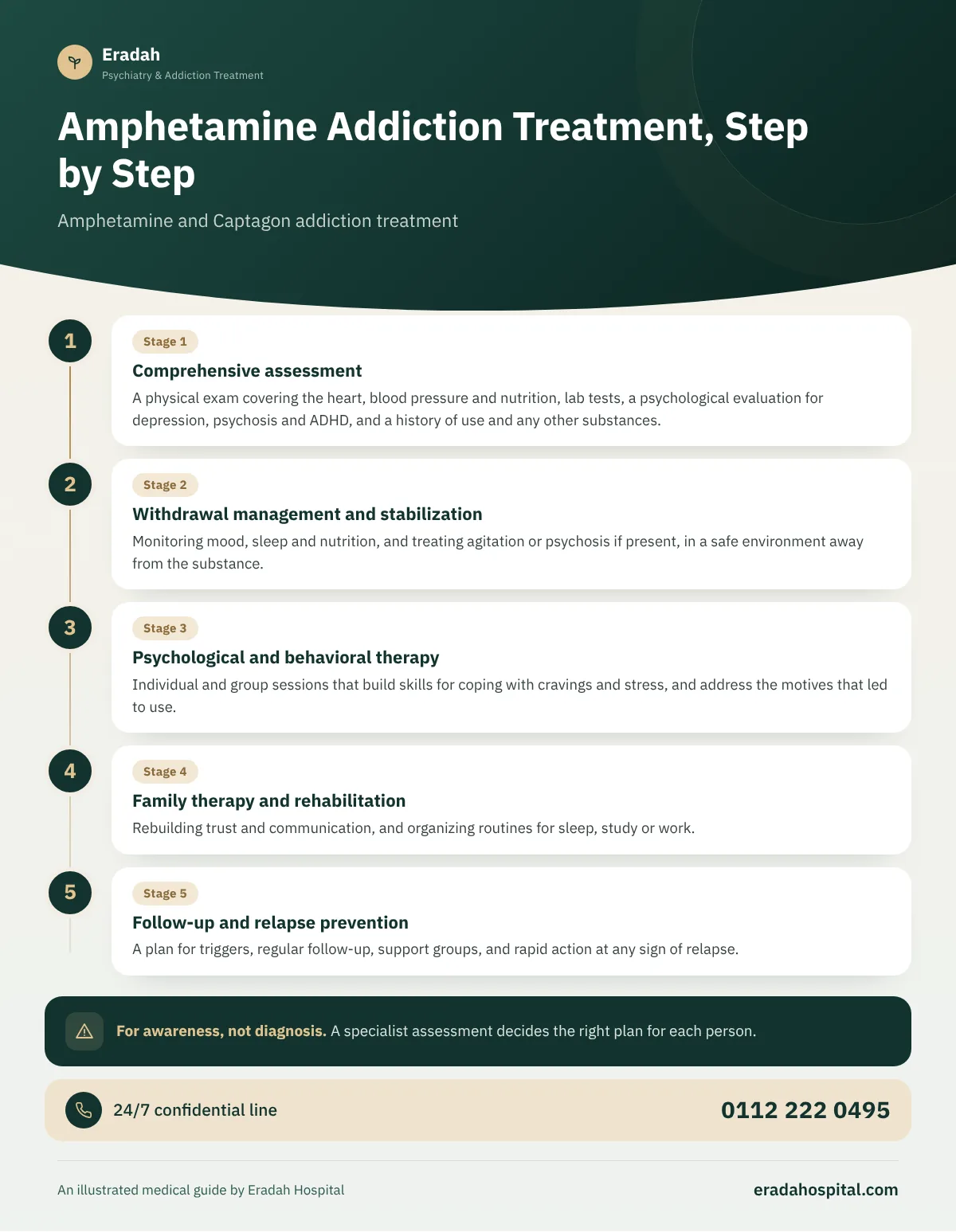
- Stage 1Comprehensive assessment
A physical exam covering the heart, blood pressure and nutrition, lab tests, a psychological evaluation for depression, psychosis and ADHD, and a history of use and any other substances.
- Stage 2Withdrawal management and stabilization
Monitoring mood, sleep and nutrition, and treating agitation or psychosis if present, in a safe environment away from the substance.
- Stage 3Psychological and behavioral therapy
Individual and group sessions that build skills for coping with cravings and stress, and address the motives that led to use.
- Stage 4Family therapy and rehabilitation
Rebuilding trust and communication, and organizing routines for sleep, study or work.
- Stage 5Follow-up and relapse prevention
A plan for triggers, regular follow-up, support groups, and rapid action at any sign of relapse.
Why does treatment begin with a careful assessment?
Stimulant addiction varies widely: there is the student who started on Captagon tablets during exams, the driver who uses them on long trips, the person with undiagnosed ADHD, and another who mixes them with hashish or sedatives. Each needs a different plan. The assessment also uncovers cardiac complications, psychosis or depression that need immediate treatment, and determines whether the patient needs residential care or whether outpatient treatment is enough.
Withdrawal management: a beginning, not an end
Stimulant withdrawal is mostly psychological, and includes a crash, exhaustion, depression and cravings; we describe it in detail on the page about amphetamine and Captagon withdrawal symptoms. At this stage the treatment team focuses on safety, monitoring mood and the risk of self-harm, and regulating sleep and nutrition. But stopping alone does not treat addiction: the brain stays sensitive to triggers, and the psychological drivers remain unless they are treated.
Are there medications for amphetamine addiction?
So far, no medication has been approved specifically to treat stimulant use disorder, as there is for opioids. But medications play important supporting roles, which the doctor determines according to the case:
| Goal | Type of medication | Note |
|---|---|---|
| Psychosis and agitation | Antipsychotics or sedatives for a short period | Used under close supervision, and stopped or continued depending on the case |
| Accompanying depression | Antidepressants | Especially if depression continues after acute withdrawal ends |
| Sleep disturbance | Behavioral sleep therapy and non-addictive medications when needed | While avoiding sleeping pills, which may cause a new dependence |
| Untreated ADHD | Options determined by the psychiatrist after stabilization | Treated with great caution and close monitoring |
Research is under way on medications and drug combinations that may reduce use in some people with stimulant use disorder, but they are not yet an approved treatment. No medication should be started or stopped without a doctor.
Psychological and behavioral therapy first
Helps the patient understand their thoughts and triggers, and build practical alternatives for coping with stress and cravings.
Programs that reward commitment and negative test results, and among the best-supported approaches in treating stimulant addiction.
Strengthens the patient's own desire to change, especially in those who do not see that they have a problem.
Teaches the family how to support without enabling use, and rebuilds trust.
A space to share the experience with others on the same journey.
Treating depression, anxiety, ADHD or trauma at the same time.
How long does amphetamine and Captagon addiction treatment take?
| Stage | Approximate duration |
|---|---|
| Withdrawal management and stabilization | About one to two weeks |
| Residential treatment and rehabilitation | 4 to 12 weeks or more, depending on the case |
| Outpatient treatment | Several months |
| Follow-up and relapse prevention | At least a year, and it may extend longer |
Staying in treatment for long enough is one of the most important factors in success. The treatment team determines the length according to the severity of the addiction, the presence of psychosis or depression, and how stable the family environment is.
Residential or outpatient treatment?
| Residential treatment | Outpatient treatment | |
|---|---|---|
| Suitable for | Severe psychosis or depression, use of multiple substances, or failed previous attempts | Milder, stable cases, or the period after residential treatment |
| Supervision | around the clock | Regular sessions and appointments |
| Distance from triggers | Full coverage throughout the stay | Needs strong family support |
| Study or work | Temporarily paused | Can continue with some scheduling |
Preventing relapse after stimulant treatment
- Identify personal triggers: exams, night shifts, staying up late, friends who use, sadness or boredom.
- An alternative plan for studying and work that relies on managing time and sleep, not on stimulants.
- A fixed routine for sleep, eating and exercise, since exercise helps restore mood and energy.
- Stick to follow-up and any prescribed medication, without stopping it on your own.
- A written plan for moments of weakness: whom to call and what to do.
- Attend support groups and stay in regular contact with the treatment team.
The family's role in treating stimulant addiction
The family is a partner in treatment, not a spectator. Programs that involve the family are linked to better outcomes, because they address communication patterns that can feed addiction, teach the family to set healthy boundaries without harshness, help them recognize early signs of a return to use such as sudden sleeplessness, loss of appetite and mood swings, and protect them from emotional exhaustion.
How do you choose a center for stimulant addiction treatment?
- Officially licensed, with psychiatrists who specialize in addiction treatment.
- Able to treat accompanying psychosis and depression, not just detox the substance.
- Provides structured psychological and behavioral therapy, not isolation alone.
- Has a family program and a clear plan for follow-up after discharge.
- Respects confidentiality and dignity, and does not promise a miracle cure in a few days.
Choosing a Hospital for Amphetamine and Captagon Addiction Treatment
The days after stopping Captagon and amphetamine are usually not physically dangerous, but they can be the riskiest days psychologically: a sharp drop in mood that can reach thoughts of self-harm, disturbed sleep, and sometimes suspiciousness, paranoia or hallucinations left over from the period of use. And because no approved medication treats stimulant addiction itself, the right facility is one with a psychiatrist on site and a strong behavioral program, not merely a room for isolation.
- Who monitors mood every day during the first two weeks, and how is the patient asked about thoughts of suicide?
- Can the team handle paranoia or agitation without violence or humiliating restraint?
- Does the program include regular motivational and cognitive behavioral therapy, rather than general lectures?
- Are accompanying hashish or tramadol use treated within the same plan?
- Is there a plan for exam seasons and night shifts, which are what most often send people back to the pills?
At Eradah, a doctor and nursing staff are present around the clock, and accompanying psychosis or depression is managed through the dual diagnosis program in a single plan. You can read more about the crash after stopping in amphetamine withdrawal symptoms. To get in touch: 01122220495 by phone or WhatsApp, day or night, or through the confidential inquiry form. The first assessment session is free and does not require you to give your name, and residential admission is for men only.
Amphetamine and Captagon Addiction Treatment at Eradah
At Eradah we begin with a comprehensive medical and psychological assessment that determines the right plan for each case, then a safe stabilization phase under round-the-clock medical supervision, where we monitor mood and sleep and treat psychosis or depression if present. This is followed by a program that combines cognitive behavioral therapy, motivational therapy and family therapy, then regular follow-up after discharge. We treat any accompanying psychiatric disorder in the same plan, with full confidentiality from the first call.