What is amphetamine?
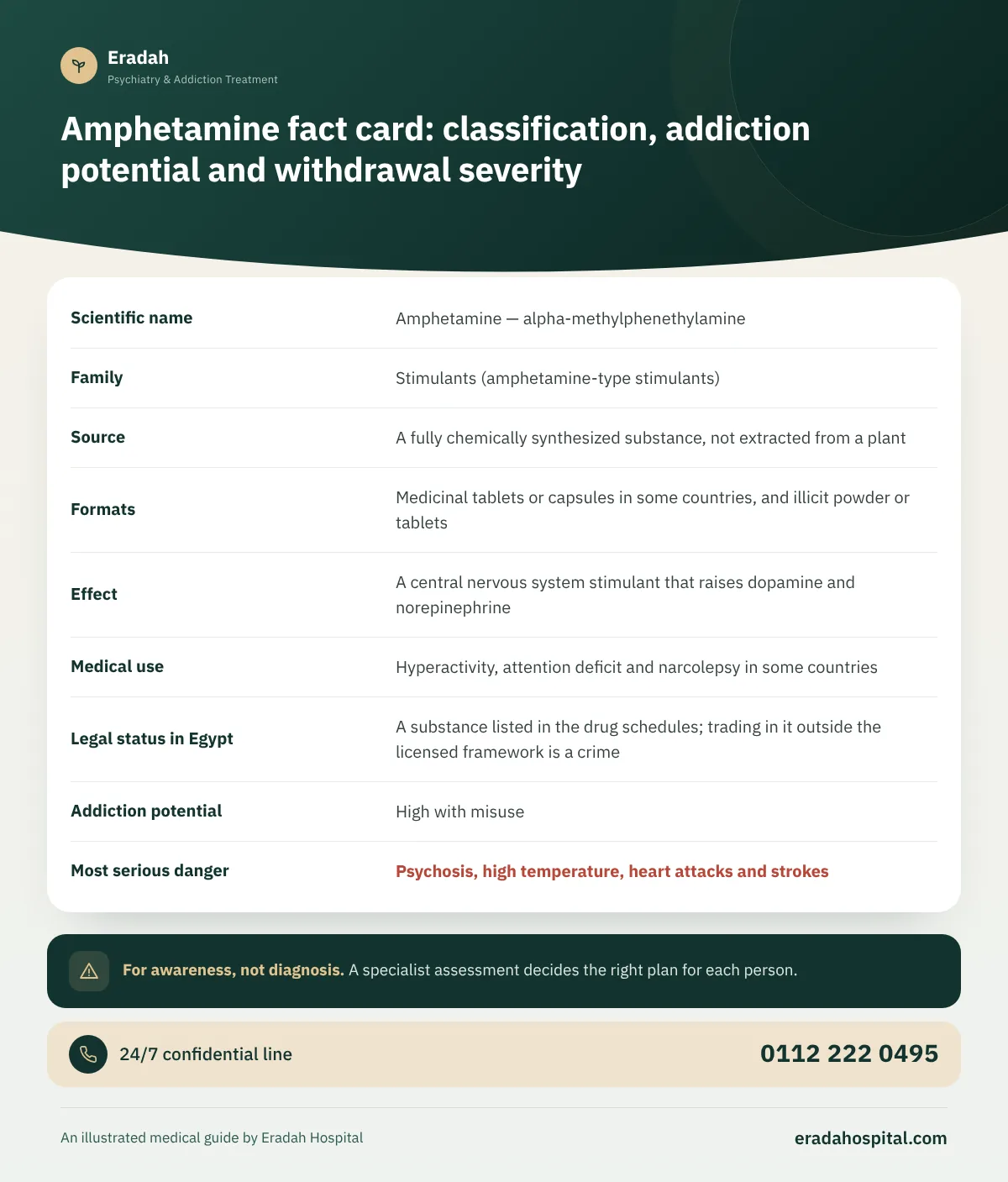
Amphetamine is a synthetic chemical substance in the stimulant family, and it is the parent molecule from which many substances were derived, the best known being methamphetamine, known in Egypt as shabu or ice.
Amphetamine was first made in the late 19th century, then spread in the 1930s as a nasal decongestant inhaler and a stimulant medication, and was widely used to keep soldiers alert in World War II. As its capacity to cause addiction and psychosis became clear, strict international controls were imposed on it.
Amphetamine exists in two closely related chemical forms, one of which has a stronger effect on the nervous system than the other. Both forms are components of some medications approved in other countries, and also of illicit tablets and powders made in secret laboratories.
Forms and names of amphetamine
The form of amphetamine varies with its source; what is prescribed in some countries differs completely in purity and oversight from what is sold on the illicit market:
Tablets or capsules prescribed in some countries for hyperactivity and narcolepsy, with a known composition and under strict oversight.
A white or grayish powder known worldwide as “speed,” of variable purity and often adulterated with other substances.
Tablets made in secret, the best known in the Arab region being Captagon tablets, most of which contain amphetamine with caffeine.
How does amphetamine affect the brain and body?
Amphetamine acts on the nerve cells that release dopamine and norepinephrine, and to a lesser extent serotonin. It does not merely block the reuptake of these messengers; it pushes the cells to release their stores, so their levels in the brain rise sharply.
- In the reward circuits: it raises dopamine, so the person feels euphoria, excess confidence and a desire to talk and move, which is what makes it addictive.
- In the autonomic nervous system: it raises norepinephrine, which increases heart rate, blood pressure and body temperature, dilates the pupils, and reduces appetite and sleep.
- With repetition: the brain adapts to this flooding, so its sense of natural pleasure declines, and the person needs the substance to feel energy or their usual mood.
The energy amphetamine gives is a loan from the body's and brain's reserves, repaid later as exhaustion and depression.
Does amphetamine have a medical use?
Yes. In a number of countries amphetamine is approved as a medication for treating hyperactivity and attention deficit disorder in children and adults, and for treating narcolepsy. In these cases it is prescribed in doses the doctor sets precisely, with monitoring of growth, sleep, blood pressure and heart rate, and it is not given to people with serious heart disease or a history of substance misuse.
Controlled medical use is fundamentally different from misuse: the patient takes a fixed dose with no euphoria under supervision, while the person misusing seeks the stimulating or euphoric effect in amounts and by routes that multiply the risk. One well-known medical stimulant in Egypt is Ritalin, used to treat hyperactivity.
Amphetamine compared with Captagon, crystal meth and cocaine
Many people confuse these substances. They share being stimulants that raise dopamine, but they differ in source, strength and the nature of the risk:
| Substance | Source | Medical use | Main risk |
|---|---|---|---|
| Amphetamine | Fully synthetic | Hyperactivity and narcolepsy in some countries | Psychosis and heart strain with misuse |
| Captagon | Illicit tablets, mostly amphetamine and caffeine | None; the original medication was withdrawn from the market | Unknown composition and unpredictable mixtures |
| Crystal meth (methamphetamine) | Derived from amphetamine | Very limited and rare | Faster addiction, and more severe psychosis and violence |
| Cocaine | Extracted from the coca plant | Limited topical use | Sudden heart attacks, even in young people |
Because the Captagon sold today is mostly based on amphetamine, the withdrawal and treatment pages in this guide cover both substances together. To learn what distinguishes Captagon itself, read the Captagon guide.
The difference between amphetamine and methamphetamine: what does the “methyl group” add?
The difference between amphetamine and methamphetamine, that is crystal meth, starts with chemistry: methamphetamine is amphetamine itself with a small methyl group added. This addition makes it more fat-soluble, so it crosses into the brain more easily. The two substances work the same way: they release dopamine and norepinephrine in large amounts.
| Amphetamine | Methamphetamine (crystal meth) | |
|---|---|---|
| Composition | The base molecule | Amphetamine with an extra methyl group |
| Medical use | Medications for hyperactivity, attention deficit and narcolepsy in some countries | Approved in the United States for hyperactivity and, for a short time, for obesity, on a restricted, non-refillable prescription |
| Common illicit form | Powder or tablets, including most Captagon pills today | Shiny crystals (“ice” or “crystal”) or powder |
| Most common route of use | Mostly swallowed or snorted | Mostly smoked, sometimes injected |
| On drug tests | Shows up on an amphetamines test | Part of it is converted to amphetamine in the body, so both usually show up |
Interestingly, a double-blind trial from Columbia University, published in the journal Addiction, compared the two substances at the same intranasal doses in 13 people who use them, and found similar effects on most measures, with a clearer effect of methamphetamine on heart rate and the feeling of euphoria. This means that a large part of the extra risk of crystal meth in reality comes from the way it is used: smoking or injecting delivers the substance to the brain immediately in a strong rush, then a “crash” that drives repeated use in a continuous pattern, as the US National Institute on Drug Abuse (NIDA) explains.
You will find withdrawal in amphetamine withdrawal symptoms, crystal meth's harms in detail in harms of crystal meth, and the treatment plan in amphetamine addiction treatment.
Common myths about amphetamine
Misconceptions about stimulants spread and lead young people to underestimate them, especially because they do not cause drowsiness or loss of consciousness like other drugs:
| The myth | The truth |
|---|---|
| “Stimulants aren't drugs, they help with work and studying” | Amphetamine is listed in the drug schedules, and it causes real addiction and psychological and heart harms. |
| “If it's a medication in other countries, it must be safe” | Safety depends on the diagnosis, the dose and medical follow-up, not on the substance alone; and illicit tablets have no oversight at all. |
| “I can quit any time” | With repetition the brain changes, and stopping becomes hard because of the crash, depression and cravings. |
| “Young people have strong hearts and aren't affected” | Heart attacks and strokes linked to stimulants happen in young people with no prior illness. |
The legal status of amphetamine in Egypt
Amphetamine is listed in the narcotic drug schedules appended to Law No. 182 of 1960 on drug control, as amended, and the law criminalizes possessing, trading or dealing in it outside the licensed medical and legal framework. Internationally it is also subject to control under the UN Convention on Psychotropic Substances. The Fund for Drug Control and Treatment of Addiction offers free, confidential treatment through hotline 16023, alongside specialized centers.
This is general educational information and not legal advice.
Amphetamine guide: everything you need to know
We have gathered everything about amphetamine into 6 pages, each answering one question in detail. Choose what you are looking for:
Harms of amphetamine
From the heart and blood vessels to psychosis, depression and malnutrition, and the danger of mixing it with alcohol or other stimulants.
Causes of amphetamine addiction
Why do many people start stimulants to study, work or lose weight, then lose control? The role of the substance, the person and the environment.
Amphetamine addiction symptoms
The physical, behavioral and psychological signs of use that a family may notice, and the diagnostic criteria.
Amphetamine and Captagon withdrawal symptoms
A crash, exhaustion, depression and cravings after stopping; the timeline, and when withdrawal becomes dangerous.
Amphetamine and Captagon addiction treatment
Cognitive behavioral and motivational therapy, treatment of accompanying psychosis and depression, the length of treatment and relapse prevention.
How long amphetamine stays in the body
How long it stays in urine, blood, saliva and hair, and why a false positive result may appear.
Found out your son is using stimulants? Start here
Many young people start stimulants to stay up studying, to work long hours or to lose weight, and do not see them as “drugs” at first. That is why the way you first talk to him matters a great deal:
- Stay calm first, and do not raise the subject while he is wired or irritable after using.
- Understand the motive: is it study pressure, an exhausting job, a wish to lose weight, or hidden depression?
- Talk about your concern for his health, sleep and mood, not about shame or punishment.
- Watch for any thoughts of suspicion, persecution or aggression, which call for an urgent psychological assessment.
- Ask for a specialist family consultation even if he refuses treatment at first.
- Save the ambulance number 123 and learn the signs of poisoning explained at the bottom of this page.
Amphetamine stimulants in numbers
Sources: a European Monitoring Centre for Drugs and Drug Addiction paper on the Captagon market, and UN News on the UNODC report in December 2025.
Signs of poisoning from amphetamine and stimulants: call the ambulance on 123 immediately
- A very high body temperature with hot skin or heavy sweating
- Chest pain or pressure, or a very fast or irregular pulse
- Seizures, muscle stiffness or an uncontrollable tremor
- Severe agitation, hallucinations, or confusion and loss of awareness of place and time
- A sudden severe headache, weakness on one side of the body, difficulty speaking, or loss of consciousness
Call the ambulance on 123 immediately, move the person to a quiet, cool place away from crowds, and talk to them calmly without violent restraint. If they lose consciousness, place them on their side and stay with them until help arrives, and do not give them any other substance or stimulating drinks.
Call the ambulance 123