Why does withdrawal happen after stimulants?
During use, amphetamine forces the brain to release large amounts of dopamine and norepinephrine, so the brain adapts by becoming less sensitive to these neurotransmitters, while the body also drains its stores of energy and sleep. When use stops, this deficit is exposed: exhaustion appears instead of energy, depression instead of euphoria, and long sleep and hunger instead of sleeplessness and loss of appetite.
Because most illicit Captagon tablets contain amphetamine, people who stop them go through almost the same course. The caffeine found in many of these tablets may add headaches and irritability in the first few days.
Timeline of Amphetamine and Captagon Withdrawal
The course differs from person to person depending on how long and how heavily they used and on their psychological state, but medical references usually describe it in three overlapping phases:
- First hours to 3 daysThe crash
Severe exhaustion and very long sleep, excess hunger, low mood, anxiety and irritability, with cravings that can be strong.
- About the first weekAcute withdrawal
Depression and mood swings, exhaustion with insomnia or excessive sleep, disturbing dreams, muscle aches, poor concentration and cravings.
- About week 2 to week 4Subacute phase
Symptoms improve gradually, with low mood, disturbed sleep and waves of cravings continuing.
- After the first monthProtracted withdrawal
In some people, loss of enjoyment, low energy and occasional cravings continue for weeks or months, especially after long-term use.
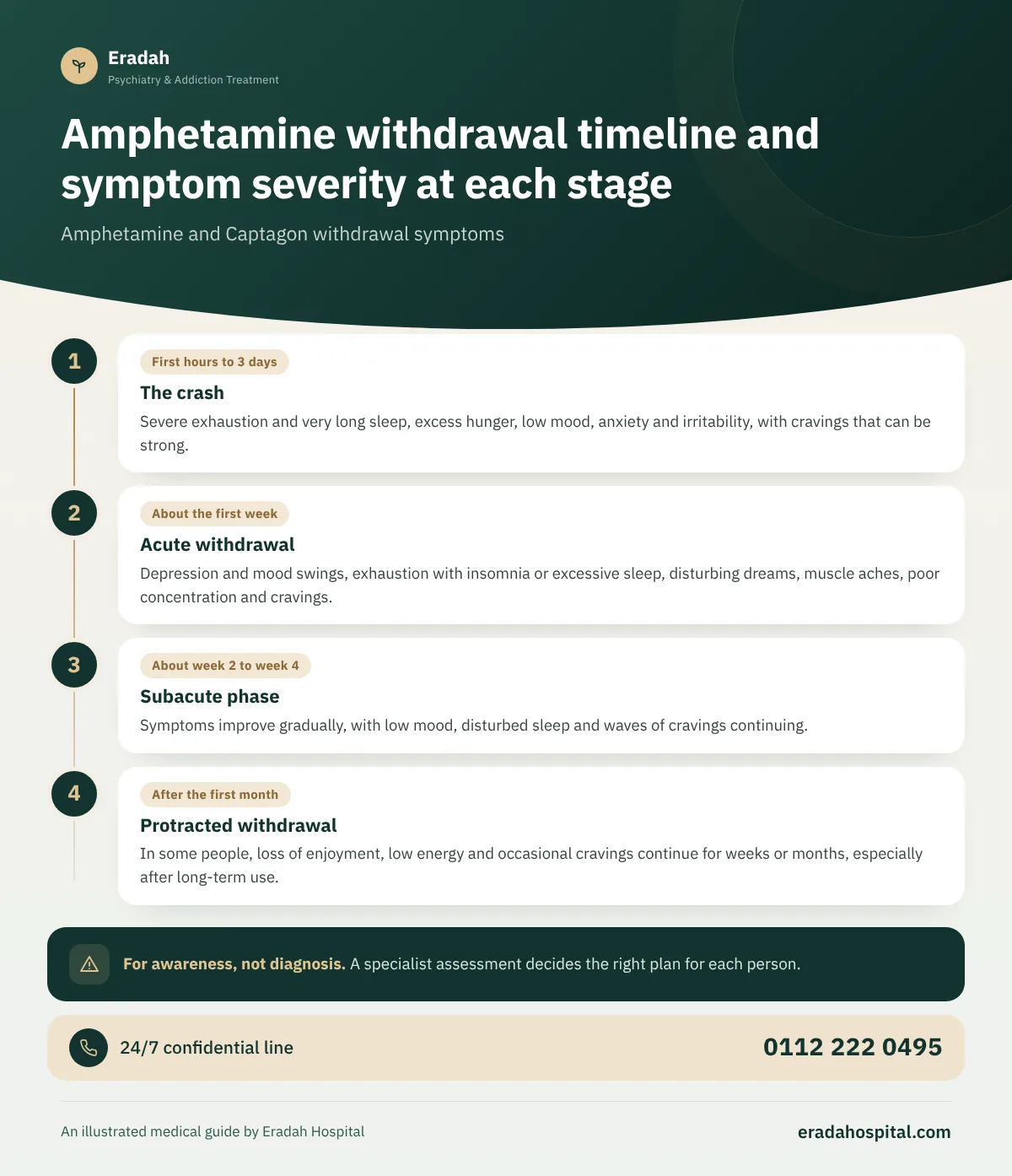
The time frames are approximate and are based on World Health Organization guidance and medical references. They vary from person to person.
Physical and psychological symptoms of amphetamine withdrawal
| Type | Symptoms |
|---|---|
| Physical | Severe exhaustion, long sleep or insomnia, increased appetite, muscle aches, slowed movement or restlessness, and headache. |
| Mood | Depression and sadness, loss of enjoyment, anxiety and irritability. |
| Cognitive | Poor concentration and memory, and slowed thinking. |
| Behavioral | Cravings to use, isolation and low motivation, and vivid, disturbing dreams. |
The DSM-5 diagnostic manual describes stimulant withdrawal as a low mood accompanied by at least two of the following: fatigue, disturbing dreams, insomnia or excessive sleep, increased appetite, and slowed movement or agitation, within hours to days of stopping.
Is amphetamine and Captagon withdrawal dangerous?
Unlike alcohol and sedative withdrawal, stimulant withdrawal does not usually cause seizures or life-threatening physical complications. But that does not mean it is safe or easy:
- Severe depression: It can be deep in the first days, and in some people it comes with thoughts of self-harm.
- Persistent psychosis: If the person had suspiciousness or hallucinations during use, they may continue for days after stopping and need treatment.
- Relapse: Cravings and the crash push many people to return to use quickly.
- Mixing other substances: If the person also uses sedatives, alcohol or pregabalin, withdrawal from those substances can carry real physical danger.
What determines the severity and length of withdrawal?
- Duration and frequency of use: Long-term daily use means more severe and longer withdrawal than occasional use.
- Pattern of heavy binges: Consecutive days without sleep make the crash afterward more severe.
- Tablet composition: In Captagon, ingredients may differ from one tablet to another, so withdrawal differs in ways that are hard to predict.
- Psychological state: Existing depression, anxiety or ADHD makes withdrawal harder.
- Accompanying substances: Mixing stimulants with sedatives or alcohol complicates withdrawal and increases its danger.
Why does withdrawal need medical supervision?
Although stimulant withdrawal does not usually require medication to prevent physical complications, medical follow-up makes a big difference:
- Assessing depression and the risk of self-harm, and monitoring them daily.
- Treating psychosis or agitation, if present, with medications chosen by the doctor.
- Regulating sleep, nutrition and fluids after a long period of neglect.
- Detecting withdrawal from other accompanying substances, which can be dangerous.
- A safe environment away from the substance during the days when cravings are at their strongest.
- A direct transition to a psychological treatment program that prevents relapse.
The page on amphetamine and Captagon addiction treatment explains what comes after this stage: psychological and behavioral therapy and follow-up.
How can the family support someone going through stimulant withdrawal?
- Accept the long sleep and hunger in the first days, as they are part of the body's recovery.
- Provide healthy food, enough fluids and a quiet environment.
- Treat irritability and sadness as symptoms, not personal insults.
- Watch their mood closely, and never ignore any talk of hopelessness or self-harm.
- Reduce access to the substance and to money in the first weeks.
- Encourage them to continue treatment after the acute symptoms are over.
Protracted withdrawal: why doesn't mood return right away?
After the acute symptoms end, many people complain of feeling “switched off” emotionally, low energy and enthusiasm, and cravings that come in waves when they are exposed to triggers such as exams, staying up late, or friends who use. This is because the brain's reward circuits need time to regain their normal sensitivity. This phase is managed with psychological therapy, regular exercise, regulating sleep, and treating depression if it persists, and knowing that it is temporary helps a great deal in getting through it.
Signs of poisoning from amphetamine and stimulants: call the ambulance on 123 immediately
- A very high body temperature with hot skin or heavy sweating
- Chest pain or pressure, or a very fast or irregular pulse
- Seizures, muscle stiffness or an uncontrollable tremor
- Severe agitation, hallucinations, or confusion and loss of awareness of place and time
- A sudden severe headache, weakness on one side of the body, difficulty speaking, or loss of consciousness
Call the ambulance on 123 immediately, move the person to a quiet, cool place away from crowds, and talk to them calmly without violent restraint. If they lose consciousness, place them on their side and stay with them until help arrives, and do not give them any other substance or stimulating drinks.
Call the ambulance 123