Why does amphetamine cause addiction?
Amphetamine has properties that make the brain “learn” to ask for it quickly:
It drives nerve cells to release their stored dopamine, so the person feels a pleasure and confidence that natural rewards do not provide.
It gives alertness and the ability to stay up and get things done, so at first it looks like a tool for success, not a danger.
The same amount has less effect with repetition, so the person increases the amount or shortens the gaps between uses.
When the effect wears off, exhaustion and depression follow, so the person returns to the substance to escape the crash, not to chase euphoria.
The most dangerous thing about stimulants is that they start as a solution to a problem, such as an exam, a night shift, or excess weight, and then become the problem.
Why do people start using amphetamine?
Motives for starting with stimulants differ from other drugs, since many of them are tied to performance, not pleasure:
| Motive | How it starts | Where it may lead |
|---|---|---|
| Studying and exams | Staying up several nights in a row before exams | A cycle of staying up then crashing, and relying on the substance under every pressure |
| Working long hours | Night shifts or long-distance driving | Chronic exhaustion, accidents, and increasing the amount over time |
| Weight loss | Wanting to lose appetite and weight | Malnutrition, disordered eating, and psychological attachment to the substance |
| Parties and late nights | Looking for energy and euphoria with friends | Mixing with other substances and a weekend pattern of use that gradually widens |
| Escaping depression | An attempt to lift mood and energy | Deeper depression after each crash and a growing need for the substance |
What all these motives share is that the substance seems “successful” at first: the student stays up, the worker gets things done, the weight drops, and the mood lifts. This temporary success is what makes the person link the substance with his ability to perform, so it is hard for him to imagine his day without it, even before any clear harm appears.
From experimenting to addiction: how does it develop?
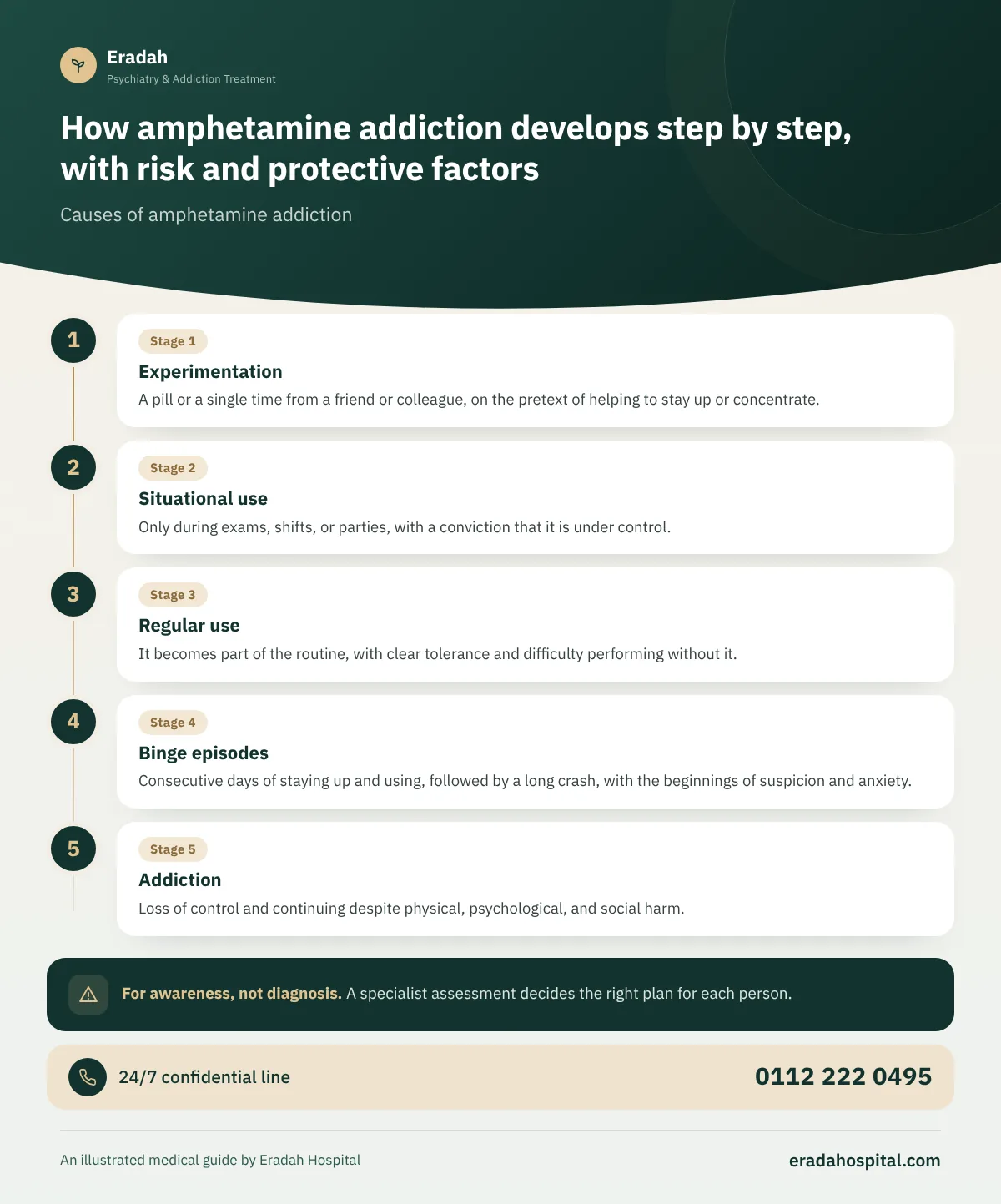
- Stage 1Experimentation
A pill or a single time from a friend or colleague, on the pretext of helping to stay up or concentrate.
- Stage 2Situational use
Only during exams, shifts, or parties, with a conviction that it is under control.
- Stage 3Regular use
It becomes part of the routine, with clear tolerance and difficulty performing without it.
- Stage 4Binge episodes
Consecutive days of staying up and using, followed by a long crash, with the beginnings of suspicion and anxiety.
- Stage 5Addiction
Loss of control and continuing despite physical, psychological, and social harm.
Mental health conditions and dual diagnosis
Stimulant addiction is closely linked to some mental health conditions, either because the person is trying to treat them himself, or because the substance exposes or worsens them:
- Untreated ADHD: The person may find that the stimulant “helps” him, so he uses it without supervision and in uncontrolled amounts.
- Depression: The temporary energy looks like a treatment, but the crash afterward deepens the depression.
- Social anxiety and low self-confidence: The stimulant gives a false boldness in social situations.
- Eating disorders and body image: It is used to suppress appetite.
- Post-traumatic stress disorder (PTSD): Some turn to stimulants to push back against emotional numbness.
Does genetics play a role in amphetamine addiction?
Yes. Research indicates that genetic factors explain a significant part of the susceptibility to addiction in general, so the risk is higher for people with a family member who has an addiction. What is meant here is a group of factors that affect the sensitivity of reward circuits and a person’s ability to control impulses, not a single gene for addiction. Genetics is a predisposition, not a destiny, and environment and upbringing play a big role.
Environment and social factors
- A culture of “performance at any cost”: Intense academic or professional pressure, with achievement valued at the expense of health and sleep.
- Availability of the substance around the person: Classmates or colleagues passing pills around as “ordinary stimulants.”
- Misinformation: Believing that stimulant pills are milder than drugs or are “just strong caffeine.”
- Starting use at an early age: The teenage brain is more prone to developing addiction.
- Weak family bonds: Lack of conversation and supervision, or constant conflict in the home.
Risk factors versus protective factors
| Area | Risk factor | Protective factor |
|---|---|---|
| Mental health | Untreated depression, ADHD, or anxiety | Early diagnosis and regular treatment under supervision |
| School and work | Constant pressure, staying up late, and unrealistic expectations | Time management, enough sleep, and realistic goals |
| Family | Lack of conversation, or a family member with an addiction | Open communication, clear boundaries, and emotional support |
| Friends | A surrounding where stimulants circulate | Supportive friends and healthy sports and social activities |
Is stimulant addiction a choice?
The first decision to try may be a choice, but addiction itself is not. With repetition, the brain circuits responsible for reward, attention, and impulse control change, so thinking about the substance becomes dominant and the voice of reason that weighs consequences weakens. That is why international medical bodies consider addiction a chronic brain disease that needs treatment, not blame. Understanding this helps the family respond with empathy, and helps the person ask for help without shame.
How do you protect yourself or your children from stimulants?
- Talk to your children early about “study and staying-up pills,” clearly and without exaggeration.
- Teach them that sleep is part of studying, not its enemy, and that achievement cannot be bought with a pill.
- Watch for changes in sleep, appetite, and mood during exam seasons.
- If your child has ADHD, make sure it is treated and followed up with a specialist doctor.
- Do not use any stimulant medication or weight-loss medication without a prescription and medical follow-up.
- Ask for specialist advice at the first sign of use, not after the problem has grown.