What happens to amphetamine inside the body?
After it enters the body, amphetamine spreads through the blood and reaches the brain, then the liver processes part of it, and a large part leaves in the urine unchanged, along with other byproducts. That is why a urine test is among the most suitable ways to detect it.
The half-life of amphetamine, meaning the time needed for its amount in the blood to fall by half, ranges from a few hours to more than a day depending on the person and conditions of elimination, and it is much longer than cocaine’s, which is why its effect and detection last relatively longer.
In practical terms, this means the body clears most of the substance within a few days after the last use, but its effects on mood, sleep, and appetite may last much longer. The substance leaving the body does not mean its effect on the brain is over, a point many families and people who use it overlook.
How long amphetamine stays by type of test
Urine
Blood
Saliva
Hair
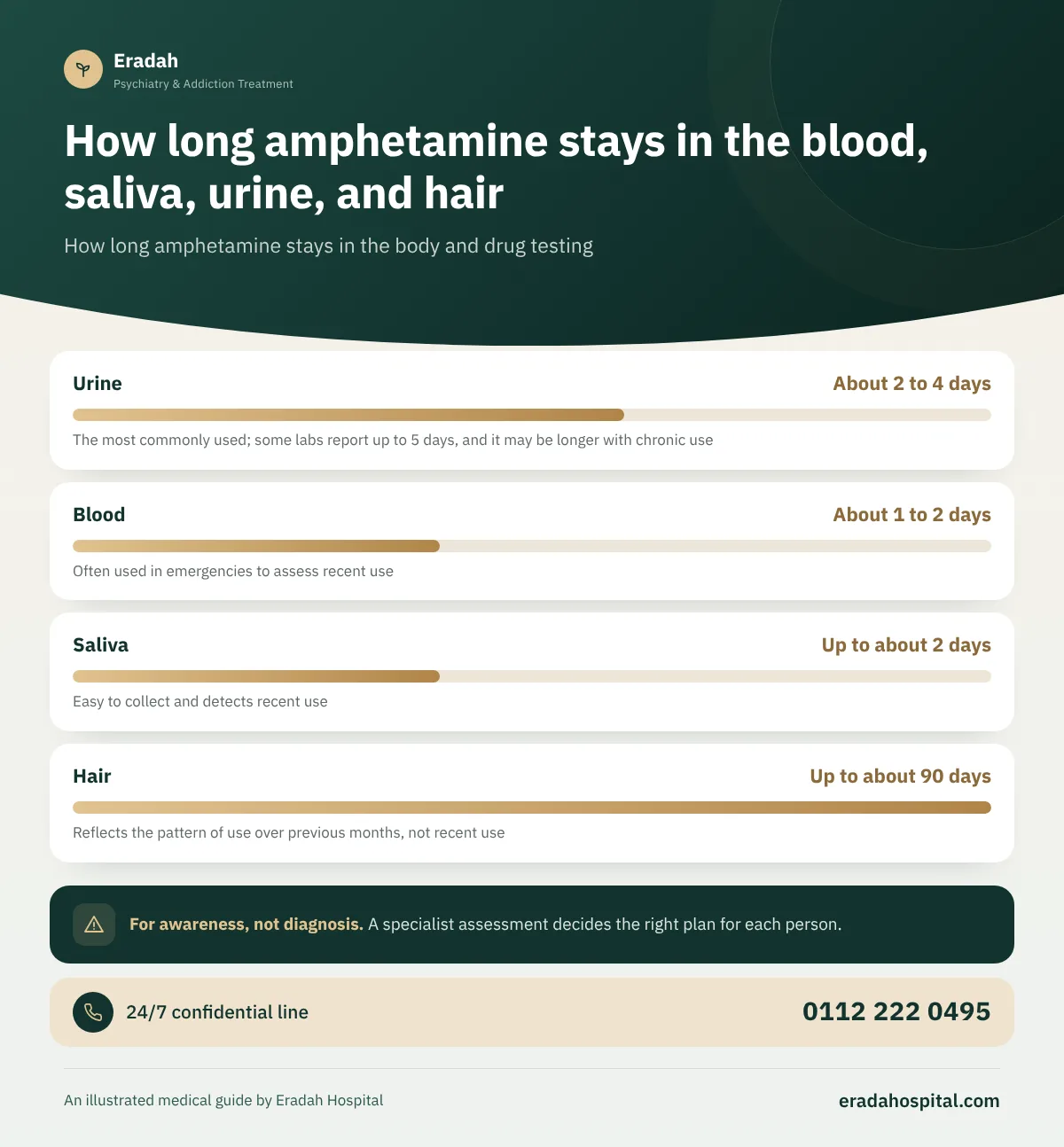
The times are approximate and vary with the laboratory and the sensitivity of the test. To interpret a specific result, consult a doctor or the laboratory.
Factors that affect how long amphetamine stays
- How often and how long it was used: Daily use or binge episodes lengthen detection time compared with a single use.
- Amount and purity of the substance: With illicit pills, no one knows the real amount inside the pill.
- Kidney and liver function: Weakness in either slows clearance of the substance.
- Age, weight, and general health.
- Type of test and cutoff: Laboratories differ in the minimum level at which a result counts as positive.
Screening test and confirmatory test
Quick, and detects the amphetamine-type stimulant group in general, but it may give a falsely positive result and does not identify the substance precisely.
Done in a specialized laboratory with precise instruments, it identifies the specific substance such as amphetamine or methamphetamine, and is requested for any positive initial result.
A positive initial test alone is not enough to judge, especially if there are medical, legal, or job consequences of the result.
Can the result be positive without amphetamine use?
Yes. Some medications can react with the initial test and give a falsely positive result. Examples that medical references mention include some cold and decongestant medicines containing pseudoephedrine, some antidepressants such as bupropion, and selegiline, a drug used in Parkinson’s disease. Also, a patient who takes a prescribed stimulant will naturally show up in the test.
What about patients who take amphetamine by prescription?
In countries where amphetamine is prescribed to treat ADHD or narcolepsy, the substance will naturally show up in the patient’s test. That is why a patient is advised to carry proof of the prescription and to tell the laboratory or employer about it in advance. The substance showing up in this case does not mean addiction or misuse; assessment depends on the whole medical picture, not the test alone. If you are traveling with a stimulant medication, check the legal rules in the country you are going to, because many countries, including Egypt, impose strict controls on these substances.
Misconceptions about stimulant tests
| The misconception | The truth |
|---|---|
| “A positive initial test is conclusive proof” | It may be falsely positive because of other medications, and needs a confirmatory test. |
| “A negative test means he doesn’t use” | The detection window in urine is short, and the use may have happened days earlier. |
| “A hair test shows what happened yesterday” | Hair reflects the pattern of use over previous weeks and months, not very recent use. |
| “All stimulants show up in the same test” | Some stimulants, such as cocaine and other ADHD medications, need their own tests. |
When are amphetamine tests requested?
- In emergencies when stimulant poisoning or unexplained acute psychosis is suspected.
- At the start of an addiction treatment program, and during it to track adherence and encourage progress.
- To follow patients who take prescribed stimulants in some countries.
- In some job, licensing, or legal procedures.
Why is testing used during treatment?
In stimulant addiction treatment programs, testing is not used for surveillance or punishment but as part of treatment itself; consecutive negative results count as an achievement to build on, and some evidence-based programs reward the patient for adherence. Testing also helps the treatment team detect any relapse early and adjust the plan before things get worse.
What does a test result mean for the family?
A positive result does not pass judgment on the person, but it opens the way to conversation and treatment. A negative result does not rule out a problem if the signs are clear, because the detection window in urine is relatively short. More important than the test is a calm conversation and a specialist assessment that looks at the whole picture.