Why is cannabidiol said to be “natural and safe”?
Many people start using CBD oil because it is “from a plant” and “doesn't get you high.” The truth is that having no high is one thing, and having no harm is something else entirely.
The US Food and Drug Administration says it is concerned that people may wrongly believe cannabidiol is “harmless,” and that the limited data available on its safety point to real risks. Most of what we know about its harms came from the trials that preceded approval of Epidiolex, a pure cannabidiol given by prescription and with monitoring. Commercial products add another risk: not knowing what is actually inside them.
What are the common side effects of cannabidiol?
The FDA notes that there are effects you may notice yourself, and that they usually improve on stopping or lowering the amount:
The most common effect; in Epidiolex trials in Lennox-Gastaut and Dravet syndromes, drowsiness and sluggishness were 32% versus 11% with placebo.
Diarrhea and reduced appetite, among the most frequent effects in the medicine's leaflet.
Irritability and agitation in some users, according to the FDA.
A rise that is often not felt and is found only on blood tests.
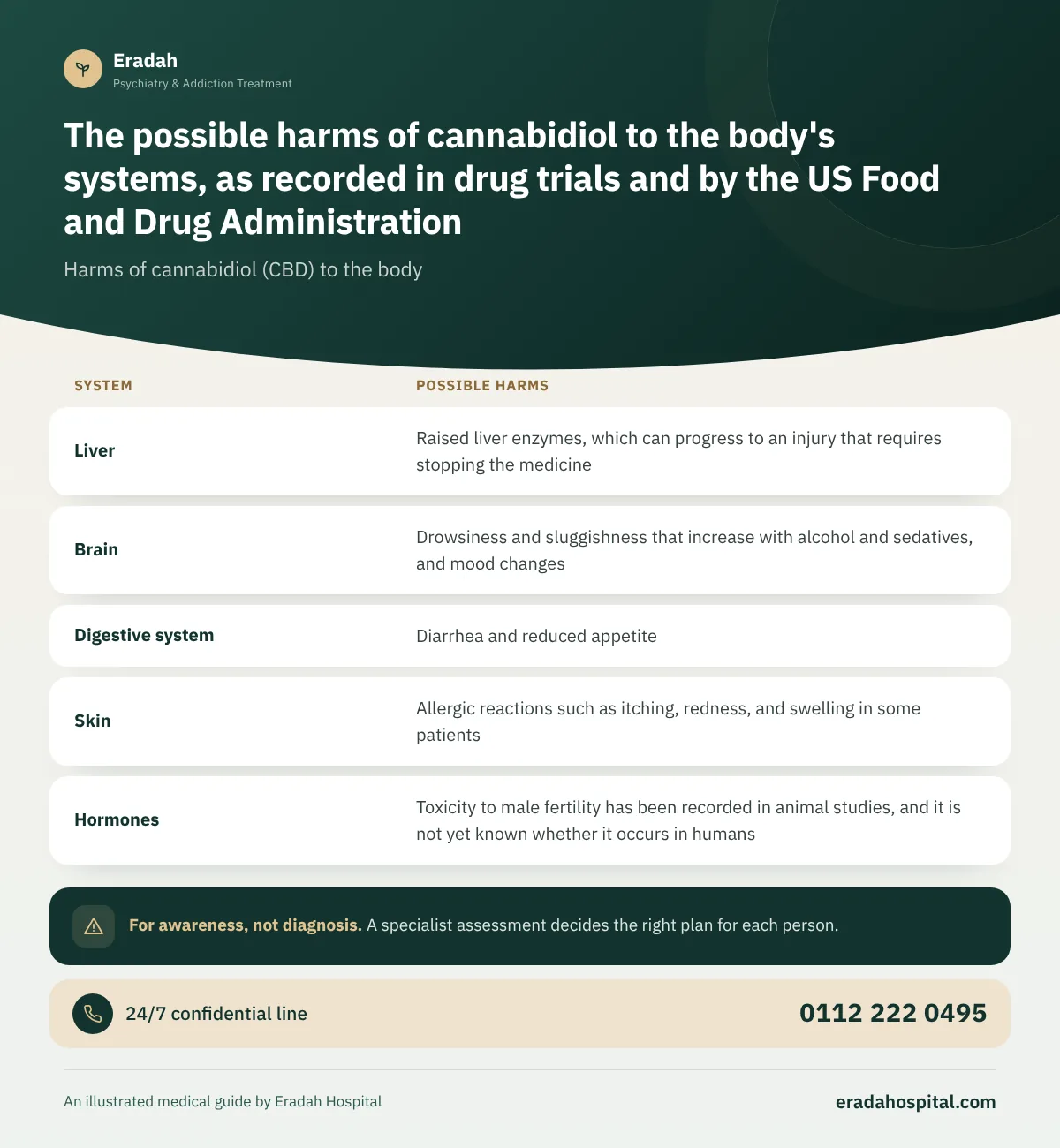
What are the harms of cannabidiol to the body's systems?
| System | Possible harms |
|---|---|
| Liver | Raised liver enzymes, which can progress to an injury that requires stopping the medicine |
| Brain | Drowsiness and sluggishness that increase with alcohol and sedatives, and mood changes |
| Digestive system | Diarrhea and reduced appetite |
| Skin | Allergic reactions such as itching, redness, and swelling in some patients |
| Hormones | Toxicity to male fertility has been recorded in animal studies, and it is not yet known whether it occurs in humans |
Does cannabidiol harm the liver?
Yes, it can. In the controlled trials of Epidiolex in Lennox-Gastaut and Dravet syndromes, the liver enzyme ALT rose to more than three times the upper limit of normal in 13% of those who took it, versus 1% with placebo. The rise usually appeared in the first two months, and was higher in those also taking the epilepsy medicine valproate.
The FDA points out that this risk can be managed when the approved medicine is taken under medical supervision with regular tests, but it is unclear how it would be managed when people use it widely without supervision. Signs of liver injury have also appeared in patients not taking other medications that affect the liver.
How does cannabidiol interact with other medications?
Cannabidiol is metabolized in the liver mainly by the enzymes CYP2C19 and CYP3A4, which also take part in breaking down many medicines. That is why the FDA says it may change how other medications work and cause serious side effects. Some of the clearest examples in the Epidiolex leaflet:
| Medicine or substance | What may happen |
|---|---|
| Valproate (an epilepsy medicine) | Clearly raises the risk of raised liver enzymes |
| Clobazam (a benzodiazepine sedative) | Increased drowsiness; in trials it was 46% with clobazam versus 16% without |
| Alcohol, sedatives, and sleep and anxiety medications | Increased drowsiness and sluggishness and a risk of injuries and accidents |
| Other medications broken down by the same enzymes | Their levels may rise or fall, so the doctor needs to review them |
So if you take Rivotril or any sedative, psychiatric medication, or epilepsy medication, do not add a cannabidiol product without consulting your doctor.
How dangerous are contaminated cannabidiol products?
In practice this is the most dangerous of the harms of cannabidiol. In the US state of Utah, a CDC report published in 2018 recorded 52 suspected or confirmed cases of poisoning linked to products sold as CBD oil. When 9 of the samples were analyzed, all contained a synthetic cannabinoid called 4-CCB, and none contained any cannabidiol.
- The most common symptom was an altered mental state in about 83% of those affected.
- Then nausea or vomiting in half of them, and seizures or tremor in about 37%.
- About 60% of them went to the emergency department, and about a quarter were under 18.
In a 2017 JAMA study, THC appeared in 18 of 84 products sold online. That means someone who thinks they are using a “natural oil” may actually be exposed to the harms of hashish or the far more severe harms of synthetic cannabinoids.
Does cannabidiol affect mood and mental health?
The FDA lists irritability and agitation among its possible effects. The Epidiolex leaflet also carries the warning that all epilepsy medicines carry: watch for the emergence of depression, suicidal thoughts, or changes in mood and behavior. This is a general warning for this drug class and does not mean every user will be affected, but it does mean any psychological change deserves review. If you have thoughts of harming yourself, ask for help right away through the mental health support line (16328) or ambulance (123).
Is cannabidiol safe for pregnant and breastfeeding women and children?
That is not yet known. The FDA lists among the open questions the effect of cannabidiol on the fetus and infant and on the developing brain in children, and the Epidiolex leaflet notes that it may harm the fetus based on animal data and that there are no data on its passing into breast milk. So pregnant or breastfeeding women use it only on a doctor's decision, and children are given it only within an approved treatment setting.
Do the harms of cannabidiol go away on stopping?
The FDA says the noticeable effects, such as drowsiness, digestive upset, and mood changes, usually improve on stopping or lowering the amount. In Epidiolex trials, the raised liver enzymes resolved in about two-thirds of cases after the medicine was stopped or reduced. Anyone using it as an epilepsy medicine should not stop it suddenly, because its leaflet states that epilepsy medicines should be stopped gradually to avoid more seizures.
Danger signs after using cannabidiol products: call the ambulance (123) immediately
- Seizures or involuntary tremor after using an oil or vaping liquid of unknown origin
- Severe confusion, agitation, hallucinations or loss of consciousness
- Deep drowsiness and difficulty waking, especially with alcohol or sedatives
- Repeated vomiting that does not stop, with dizziness
- Swelling of the face or lips, or difficulty breathing or swallowing after use
Call ambulance (123) immediately. If the person is unconscious but breathing, place them on their side so they do not choke on vomit. Stay with them and do not leave them alone. Do not give them food or drink, and tell the paramedics everything they took or used, and the amount and time if you know them.
Call the ambulance 123