What is cannabis and its derivatives?
Cannabis is a plant people have known for thousands of years and used for fibers and ropes, but today it is known mainly as the most widely used drug in the world and in Egypt.
The flower tops of the cannabis plant secrete a sticky resinous substance rich in compounds called cannabinoids. The two most important are THC, which is responsible for the feeling of being high and for most of the psychological harms, and CBD, which does not cause a high and appears to soften some of THC's effects. The ratio of the two varies widely from one strain to another, and the effect and risk vary with it.
When we say “cannabis and its derivatives,” we mean every product taken from the plant itself: the pressed resin known in Egypt as hashish, the dried leaves and flower tops known as bango or marijuana, as well as oils, concentrates and high-potency edibles common in other countries. What is called “synthetic hashish” does not belong to this family at all, as we explain below.
The market also uses the name hydro for high-potency cannabis strains; the higher the concentration of the active substance, the greater the chances of severe anxiety, psychosis and dependence, even if the product looks “natural.”
How does THC affect the brain? The endocannabinoid system
The human body has a natural system called the endocannabinoid system, which releases substances similar in structure to THC and acts on receptors spread through the brain and body to regulate mood, memory, appetite, sleep, pain sensation and movement. These natural substances are released in measured amounts and break down quickly.
When THC enters the body, it mimics these substances and binds to the same receptors, but for longer and in a way the body does not regulate, which throws this delicate system off balance. Because THC is a partial agonist of the receptors, there is a ceiling on how strong its effect can be, which is a key point for understanding the difference between it and synthetic substances.
Difficulty forming new memories and concentrating, worse with regular use.
Relaxation in some people, and anxiety, suspicion and panic attacks in others, along with a distorted sense of time.
Slowed reactions and poor balance, which is why driving becomes dangerous.
The brain reduces its sensitivity to the substance, so tolerance appears, then dependence and withdrawal symptoms.
Types of cannabis and its derivatives
Hashish and bango each have a full guide and separate pages on harms, symptoms and detection. Here is a short card for each:
Hashish
HashishPressed cannabis plant resin that impairs memory and concentration and is linked to psychosis in people who are predisposed to it.
- Classification
- Cannabis (resin)
- Medical use
- Not used medically in Egypt
- Addiction potential
Moderate- Withdrawal
Moderate
Main risk: impaired memory and psychosis in people who are predisposed
Bango
MarijuanaAlso known as: marijuana
The dried leaves and flowering tops of the cannabis plant, known worldwide as marijuana.
- Classification
- Cannabis (leaves and flowers)
- Medical use
- Not used medically in Egypt
- Addiction potential
Moderate- Withdrawal
Moderate
Main risk: impaired concentration and triggering of psychosis
Hydro
High-potency cannabis (hydroponic)Also known as: hydro bango
A common market name for high-potency cannabis varieties; the higher the concentration of the active compound, the greater the risks of psychosis and addiction.
- Classification
- High-potency cannabis (herbal)
- Medical use
- Not used medically in Egypt
- Addiction potential
High- Withdrawal
Moderate
Main risk: psychosis and panic attacks with high potency
Cannabidiol
Cannabidiol (CBD)Also known as: CBD
A compound from the cannabis plant that does not cause a high. An approved medication for a rare form of epilepsy is derived from it, while commercial products may contain THC.
- Classification
- Non-intoxicating cannabis compound
- Medical use
- Rare forms of epilepsy
- Addiction potential
Low- Withdrawal
Low
Main risk: products adulterated with THC, and its effect on the liver
What is the difference between hashish and bango?
Hashish and bango come from the same plant and contain the same active substance; the main difference is the part used and the level of concentration. So they share addiction, withdrawal and treatment, while differing in form and average strength:
| Point of comparison | Hashish | Bango |
|---|---|---|
| Part used | Resin extracted from the flower tops | Dried leaves and flowering tops |
| What it looks like when identified | Brown to black pieces or slabs | Crumbled green or brown herbs |
| Average THC in Europe in 2023 | About 23% | About 11% |
| Main added risk | High concentration and the possibility of adulteration | Herbs may be sprayed with synthetic chemicals |
| Addiction and withdrawal | Both possible | Both possible |
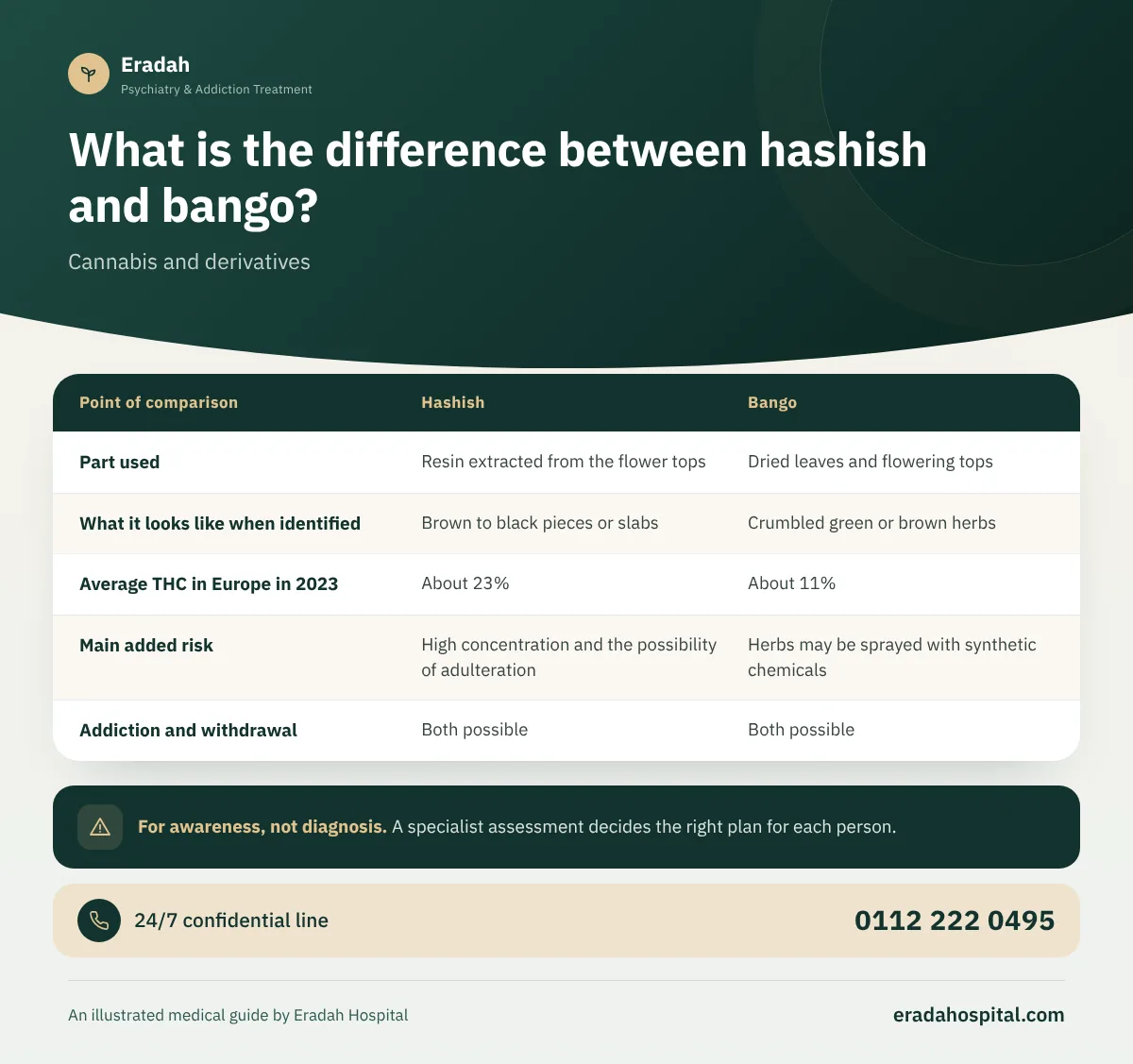
Concentration figures are from the European Union Drugs Agency, and there are no comparable published figures for the Egyptian market. The difference in averages does not mean bango is “mild”; its strong strains approach hashish.
The difference between hashish and bango in effect and danger: which is more dangerous?
After learning the difference between hashish and bango in form and source, the question families ask most remains: which is more dangerous? The more accurate answer is that the danger is not determined by the name so much as by the THC concentration in the strain, the frequency of use, the age of starting, and what may be mixed into the substance.
In a British study published in the journal Psychological Medicine, frequent use of a high-potency type, which at the time was a strong herbal cannabis called “skunk,” was linked to more severe dependence, especially in younger people, and to clearer effects on memory and suspicion and paranoia. Resin and the weaker herbal cannabis of that time were not linked to dependence to the same degree. In other words, “herbal” is not necessarily milder and “resin” is not necessarily stronger; what matters is the strength of the strain itself.
| Hashish | Bango | |
|---|---|---|
| What determines the strength of the effect | THC concentration in the resin, which is currently high on average | THC concentration in the strain, including very strong strains |
| The best-known added risk | Adulteration with other unknown substances | Spraying the herbs with far more dangerous synthetic cannabinoids |
| Psychosis and paranoia | The risk rises with high concentration and daily use | The same risk with strong strains |
| Showing up in a test | Detected through THC metabolites themselves | Detected through the same metabolites, with no difference in detection |
| Addiction, withdrawal and treatment | Roughly the same | Roughly the same |
Because the active substance is the same, the hashish withdrawal symptoms and the plan for hashish addiction treatment apply to bango as well, and you will find the harms of each in harms of hashish and harms of bango.
Is cannabis today stronger than cannabis in the past?
Yes, and the difference is large. European Union Drugs Agency data show that the average THC content of cannabis resin seized in Europe roughly doubled over ten years. Hybrid strains very high in THC and low in CBD have also appeared, and these are the strains research links to a higher risk to mental health.
What that means for families is that the picture the parents' generation has of “a hashish cigarette at an evening get-together” no longer resembles reality. A large European study published in The Lancet Psychiatry found that daily use of high-potency cannabis is linked to a marked rise in the likelihood of psychosis.
Natural cannabis and synthetic cannabis: what is the real difference?
This is the most important paragraph on the page, because confusing the two is very common within families and among young people. The word “hashish” in the name “synthetic hashish” suggests it is a type of cannabis, but in truth synthetic cannabis such as Strox and Voodoo contains neither the cannabis plant nor THC; it contains manufactured chemicals sprayed onto dried herbs.
| Point of comparison | Natural cannabis (hashish and bango) | Synthetic cannabis (Strox and Voodoo) |
|---|---|---|
| Source | The cannabis plant itself | Chemical compounds from unlicensed labs |
| Active ingredient | THC, a partial agonist of the receptors | Full agonists that are far stronger and variable |
| Consistency of composition | Varies, but it is the same substance | Changes from one bag to another and one batch to another |
| Serious acute poisoning | Rare in adults | Seizures, heart rhythm disturbance and kidney injury have been recorded |
| A standard cannabis test | Detects it | Mostly does not detect it |
Is cannabis “natural, therefore safe”? Myths and facts
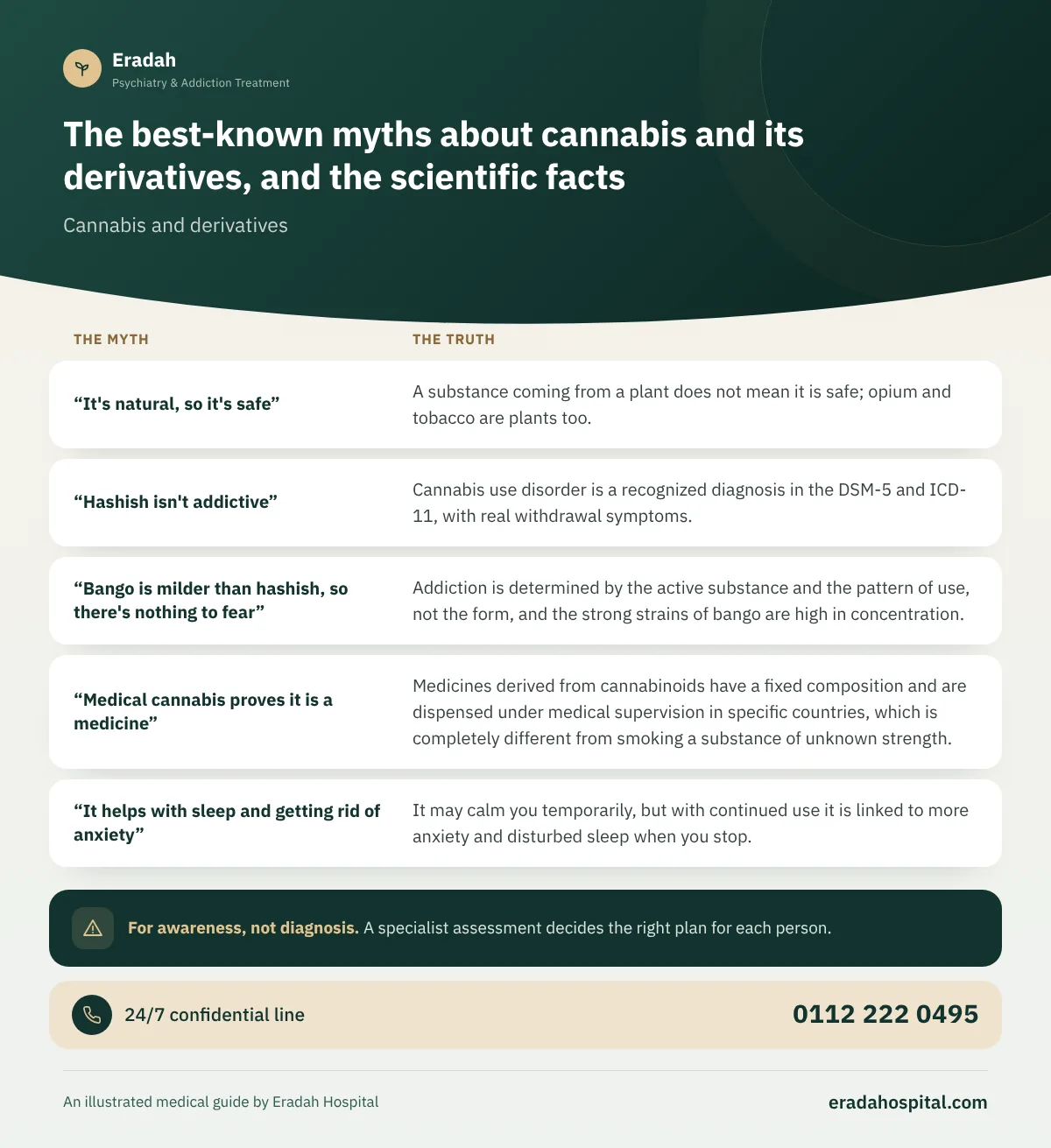
The wide spread of cannabis has surrounded it with many ideas that young people pass around as facts, and this normalization is one of the main reasons people delay seeking treatment:
| The myth | The truth |
|---|---|
| “It's natural, so it's safe” | A substance coming from a plant does not mean it is safe; opium and tobacco are plants too. |
| “Hashish isn't addictive” | Cannabis use disorder is a recognized diagnosis in the DSM-5 and ICD-11, with real withdrawal symptoms. |
| “Bango is milder than hashish, so there's nothing to fear” | Addiction is determined by the active substance and the pattern of use, not the form, and the strong strains of bango are high in concentration. |
| “Medical cannabis proves it is a medicine” | Medicines derived from cannabinoids have a fixed composition and are dispensed under medical supervision in specific countries, which is completely different from smoking a substance of unknown strength. |
| “It helps with sleep and getting rid of anxiety” | It may calm you temporarily, but with continued use it is linked to more anxiety and disturbed sleep when you stop. |
What are the shared risks of cannabis and its derivatives?
- Impaired memory and concentration, with a bigger effect on the brain, which is still developing in adolescence.
- Anxiety and panic attacks, and a higher risk of psychosis in people who are predisposed, especially with strong strains.
- Dependence and addiction, and withdrawal symptoms such as irritability, insomnia and loss of appetite.
- Cannabis hyperemesis syndrome in some long-term users: repeated bouts of vomiting with frequent hot showers.
- Harm to the respiratory system from smoking, and the danger of driving under the influence.
- The risk of poisoning in children if they get hold of edible products containing cannabis.
The details differ from one substance to another, so we have given one page to the harms of hashish and another to the harms of bango.
Cannabis in Egypt: prevalence and the law
Hashish is the most widely used drug in Egypt, and cannabis is the most widely used drug in the world by a wide margin, according to the World Health Organization and the United Nations Office on Drugs and Crime. It appears in some works of art and songs in a lighthearted or ordinary way, which dulls the sense of its danger.
Legally, hashish and bango are prohibited substances in Egypt under Law No. 182 of 1960 on drug control, growing the cannabis plant is banned, and there is no licensed medical use of hashish in Egypt. Legalizing cannabis in some countries changes nothing about its legal status here or about its effect on the brain. This is general awareness information, not legal advice.
Withdrawal, treatment and detection: what you need to know
Withdrawal from hashish and bango is not usually life-threatening, but it is real and unpleasant: irritability, insomnia, disturbing dreams, loss of appetite and cravings, with details on the page about hashish and bango withdrawal symptoms. Treatment relies mainly on behavioral psychotherapy and treating any co-occurring anxiety or depression, as in hashish and bango addiction treatment.
As for detection, because THC dissolves in fat and is stored in body tissues, its by-products may stay in the urine longer in regular users than in someone who used once; approximate details are on the page about how long hashish stays in the body.
How can families protect their children from cannabis?
Many young people start cannabis in their teens out of curiosity and peer pressure, and the earlier the start, the greater the risk of addiction and of effects on studies and mental health. An early, calm conversation helps more than scare tactics or humiliating surveillance:
- Talk with your children with accurate information about cannabis, acknowledge that some people use it with no obvious problem, then explain why the risk is different at their age.
- Explain clearly that “synthetic hashish” is not hashish, that it is far more dangerous, and that a previous experience does not protect against the next one.
- Watch for sudden changes compared with your child's usual self: falling grades, changing friends, frequent late nights, withdrawal, and red eyes.
- If you find suspicious herbs or pieces, do not react with violence; choose a calm time to talk and seek specialist advice.
- Pay attention to anxiety and depression in a teenager, as many turn to cannabis to calm suffering they have not spoken about.
When does a cannabis use case need emergency care? Call ambulance (123)
- A severe panic attack that will not settle, or acute psychosis with hallucinations, suspicion and behavior dangerous to the person or others
- Chest pain, severe palpitations or fainting
- Repeated vomiting that will not stop, with dehydration or inability to drink fluids
- Seizures, loss of consciousness or severe agitation, as these signs point to a synthetic substance rather than natural cannabis
- A child who swallowed a product containing cannabis, even if they seem fine at first
Call ambulance on 123, and stay with the person in a quiet place and speak to them calmly without arguing or frightening them. If they are unconscious, place them on their side, and tell the paramedics everything you know about the substance without fear, because information saves lives.
Call the ambulance 123