How long does cannabidiol stay in the body?
“I only take CBD oil, how did the test come back positive for hashish?” This question comes up repeatedly, and the answer is usually about what the product contains alongside the cannabidiol, not the cannabidiol itself.
According to the official leaflet for Epidiolex, cannabidiol is broken down in the liver and intestines, mainly the liver, by the enzymes CYP2C19 and CYP3A4, and most of it leaves in the stool, with a small portion through the kidneys. Its half-life in the blood was 56 to 61 hours in healthy people who took it twice daily for 7 days. That means the body needs days to clear it after regular use.
Its absorption varies greatly with the method of use and the formulation: in a study published in 2022 of 18 adults, its concentrations in urine were higher after taking it by mouth than after vaping, and they differed between capsules, syrup, and Epidiolex.
What does a hashish test actually look for?
A urine cannabis test does not look for cannabidiol, but for the breakdown product of THC known by the abbreviation THC-COOH. So cannabidiol itself, however long it stays in the body, should not make a cannabis test positive. Specialized laboratories can measure cannabidiol when needed for research or treatment purposes, but it is not part of standard drug tests.
When does a CBD product give a positive hashish test?
This happens when the product contains THC, even in small amounts that do not cause a high. Studies have clearly recorded this:
- In the same 2022 study, when 18 participants inhaled cannabidiol-rich cannabis containing a small amount of THC, 3 of them gave urine samples in which the THC metabolite exceeded the confirmation cutoff, and all were positive on the preliminary test at the lowest detection threshold.
- And in a study published in 2026, 60 adults took cannabidiol oil by mouth with different small amounts of THC, or none, for two weeks. Positive urine results appeared in at least one participant in every group whose oil contained THC, and two positive samples even appeared a week after stopping.
- In the group that took cannabidiol alone, one positive sample appeared during the period of use, a rare and unexpected result that shows interpreting any result needs caution and a confirmatory test.
The researchers concluded that conventional tests cannot reliably distinguish between cannabis use and the use of cannabis products containing small amounts of THC, and that a positive result can come from amounts that cause neither a high nor impairment.
Which cannabidiol products are more likely to give a positive result?
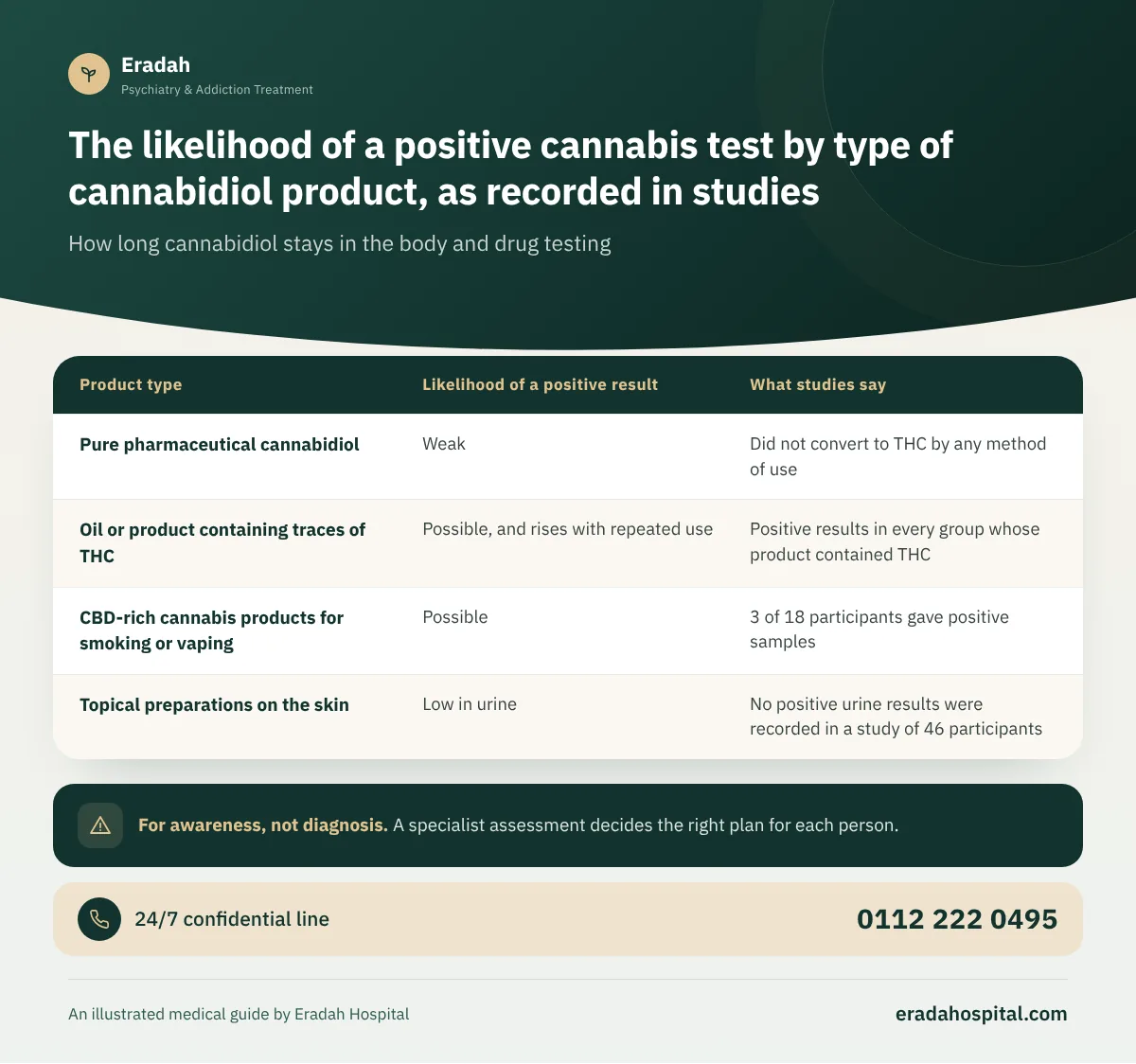
| Product type | Likelihood of a positive result | What studies say |
|---|---|---|
| Pure pharmaceutical cannabidiol | Weak | Did not convert to THC by any method of use |
| Oil or product containing traces of THC | Possible, and rises with repeated use | Positive results in every group whose product contained THC |
| CBD-rich cannabis products for smoking or vaping | Possible | 3 of 18 participants gave positive samples |
| Topical preparations on the skin | Low in urine | No positive urine results were recorded in a study of 46 participants |
The basic problem remains label accuracy; in a 2017 JAMA study only about 31% of 84 products had accurate labels, and THC appeared in 18 of them. So the phrase “THC-free” is not a guarantee unless the product is a licensed medicine of known composition.
Do topical creams and patches show up on a test?
In a study published in 2024, 46 adults used five commercial cannabidiol-rich topical products, such as cream, lotion, and a patch, for more than a week. No cannabis-positive urine sample was recorded under US federal workplace testing criteria. But the researchers unexpectedly detected concentrations of THC in saliva in 9 participants, which means the type of sample changes the picture.
What factors determine the test result?
- The product's THC content: the most important factor, and it may not be accurately stated on the container.
- Regularity of use: daily use accumulates more THC metabolites than a single use.
- Method of use: by mouth, vaping, or on the skin.
- Sample type and detection threshold: urine, saliva, or blood, and the sensitivity of each laboratory's test.
- Individual differences: liver function, other medications, and body fat stores.
What should you do if your test is positive and you use CBD?
- Tell the doctor or laboratory before the test about everything you use, including cannabidiol products.
- Keep the container, the product name, and the batch number if there is one.
- Ask for a laboratory confirmatory test of the preliminary result, as the guide to drug testing explains.
- Remember that the confirmatory test confirms the presence of a THC metabolite but does not identify its source, so if the product contains THC the result will remain positive.
- If you take Epidiolex by prescription, keep the prescription and inform the requesting party.
Why do we not offer tips for getting around the test?
Because the aim of this page is for you to understand your result, not to hide it. Attempts to “flush” the body with drinks or diuretics do not change how substances are broken down, and excess fluids can cause a dangerous salt imbalance. And if “CBD oil” is a cover for hashish use, or has become a daily habit that is hard to leave, the helpful step is a confidential assessment with a specialist.