What is cannabidiol?
“It’s a natural oil for anxiety and sleep, not hashish.” This is how cannabidiol is marketed online. Some of it is true and some is misleading, and the difference may matter for your health and for your test result.
The cannabis plant contains hundreds of compounds, the two best known being THC, which is responsible for the high in hashish and bango, and cannabidiol, known as CBD for short. The US Food and Drug Administration explains that THC is what produces the “high” associated with marijuana, while cannabidiol is a different compound, now sold in oils, drops, capsules, candy and cosmetics, many of them without pharmaceutical oversight.
That is why cannabidiol sits within the cannabis family on our site: not because it is an addictive substance, but because the most common questions about it are: Is it a drug? Does it show up in a test? And how is it related to hashish?
What is the difference between cannabidiol and THC?
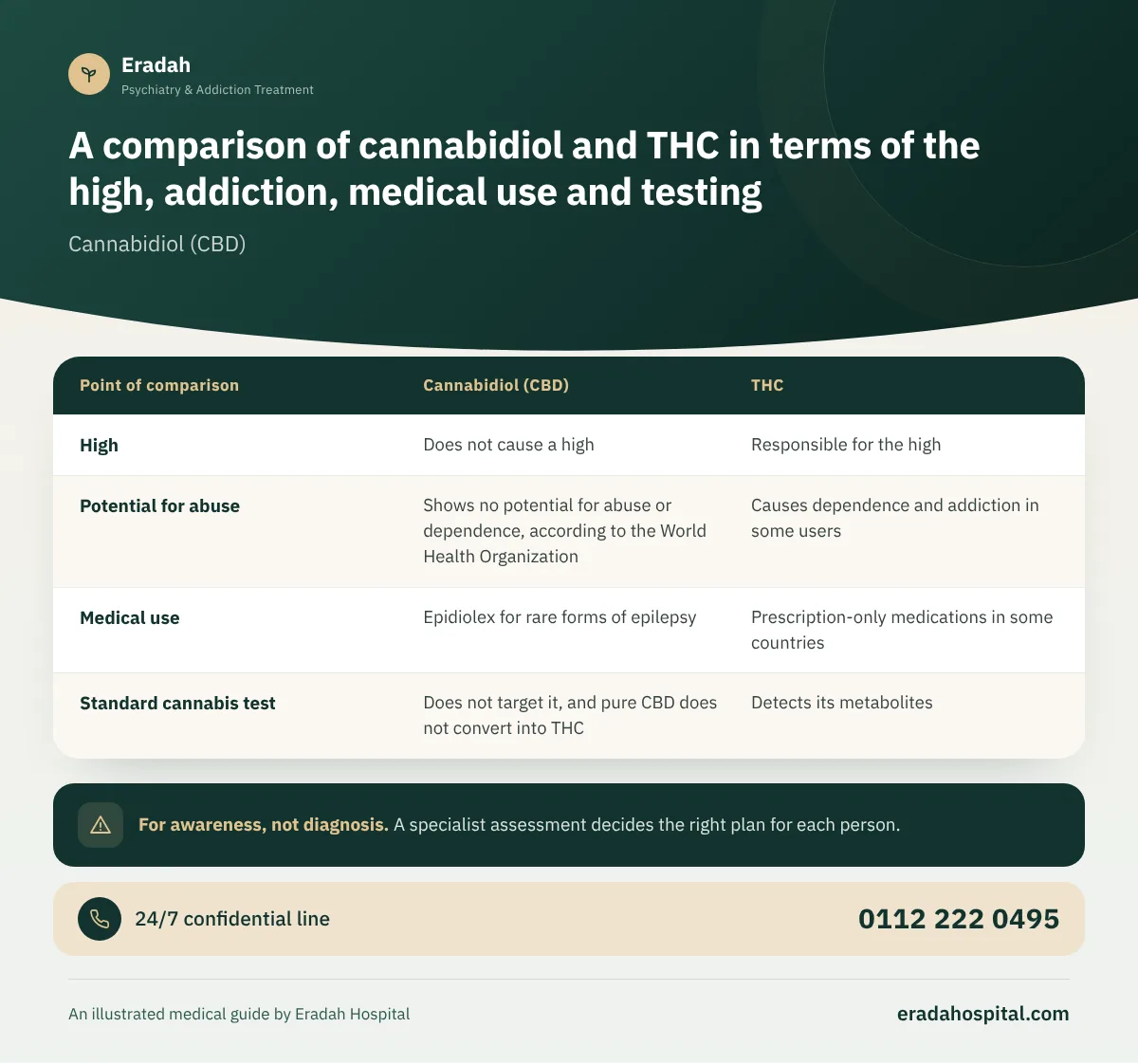
| Point of comparison | Cannabidiol (CBD) | THC |
|---|---|---|
| High | Does not cause a high | Responsible for the high |
| Potential for abuse | Shows no potential for abuse or dependence, according to the World Health Organization | Causes dependence and addiction in some users |
| Medical use | Epidiolex for rare forms of epilepsy | Prescription-only medications in some countries |
| Standard cannabis test | Does not target it, and pure CBD does not convert into THC | Detects its metabolites |
How does cannabidiol affect the brain and body?
How cannabidiol works is still not precisely known. The official prescribing information for Epidiolex states that the mechanism by which it prevents seizures in humans is unknown, and that it does not appear to work through cannabinoid receptors the way THC does. This explains why it does not cause a feeling of a high or altered perception.
But the absence of a high does not mean the absence of an effect. Cannabidiol is metabolized in the liver by enzymes that act on many other medications, so its most important harms come from the liver, from drug interactions and from drowsiness, not from addiction.
What are the approved medical uses of cannabidiol?
The only use approved so far by the US Food and Drug Administration is the medication Epidiolex, a pure cannabidiol oral solution approved in 2018 to treat seizures associated with Lennox-Gastaut syndrome and Dravet syndrome. Its current label also includes tuberous sclerosis complex, for people aged one year and older. It is given by prescription with follow-up, as its label calls for liver function tests before starting and during treatment.
Is cannabidiol a drug of abuse or addictive?
Pharmacologically, no. The World Health Organization’s Expert Committee on Drug Dependence reviewed it in 2018 and found that it has no intoxicating psychoactive properties and no potential for abuse or dependence, and recommended that pure preparations of it not be placed under international control.
This is supported by studies in the Epidiolex label: in a study of recreational drug users, ratings of “drug liking” for cannabidiol fell within the placebo range, unlike synthetic THC and alprazolam. In another study, adults took cannabidiol for 28 days and then stopped, and showed no withdrawal symptoms during 6 weeks of follow-up. But all of this concerns pure cannabidiol, not any product sold under its name.
Why is the problem the product, not the compound?
A study published in JAMA in 2017 analyzed about 84 cannabidiol products sold online and found that only 26 of them, about 31%, were accurately labeled, and that THC appeared in 18 products. In the US state of Utah, a 2018 report from the Centers for Disease Control and Prevention documented dozens of poisoning cases linked to products sold as CBD oil, which on analysis were found to contain synthetic cannabinoids and no cannabidiol at all.
The legal status of cannabidiol in Egypt
Internationally, the World Health Organization recommended that pure cannabidiol not be controlled, but regulation of its products varies widely from country to country. We are not aware of a published Egyptian text that specifically addresses commercial cannabidiol products, while cannabis and THC fall under Narcotics Law No. 182 of 1960 and its schedules. Because a product may contain THC without it being stated on the package, do not rely on the word “legal” written on it.
This is general educational information and not legal advice.
Cannabidiol in numbers
Sources: the Bonn-Miller et al. study in JAMA 2017, the official prescribing information for Epidiolex, and the US Centers for Disease Control and Prevention MMWR report, 2018.
Cannabidiol harms and testing in brief
Harms: the most notable are drowsiness, digestive upset, raised liver enzymes and interaction with medications such as epilepsy drugs and sedatives, along with the risk of contaminated products. Details are in the guide to cannabidiol harms.
Testing: cannabis tests look for THC metabolites, not cannabidiol, and pure CBD does not convert into THC in the body, but products containing small amounts of THC may give a positive result. Read about how long cannabidiol stays in the body and testing.
Cannabidiol guide: everything you need to know
We have gathered everything about cannabidiol into 2 pages, each answering one question in detail. Choose what you are looking for:
Harms of cannabidiol (CBD) to the body
What are the harms of cannabidiol (CBD oil)? Drowsiness and digestive upset, raised liver enzymes, its interaction with epilepsy drugs and sedatives, and the risk of products contaminated with THC or synthetic cannabinoids.
How long cannabidiol stays in the body and drug testing
Does cannabidiol (CBD) show up in a drug test? How long it stays in the body, why pure CBD does not convert into THC, and when its products give a positive hashish test.
When do you need medical advice?
- Before using any cannabidiol product if you have liver disease or take regular medications, especially epilepsy drugs or sedatives.
- If you are pregnant or breastfeeding, because its safety during these periods has not been established.
- If “CBD oil” is the start of using hashish or THC products, or has become a daily way of silencing undiagnosed anxiety or insomnia.
- If signs of poisoning appear after a product of unknown origin, call the ambulance (123).
Reliance on these products may be driven by depression or an anxiety disorder that needs real treatment, and outpatient treatment at Eradah offers a confidential assessment for such cases.
Danger signs after using cannabidiol products: call the ambulance (123) immediately
- Seizures or involuntary tremor after using an oil or vaping liquid of unknown origin
- Severe confusion, agitation, hallucinations or loss of consciousness
- Deep drowsiness and difficulty waking, especially with alcohol or sedatives
- Repeated vomiting that does not stop, with dizziness
- Swelling of the face or lips, or difficulty breathing or swallowing after use
Call ambulance (123) immediately. If the person is unconscious but breathing, place them on their side so they do not choke on vomit. Stay with them and do not leave them alone. Do not give them food or drink, and tell the paramedics everything they took or used, and the amount and time if you know them.
Call the ambulance 123