How does cocaine change inside the body?
Cocaine is broken down quickly by enzymes in the blood and liver, which is why most of it disappears from the blood within hours. Tests usually do not look for cocaine itself but for its metabolites, which last longer:
The main metabolite most urine tests look for; it stays in the body much longer than cocaine itself.
Another major metabolite formed by enzymes, which some confirmatory tests may look for.
Forms only when cocaine and alcohol are present together, and its presence indicates that both were used.
How long cocaine stays, by type of test
Urine
Blood
Saliva
Hair
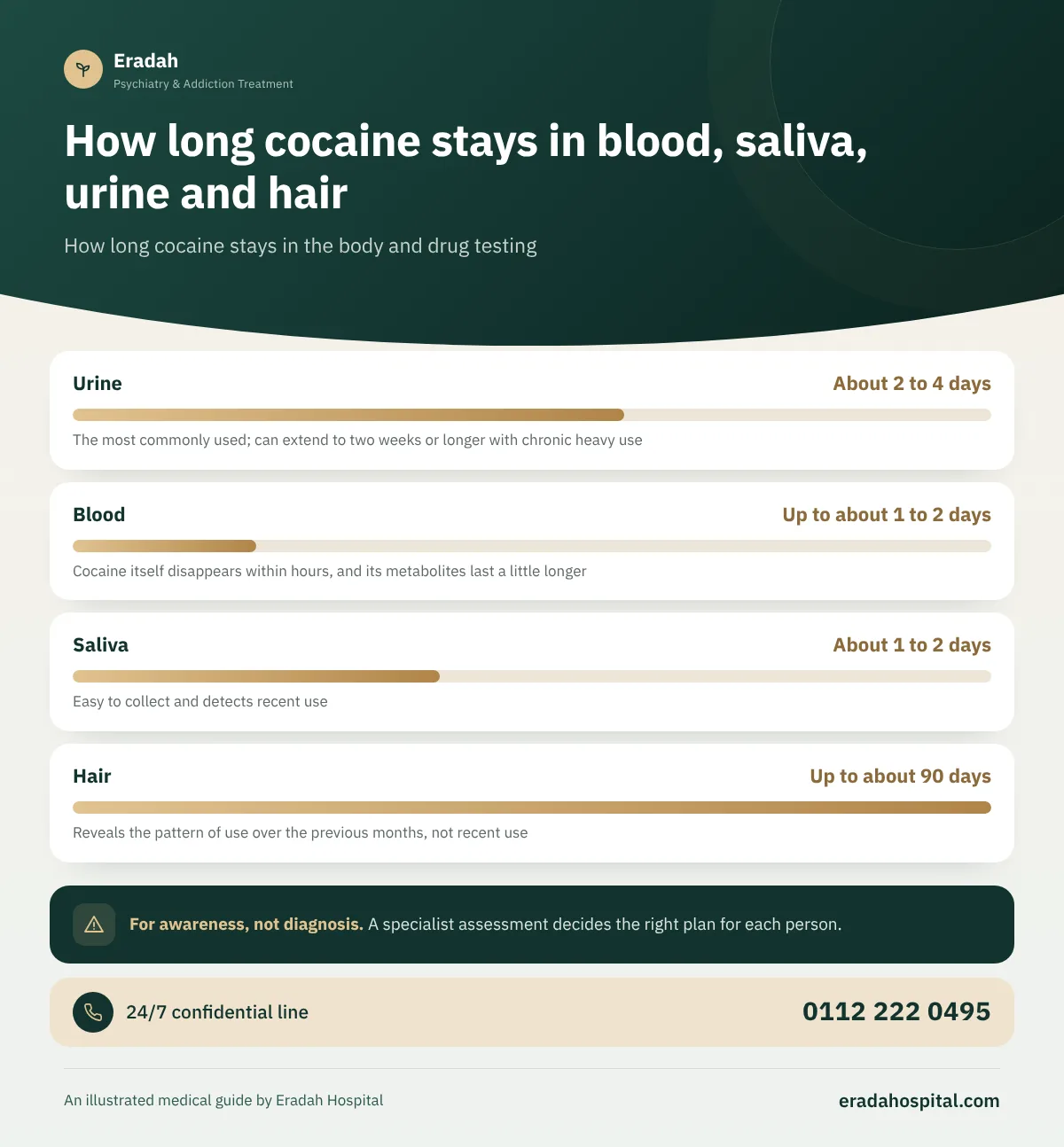
These durations are approximate and vary by laboratory and test sensitivity. For an accurate interpretation of a specific result, consult the doctor or the laboratory.
Factors that affect how long cocaine stays
- Frequency and length of use: daily or chronic use lengthens the detection time considerably compared with a single occasion.
- Amount and purity: larger amounts take longer for the body to clear their metabolites.
- Alcohol: combining alcohol with cocaine forms cocaethylene, which stays in the body longer.
- Liver and kidney function: weakness in either slows the clearing of metabolites.
- Age, metabolism and general health.
- Type of test and cutoff: each laboratory has a minimum concentration above which a result is considered positive.
What is the difference between a screening test and a confirmatory test?
| Testing | How it works | When it is used |
|---|---|---|
| Screening test (strip or immunoassay) | Quickly detects the presence of cocaine metabolites above a set level | First-line screening in clinics, emergency departments and workplaces |
| Confirmatory test (chromatography with mass spectrometry) | Identifies the substance and its metabolites with high accuracy | Confirms any positive or disputed result before any important decision |
The rule is that a positive result on a screening test is not final, but is sent for confirmation at a specialized laboratory, especially if a medical, employment or legal decision depends on it.
Can a result be positive without using cocaine?
Cocaine tests are among the more accurate screening tests, with relatively little interference from common medications compared with others. But there are situations in which cocaine metabolites may appear without use in the usual sense:
- Medical use of a cocaine solution as a local anesthetic in some ear, nose and throat procedures.
- Drinking coca leaf tea, which is common in some South American countries.
- Rare errors in sample collection or handling in the laboratory.
When are cocaine tests requested?
- In the emergency department for chest pain, seizures, agitation or unexplained high temperature in a young person, because knowing the cause changes the treatment.
- At the start of an addiction treatment program, during it to track progress, and in incentive programs that reward negative tests.
- In some job, licensing, or legal procedures.
Does a test result show how much was used or when?
Not precisely. A screening test usually answers “yes” or “no” depending on whether metabolites exceed a certain level, and a confirmatory test measures the concentration, but concentration is affected by many factors such as the amount of fluid in the body, the time the sample was taken and how often the person uses. So a single result cannot tell you the exact amount or day, and the doctor relies on the medical history and repeated tests to build a more accurate picture.
Can a baby’s exposure to cocaine be detected?
Yes, tests may be done on a newborn when exposure to cocaine during pregnancy is suspected, such as testing the baby’s urine, first stool or the umbilical cord, and these samples can reveal exposure over a longer part of the pregnancy. The purpose is purely medical: to monitor the child and provide appropriate care for the baby and mother, not to condemn. The best thing a mother can do is to tell her doctor honestly from the start so a safe plan can be made.
Your son’s test came back positive? What should you do?
- Do not act in the heat of anger, and ask for a confirmatory test if one has not been done.
- Talk to him calmly about the result and your worry, and listen to his account without interrupting.
- Remember that a single result cannot tell whether it was experimentation or addiction; that is decided by a specialist assessment.
- Book a confidential medical and psychological assessment, since early intervention changes the course a great deal.
- Watch for emergency signs such as chest pain and seizures, and keep the ambulance number (123) handy.
Why are tests used during treatment?
In treatment programs, tests are not used to punish but to help the patient and the team see the picture clearly. A negative test is an achievement to build on, and in incentive programs it is tied to tangible rewards, while a positive test is a signal to adjust the plan, not a reason for expulsion or blame. This approach is among the most effective proven for treating stimulant addiction.