Why does cocaine cause such strong addiction?
Cocaine has pharmacological properties that make it one of the most powerful substances in producing psychological dependence:
It reaches the brain within seconds to minutes, and substances that arrive faster are higher in addictive potential; crack is the fastest.
It blocks dopamine reuptake so it stays elevated in a way natural pleasures do not produce, and the brain learns to seek it.
The effect fades within minutes to under an hour, so the sudden crash pushes repeated use within a single session.
With repetition, the enjoyment of ordinary things weakens and stress without the substance increases, so use becomes an escape rather than a search for a high.
At first the person uses to feel better than usual, and in the end uses just to feel normal.
Why do cravings return when you see certain places or people?
The brain links the dopamine surge to everything surrounding it: the place, friends, music, money in the pocket, even certain days of the week. Over time these “triggers” alone are enough to set off a strong craving, even after weeks of stopping. This conditioned learning is one of the most important causes of relapse in cocaine addiction in particular, which is why behavioral therapy focuses on identifying triggers and dismantling them.
Does genetics play a role in cocaine addiction?
Studies indicate that genes explain an important part of a person's susceptibility to addiction in general, and to stimulant addiction in particular. That is why the risk is higher in people with a parent or sibling who has an addiction. What is meant is a group of factors that influence how the brain responds to the substance and its ability to control impulses, and they always interact with the environment; there is no “addiction gene” in the common sense.
Mental health conditions and dual diagnosis
Some people turn to cocaine to numb psychological pain that was never diagnosed or treated, and the temporary fix becomes a bigger problem. Among the disorders most linked to stimulant addiction:
| Disorder | How it relates to use |
|---|---|
| Depression | The person looks for a high that breaks the sense of emptiness, and then the crash after the effect deepens the depression itself. |
| ADHD (attention-deficit/hyperactivity disorder) | The person may feel the stimulant “organizes” their thinking, so they treat themselves with a dangerous substance instead of proper treatment. |
| Bipolar disorder | Impulsiveness during manic episodes, and trying to escape during depressive episodes. |
| Social anxiety | Looking for artificial confidence in social situations and parties. |
| Post-traumatic stress disorder (PTSD) | Trying to escape painful memories and emotional numbness. |
Treating these disorders is an essential part of addiction treatment, and you will find the details on the page about dual diagnosis.
Trauma and difficult childhood experiences
Harsh childhood experiences, such as neglect, domestic violence, losing a parent, or living with someone who has an addiction, are linked to a clear rise in the risk of addiction later. These experiences affect the development of the brain's stress systems and make a person more likely to look for a quick way to calm their feelings. Specialized trauma-focused psychotherapy greatly improves the chances of recovery.
Environment, peers, and work stress
Cocaine has a particular social image that makes the environment a strong factor in its start and continuation:
- Nightlife and party settings: cocaine is often linked to alcohol and staying up late, and the first try is often an offer from a friend at a party.
- The myth of performance and success: some people working under pressure think the stimulant helps them work longer hours, so it starts “out of necessity” and turns into addiction.
- Having money: higher income or easy money may raise availability, while addiction later drives people into debt.
- Peers: having friends who use normalizes it and makes refusing harder, especially for teenagers.
- Lack of supervision and support: weak family communication or isolation leaves a person without a safety net.
How does use develop into addiction?
- Stage 1Experimentation
Out of curiosity, peer pressure, or a wish for confidence and energy, usually at a social occasion.
- Stage 2Occasional use
Tied to particular days or particular people, and the person thinks they are “under control.”
- Stage 3Regular use
Use becomes more frequent, binges begin, and the crash, insomnia, and excess spending appear.
- Stage 4Dependence and addiction
A strong craving that is hard to resist, continued use despite health, financial, and family losses, and failed attempts to stop alone.
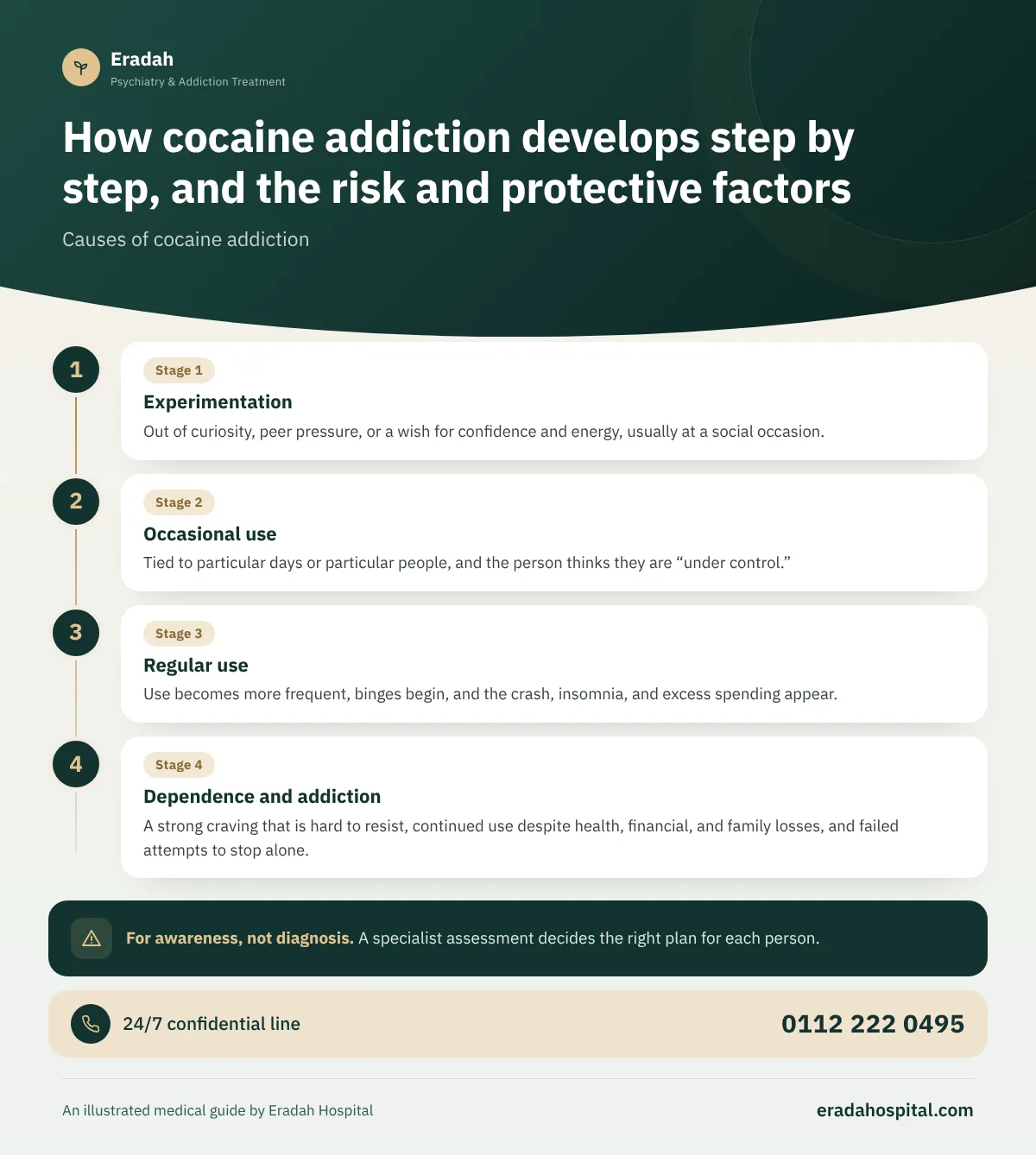
Not everyone who tries it goes through all of these stages, but no one knows in advance whether they will stop at the first or reach the last.
Risk factors and protective factors
| Risk factors | Protective factors |
|---|---|
| Family history of addiction | A warm family relationship and open communication |
| Untreated mental disorder | Early diagnosis and treatment of mental disorders |
| Starting use at an early age | Delaying any experimentation with substances until after adolescence |
| A nightlife, alcohol, and substance-using peer environment | Supportive friends and healthy sports and social activities |
| Chronic work stress with no healthy ways of coping | Stress-management skills and regular sleep |
| Childhood trauma | Specialized psychotherapy and social support |
Who is most at risk of cocaine addiction?
There is no “single profile” of who becomes addicted to cocaine, but the risk rises in particular groups: young people in their early twenties, people who work in long-hour or high-pressure environments, those with an untreated mental disorder, those who drink a lot of alcohol, and those with a family history of addiction. Knowing this helps families and workplaces notice early and offer support before the problem deepens.
Common myths about the causes of cocaine addiction
- “Cocaine isn't addictive because its effect is short”: the opposite is true; the short effect is one of the reasons for repeated use and addiction.
- “An addict is a person with weak willpower”: addiction is a change in brain circuits, and willpower alone is often not enough without treatment.
- “I only use at parties so I'm safe”: many cases of addiction began with occasional use, and the risk of a heart attack is there every time.
- “It helps me work and focus”: the improvement is temporary, followed by exhaustion, distraction, and declining performance.