When does a person need treatment for ecstasy addiction?
Things do not have to reach a breakdown before you ask for help. A specialist assessment is worthwhile if use keeps recurring despite attempts to stop, if enjoying things or connecting with people has become hard without the drug, if clear depression and anxiety appear, if mixing with other substances has begun, or if studies or work have declined. Early intervention is easier, shorter and more successful.
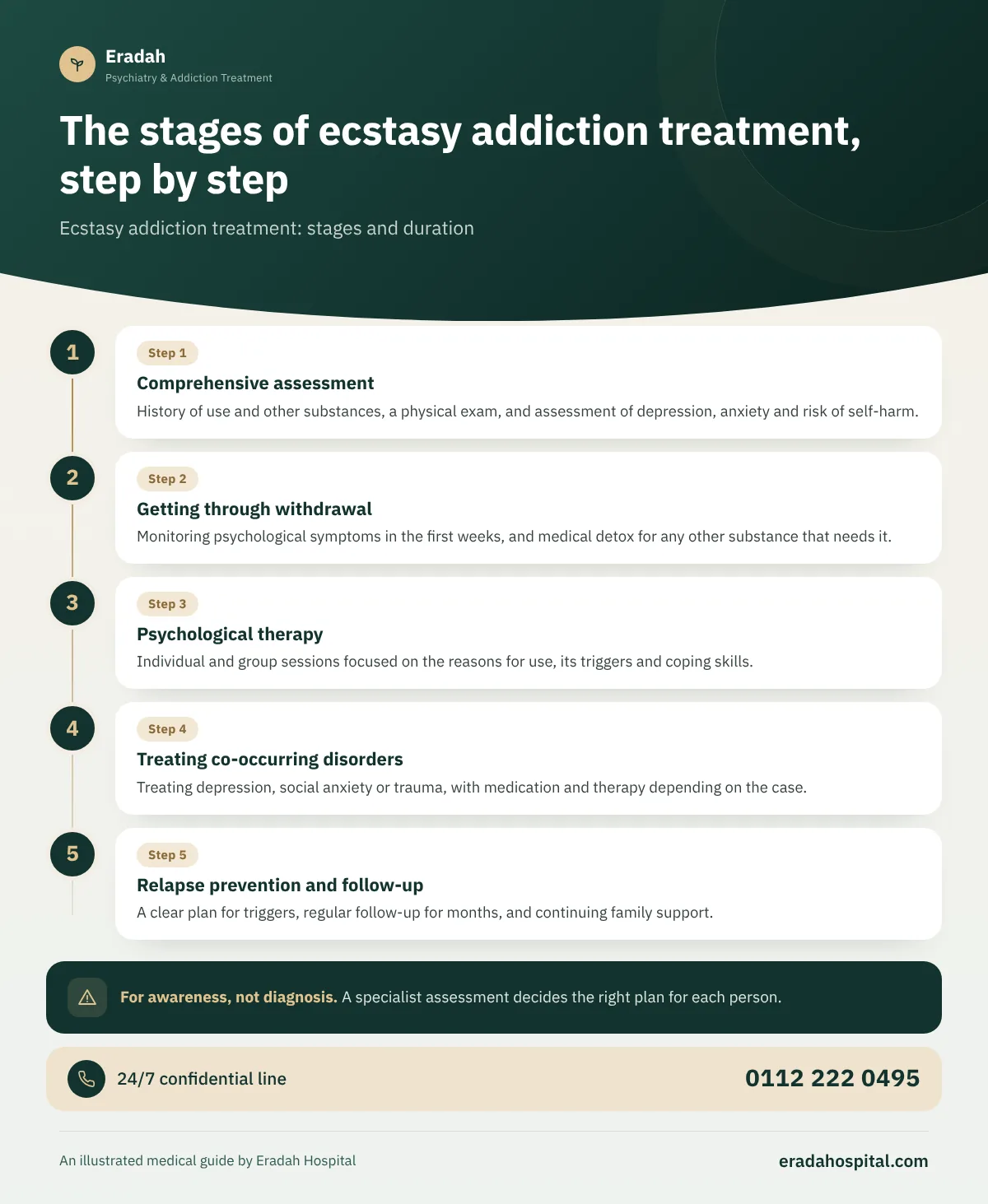
Stages of ecstasy addiction treatment
- Step 1Comprehensive assessment
History of use and other substances, a physical exam, and assessment of depression, anxiety and risk of self-harm.
- Step 2Getting through withdrawal
Monitoring psychological symptoms in the first weeks, and medical detox for any other substance that needs it.
- Step 3Psychological therapy
Individual and group sessions focused on the reasons for use, its triggers and coping skills.
- Step 4Treating co-occurring disorders
Treating depression, social anxiety or trauma, with medication and therapy depending on the case.
- Step 5Relapse prevention and follow-up
A clear plan for triggers, regular follow-up for months, and continuing family support.
Managing the withdrawal stage
Ecstasy withdrawal is mostly psychological, showing up as depression, exhaustion, anxiety and cravings. In this stage the treatment team focuses on monitoring mood and the risk of self-harm, regulating sleep and nutrition, and making sure there is no dependence on other substances, such as alcohol or sedatives, that may need special medical withdrawal. The full details are on the page about ecstasy withdrawal symptoms.
Psychological therapies used
Helps the person understand the thoughts and situations that lead to use and learn practical alternatives for dealing with them; it is among the best-supported treatments.
Strengthens the person's own motivation to change, especially in young people who do not see that they have a problem.
Sharing experiences with others on the same journey breaks isolation and strengthens commitment.
Improves communication within the family and teaches it how to support without controlling or enabling.
Are there medications for treating ecstasy addiction?
There is, so far, no medication approved specifically for treating ecstasy addiction, unlike opioid addiction, for example. But a psychiatrist may prescribe medication for the accompanying depression, anxiety or insomnia after a careful assessment.
Dual diagnosis treatment
A large share of people who have problems with ecstasy have underlying social anxiety, depression or trauma, and the use is an attempt at self-medication. If the addiction is treated alone without the psychiatric disorder, the main reason for going back remains. That is why a good program treats both conditions together in one plan. Read more about dual diagnosis.
Outpatient or residential treatment?
| Residential treatment | Outpatient treatment | |
|---|---|---|
| Suitable for | Severe depression or risk of self-harm, use of multiple substances, or failed earlier attempts | Stable cases, and occasion-linked use |
| Supervision | around the clock | Regular sessions and appointments |
| Distance from triggers | Full coverage throughout the stay | Needs strong commitment and family support |
| Daily life | A temporary break from study or work | Can continue |
How long does ecstasy addiction treatment take?
There is no single duration that suits everyone. The first weeks are usually devoted to getting through withdrawal and starting psychological therapy, then the treatment program continues for months, followed by regular follow-up that may run for a year or more. Research generally indicates that staying in treatment for long enough is among the most important factors in success.
How do we prevent relapse?
- Identifying personal triggers: particular parties, friends, or feelings such as loneliness and boredom.
- Building real alternatives for leisure and connection without substances.
- A written plan for what to do when a craving comes, and whom to call.
- Ongoing treatment of anxiety and depression, since they are among the strongest drivers of return to use.
- Regular follow-up even after improvement; a relapse is a stage that can be overcome, not a final failure.
Treatment for young adults and teenagers
Ecstasy use often begins at a young age, so treating young people needs a special approach: sessions that respect their independence and do not treat them as accused, a focus on goals that matter to them such as study, sport and relationships, and family involvement in a way that does not turn treatment into surveillance. Attention is also given to developing skills for refusing offers at parties and among friends, and building new social circles.
Life after treatment
Recovery means moving away from the drug and building a life in which the person does not need it. That includes regaining enjoyment of simple things, learning to connect with others without a chemical go-between, treating social anxiety at its root, and finding new sources of pleasure and belonging. This is a journey that takes time, but it is possible and worth it.
How do you choose a center for ecstasy addiction treatment?
- Officially licensed, with psychiatrists who specialize in addiction.
- Assesses mental health and treats dual diagnosis.
- Offers cognitive behavioral therapy and a family program.
- Respects confidentiality and dignity, and explains the plan and duration clearly.
- Does not promise a miracle cure in a few days.
Myths about ecstasy addiction treatment
| The myth | The truth |
|---|---|
| "It's enough for him to stop going to parties" | Staying away from triggers is important, but without treating the psychological causes the risk of going back remains. |
| "He doesn't need treatment because it isn't heroin" | Psychological dependence and the accompanying depression need specialist treatment like any other addiction. |
| "A relapse means treatment failed" | Relapse is common in chronic conditions, and it means the plan needs adjusting, not that hope is over. |
Choosing a hospital for ecstasy addiction treatment
Ecstasy mostly does not leave a violent physical withdrawal, but what follows is heavier than parents expect: a low mood, anxiety and disturbed sleep that can last for weeks, in a young person who uses at parties and often mixes pills with alcohol or hashish. So the right place is the one that takes mood, age and mixing seriously before anything else.
| What the young person faces | What the facility should provide |
|---|---|
| Sadness and low energy after stopping | Measuring depression and thoughts of self-harm and following them week by week |
| Other substances alongside the pills | Detailed questions about everything used, not ecstasy alone |
| Peer and party pressure | Cognitive behavioral therapy that trains refusal and building a new circle of friends |
| Sensitivity to being monitored | An approach that preserves the young person's trust and does not turn the family into an inspector |
| Expecting a magic medication | Being honest that medication only treats the accompanying anxiety and depression |
Eradah receives teenagers for assessment, treatment and follow-up with their families, where psychological specialists run individual and group sessions, while the doctor sets the medication plan when there is depression or anxiety. Adult patients who need distance from the late-night circle can stay in rooms set in a garden, with a gym and a swimming pool. To know what awaits after stopping, read about ecstasy withdrawal.
Ecstasy addiction treatment at Eradah
At Eradah we begin with a confidential, comprehensive medical and psychological assessment, then set a plan to suit each person: outpatient or residential treatment depending on the case, with cognitive behavioral therapy, treatment for co-occurring depression and anxiety, a dedicated family program, and regular follow-up after the program ends. We work toward a life in which the person can enjoy themselves and connect with others without substances, and stopping is the first step toward it.