How does the body eliminate ecstasy?
Ecstasy is absorbed from the digestive tract and reaches its highest blood concentration in about two hours. The liver then processes it into byproducts, including the active compound MDA, which can prolong its effect, and the drug and its byproducts leave mainly in the urine.
Source: StatPearls, MDMA toxicity. Figures are approximate and vary from person to person.
How long does ecstasy stay in urine, blood, saliva and hair?
Urine
Blood
Saliva
Hair
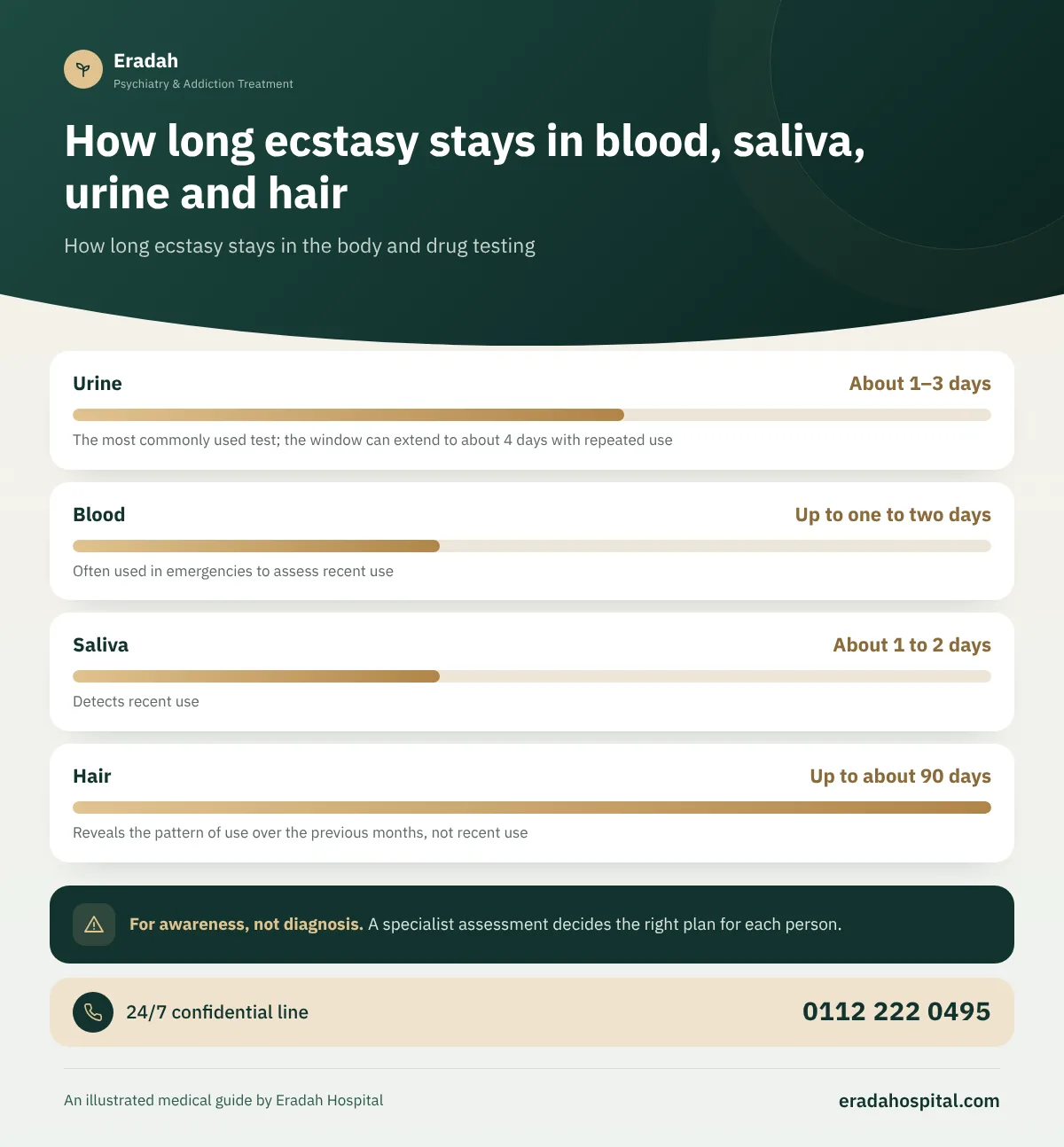
Durations are approximate and vary with the laboratory and test sensitivity. To interpret a specific result, consult the doctor or the laboratory.
Factors that affect how long ecstasy stays
- Frequency and length of use: repeated use lengthens the detection time compared with a single use.
- Amount and pill content: pills are of unknown composition and may contain other substances that are detected over different periods.
- Liver and kidney function: weakness in either slows elimination of the drug.
- Genetic differences: people differ in the activity of the liver enzymes that break down MDMA.
- Age and general health: the speed of elimination varies from person to person.
Screening test and confirmatory test
Quick, and often relies on detecting the amphetamine group; it may not always pick up MDMA or may give a false positive.
Done in a specialized laboratory with precise instruments; it identifies MDMA and its byproducts specifically, and is requested after any positive screening result.
A confirmatory test alone cannot determine precisely when the use took place, so it is always read together with the medical history and circumstances.
How long ecstasy stays compared with other substances
| Substance | In urine, approximately | Note |
|---|---|---|
| Ecstasy | 1-3 days | May extend a little with repeated use |
| Shabu and amphetamines | Roughly 1-4 days | Varies with frequency of use and the substance |
| Hashish | Days to weeks | Becomes much longer with chronic use |
| Heroin | 1-3 days | Usually detected through its byproducts |
Durations are approximate and vary with the laboratory and test sensitivity.
Can the result be a false positive?
Yes, in the screening test. Medical references indicate that some medications, such as nasal decongestants containing pseudoephedrine and some antidepressants such as bupropion, can interfere with initial amphetamine screening tests. This is why the laboratory must be told about all the medications the person takes, and a positive result is accepted only after the confirmatory test.
Why might the test show substances other than ecstasy?
Because ecstasy pills often contain other substances such as methamphetamine, cathinones and ketamine, the test may show a substance the person did not expect, or may not show MDMA at all. That result is itself an important message: someone who uses pills does not really know what is entering their body.
When is an ecstasy test requested?
- In the emergency room when there is overheating, seizures or confusion, to find the cause and set the right treatment.
- At the start of a treatment program, then periodically to monitor abstinence and support commitment.
- In some occupational or legal examinations according to the rules in force.
Which sample does the doctor request, and why?
| Sample | When it is mostly used | What it shows |
|---|---|---|
| Urine | Periodic follow-up and treatment programs | Detecting use in the preceding few days |
| Blood | Emergencies and critical cases | Assessing very recent use and the level of the drug at the time of examination |
| Saliva | Quick testing in some settings | Easily detecting recent use |
| Hair | Assessing the long-term pattern of use | Finding out how often use occurred over the preceding months |
The doctor chooses the sample type and test according to the goal: whether it is to rescue an emergency case, follow up treatment, or assess a long-term pattern. That is why there is no single "best" test in every case.
Does a negative result mean the person did not use?
Not necessarily. The use may have happened before the detection window ended, the screening test may not be sensitive enough to pick up MDMA, or the pill itself may have contained no MDMA but another substance that the test does not cover. That is why the result is considered together with the signs and the history, and is not on its own conclusive proof in either direction.
Why don't we give tips for getting around the test?
At Eradah we do not provide any information on hiding use or cheating tests, because this protects no one; it delays treatment and exposes the person to greater risks. Many of the popular recipes for this purpose are also dangerous in themselves, such as drinking too much water, which can cause dangerous sodium deficiency. The better path is always an honest conversation and asking for help.
What does a test result mean for the family?
A positive result does not condemn the person; it is information that opens the door to treatment. And a negative result does not rule out a problem if the signs are clear, because the detection window in urine is short. What matters most is a calm conversation and a specialized assessment that looks at the whole picture.
Testing in the emergency room: its aim is treatment, not blame
In emergency departments, testing is not done to judge the patient but to understand the cause of the condition and direct treatment quickly; treating overheating differs from treating low sodium, serotonin syndrome or poisoning from a counterfeit substance. That is why telling the doctors honestly what the person took, when, and with what other substances can save their life. And do not wait for a test result before calling an ambulance if danger signs appear.