Why does ecstasy attract people who try it?
Ecstasy differs from many drugs in that its main appeal is emotional and social: it gives a feeling of warmth, acceptance and openness toward others, feelings that many young people lack in their daily lives.
- Euphoria with a feeling of closeness: the drug becomes associated with moments the person sees as some of the best experiences of their life, so they want to repeat them.
- The comedown that drives repeat use: the sadness and exhaustion after the effect wears off may push some people to look for the drug again to escape them.
- Tolerance: with repeated use the effect weakens, so the person tends to take more, take it more often, or add other substances.
- The effect on dopamine: the drug helps activate the reward circuit, the circuit that learns from repetition and builds cravings.
Do social anxiety and depression drive ecstasy use?
Yes, this is one of the most important causes. A person with extreme shyness or social anxiety may find in ecstasy a temporary "solution" that lets them connect and open up, and a person with depression may look to it for moments of happiness that have been missing.
The problem is that the drug itself increases depression and anxiety once its effect wears off, creating a vicious circle: anxiety or sadness, then use, then a deeper comedown, then the urge to use again. That is why any treatment plan must also treat the co-occurring psychiatric disorder, which is known as dual diagnosis.
Trauma and painful experiences
People who went through psychological trauma, abuse or loss in childhood or adolescence are more likely to use substances in general. Ecstasy may attract them in particular because it temporarily eases fear and tension and gives a sense of safety. But this temporary relief does not treat the trauma; it postpones facing it and adds a new problem on top. Specialized trauma therapy is the real way forward.
Party culture and friends
Ecstasy is closely tied to nightclubs, festivals and music gatherings, and the environment plays a big part in both starting and continuing use:
The wish to belong to the group and not to seem different.
The widespread idea that it is a "light party drug" that does not cause addiction or harm.
Content that glamorizes the experience and hides its complications and tragedies.
The party itself becomes a trigger that brings on the urge to use.
Does genetics play a role in ecstasy addiction?
Research indicates that genetic factors explain a large share of vulnerability to addiction in general, so a person with a first-degree relative with addiction is more likely to develop it. People also differ genetically in how fast the liver breaks down MDMA, which may change how strong its effects and complications are. But genetics is a predisposition, not a destiny; a supportive environment and early treatment change the course a great deal.
Why does use often start in young adulthood?
The parts of the brain responsible for controlling impulses and judging consequences keep developing until roughly the mid-twenties, while the desire for new experiences, excitement and belonging is at its peak. This is why most ecstasy use begins in late adolescence and the early twenties, and the earlier use begins, the higher the risk of addiction later.
How do misconceptions contribute to addiction?
One of the most dangerous reasons ecstasy spreads is that many people do not consider it a "real drug". It comes as a colorful pill, is linked to music and fun, and news about psychotherapy research on it circulates widely. This image lowers people's guard and makes the first try easier, and later makes it harder to admit a problem, because the person tells themselves they are not using anything dangerous.
The truth is that a drug's danger is not measured by its appearance or the place it is used, but by its effect on the brain and body, and by the fact that what is in the pill is unknown every time.
Boredom and sensation seeking
Some personalities are naturally drawn to new experiences and excitement, and get bored quickly with routine. This trait is not a flaw in itself, but when it combines with idle time and a lack of goals and enjoyable activities, ecstasy becomes an easy way to break the boredom. Providing real alternatives for excitement, such as sports, safe adventures, the arts and volunteering, is among the most important protective factors for these personalities.
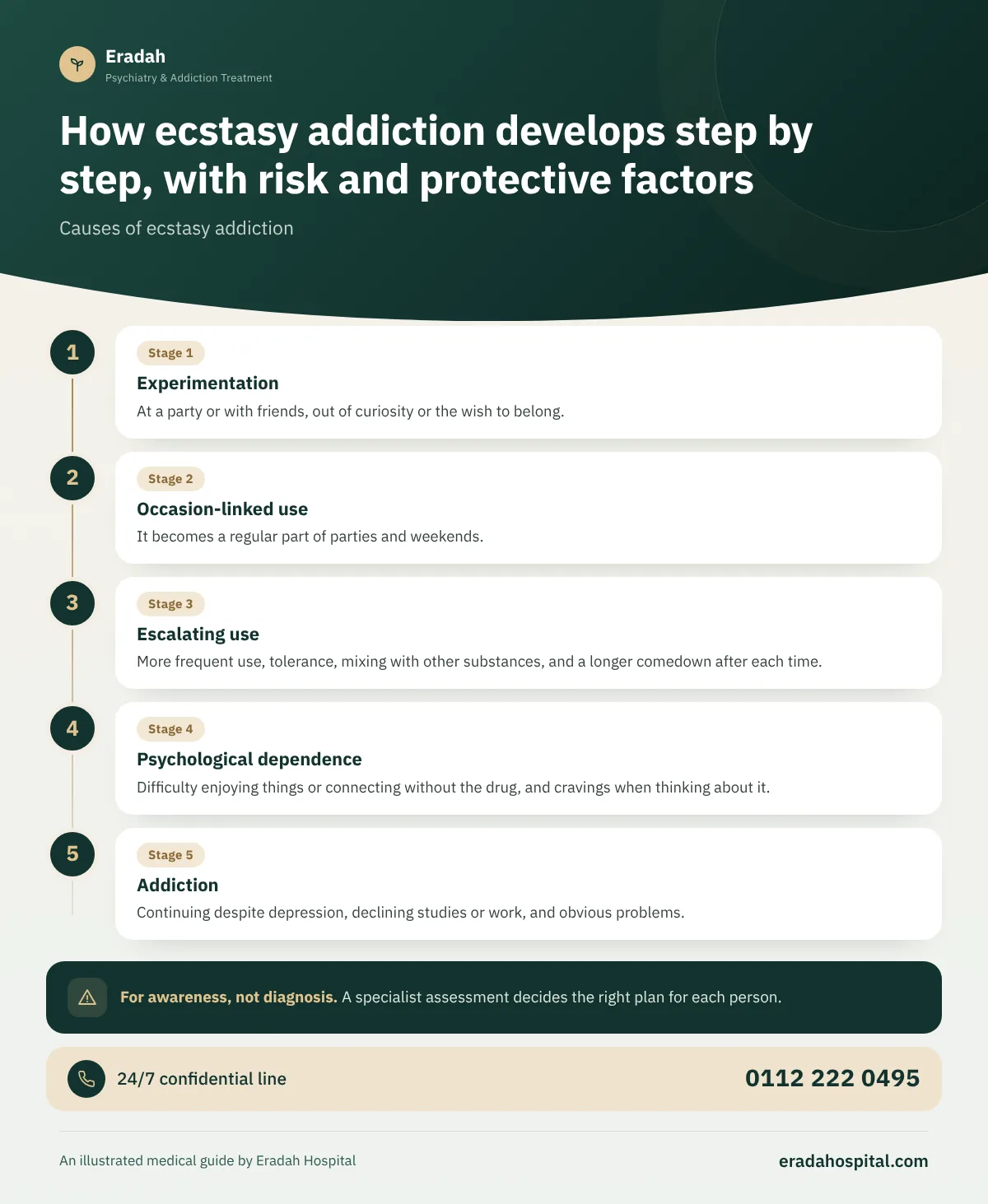
From experimenting to addiction: how does it develop?
- Stage 1Experimentation
At a party or with friends, out of curiosity or the wish to belong.
- Stage 2Occasion-linked use
It becomes a regular part of parties and weekends.
- Stage 3Escalating use
More frequent use, tolerance, mixing with other substances, and a longer comedown after each time.
- Stage 4Psychological dependence
Difficulty enjoying things or connecting without the drug, and cravings when thinking about it.
- Stage 5Addiction
Continuing despite depression, declining studies or work, and obvious problems.
Risk factors and protective factors
| Area | Risk factor | Protective factor |
|---|---|---|
| Mental health | Untreated social anxiety, depression or trauma | Early diagnosis and treatment, and skills for coping with emotions |
| Family | Lack of communication or supervision, or addiction in a family member | Open conversation, clear boundaries and emotional support |
| Friends | A group whose entertainment revolves around substances | Supportive friends and substance-free leisure activities |
| Knowledge | Believing the drug is safe or "natural" | Accurate information about its real risks |
What should the family do if they notice risk factors?
Having a risk factor does not mean addiction is coming, but it is a chance for prevention. If you notice in your son extreme shyness, persistent sadness, or a growing attraction to parties you know nothing about, start with conversation and attention, and do not hesitate to seek a psychological assessment for anxiety or depression. Treating the cause early saves a great deal of addiction treatment later, and protects the young person from finding his solutions in an unknown pill.
And remember that a young person who feels he can talk to you about his problems without fear of punishment or ridicule is protected by that relationship more than by strict monitoring.