What are the stages of fentanyl addiction treatment?
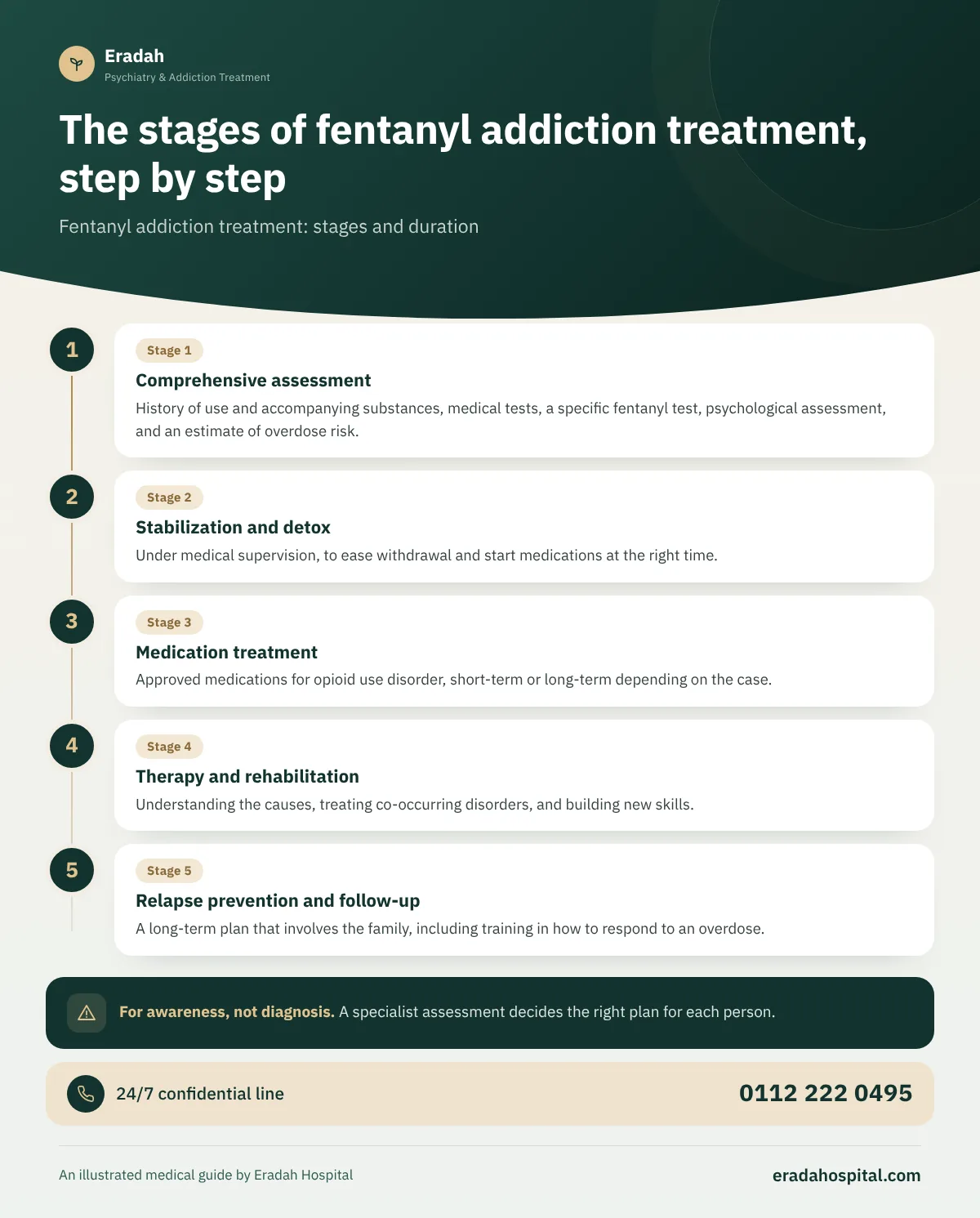
Fentanyl addiction is a serious condition that needs a structured plan, but it is not hopeless; many people have recovered from it and returned to their lives. Most plans pass through the following stages:
- Stage 1Comprehensive assessment
History of use and accompanying substances, medical tests, a specific fentanyl test, psychological assessment, and an estimate of overdose risk.
- Stage 2Stabilization and detox
Under medical supervision, to ease withdrawal and start medications at the right time.
- Stage 3Medication treatment
Approved medications for opioid use disorder, short-term or long-term depending on the case.
- Stage 4Therapy and rehabilitation
Understanding the causes, treating co-occurring disorders, and building new skills.
- Stage 5Relapse prevention and follow-up
A long-term plan that involves the family, including training in how to respond to an overdose.
Why does fentanyl treatment begin with a careful assessment?
Because a person with fentanyl addiction often has more than one problem: they may be using other substances, knowingly or not, and may have effects of past overdoses, infections related to injecting, or depression and anxiety. The assessment determines:
- The substances actually being used, through tests that include fentanyl and accompanying substances.
- Physical health: the heart, lungs, liver, kidneys and viral infections.
- Whether there are substances that need special withdrawal management, such as benzodiazepines or alcohol.
- Mental health and the risk of self-harm.
- The level of family and social support, and the most suitable place for treatment.
How is detox from fentanyl done?
Detox is done under medical supervision, and the doctor chooses the most suitable approach for each case. It may include starting an approved opioid treatment medication that eases withdrawal and continues afterward. Because fentanyl may stay in body tissues for longer, starting some medications requires special experience and precise timing to avoid sudden withdrawal. Accompanying symptoms such as nausea, diarrhea and insomnia are treated with appropriate medications.
You can find the details of this stage's symptoms and duration on the page Fentanyl withdrawal symptoms.
What medications are used to treat fentanyl addiction?
The World Health Organization and the US National Institutes of Health recommend medication treatment for opioid use disorder, because it reduces relapse, overdose and death. The doctor chooses what suits the case and what is available and approved locally. They are listed here only to explain their roles:
| Medicine | Role in treatment |
|---|---|
| Buprenorphine (alone or with naloxone) | Eases withdrawal and cravings and reduces overdose risk; starting it after fentanyl needs precise timing |
| Methadone | A long-acting opioid used within structured programs, suitable for many cases of severe dependence |
| Naltrexone | Blocks the effect of opioids and helps prevent relapse; it is started only after detox is complete |
| Symptom-relief medications | Such as clonidine or lofexidine, and medications for nausea, diarrhea and insomnia |
| Naloxone | An emergency medication that reverses an overdose, available in emergency departments |
Doses are deliberately not given here; they are set and adjusted by the doctor alone, according to each patient's condition.
What is the role of individual and family therapy?
Helps identify the triggers and thoughts that lead to use, and build practical alternatives.
Strengthens inner motivation for change and reduces ambivalence.
Programs that reward commitment to treatment, proven effective with substance addiction.
Rebuilds trust and teaches the family to support without enabling use.
Sharing experiences with others on the road to recovery reduces isolation and shame.
If the patient also has depression, anxiety or post-traumatic stress disorder (PTSD), these are treated at the same time within a dual diagnosis program.
Inpatient or outpatient treatment?
| Inpatient treatment | Outpatient treatment | |
|---|---|---|
| Suits | Severe dependence, multiple substances, repeated overdoses, and medical or psychological complications | Relatively stable cases with strong family support and commitment to follow-up and medication treatment |
| Advantages | Continuous medical supervision, safety during the most dangerous days, and distance from triggers | Continued work and family life |
| Challenge | Temporary time away from daily life | Exposure to triggers and risk of access to the substance |
With fentanyl in particular, many doctors prefer to begin treatment as an inpatient, especially when there have been previous overdoses or multiple substances.
How long does fentanyl addiction treatment take?
The stabilization and detox stage usually takes from days to weeks, and psychological rehabilitation extends from weeks to months. Medication treatment may continue for months or years depending on the case, and research shows that continuing it for long enough is associated with a clear drop in relapse and death. A long course of treatment is not a failure; it is the management of a chronic illness, like diabetes or high blood pressure.
How can relapse and overdose be prevented?
- A written plan for recognizing and handling triggers.
- Continuing medication and psychological treatment even after feeling better.
- Training the family in the signs of overdose, calling the ambulance (123), and the recovery position.
- Recognizing that tolerance falls after stopping, and that any return to use can be fatal.
- Building a new life: work, supportive relationships, and meaningful activities.
- Treating a relapse, if it happens, as a signal to adjust the plan quickly, not as the end of the road.
How do you choose the right treatment center?
- An official license and a team that includes psychiatrists, internists and therapists.
- Experience in treating potent opioids and in approved medication treatment.
- A written individual plan and tests that include fentanyl.
- Treatment of co-occurring psychiatric disorders and involvement of the family.
- Confidentiality and respect, and a follow-up program after discharge.
Choosing a Hospital for Fentanyl Addiction Treatment
With fentanyl, the danger does not end when withdrawal symptoms end; it may be at its greatest afterward. After a few days of stopping, the body's tolerance falls, and any return, even to an amount that used to be usual, can become a fatal overdose. And because the substance may stay in tissues longer than heroin, choosing the timing of any medication treatment takes special experience. So ask any center specific questions:
- Are tests able to detect fentanyl itself performed, not just the general opiate test?
- Does the doctor discuss with the family the approved medication options for opioid use disorder, rather than stopping at detox?
- What is the plan for transferring the patient if breathing slows or a complication arises that cannot be treated within the center?
- Is a family member trained in the signs of overdose and the recovery position before discharge day?
- Is the first follow-up appointment set before the patient leaves?
At Eradah, detox is done under medical supervision with a doctor and nursing staff around the clock. If a patient needs care that is not available at the center, they are transferred by ambulance to the nearest general hospital. The patient is then connected to a follow-up and relapse prevention plan, with a medication plan set by the doctor. For a consultation, call or message us at 01122220495 at any time, or ask us to call you back; the first consultation is free and confidential, and residential treatment with us is for men only.
Fentanyl addiction treatment at Eradah
At Eradah we begin with a comprehensive medical and psychological assessment and precise tests, then set an individual plan for detox under continuous medical supervision. We discuss approved medication treatment options with the patient and family, alongside individual, group and family therapy, training for the family in handling emergencies, and regular follow-up after discharge. All of this is done in complete confidentiality.