What makes fentanyl so addictive?
The more potent a substance is and the faster it reaches the brain, the faster the brain learns it. Fentanyl combines both: it binds to opioid receptors with great strength and crosses into the brain within minutes, releasing dopamine sharply in the reward circuits, and then its effect wears off relatively quickly, leaving a desire to repeat.
With repetition, tolerance forms quickly, so the person needs a larger amount, and physical dependence develops, so painful withdrawal symptoms appear when the supply drops. Use after that becomes an escape from pain more than a search for euphoria.
How do people end up using fentanyl?
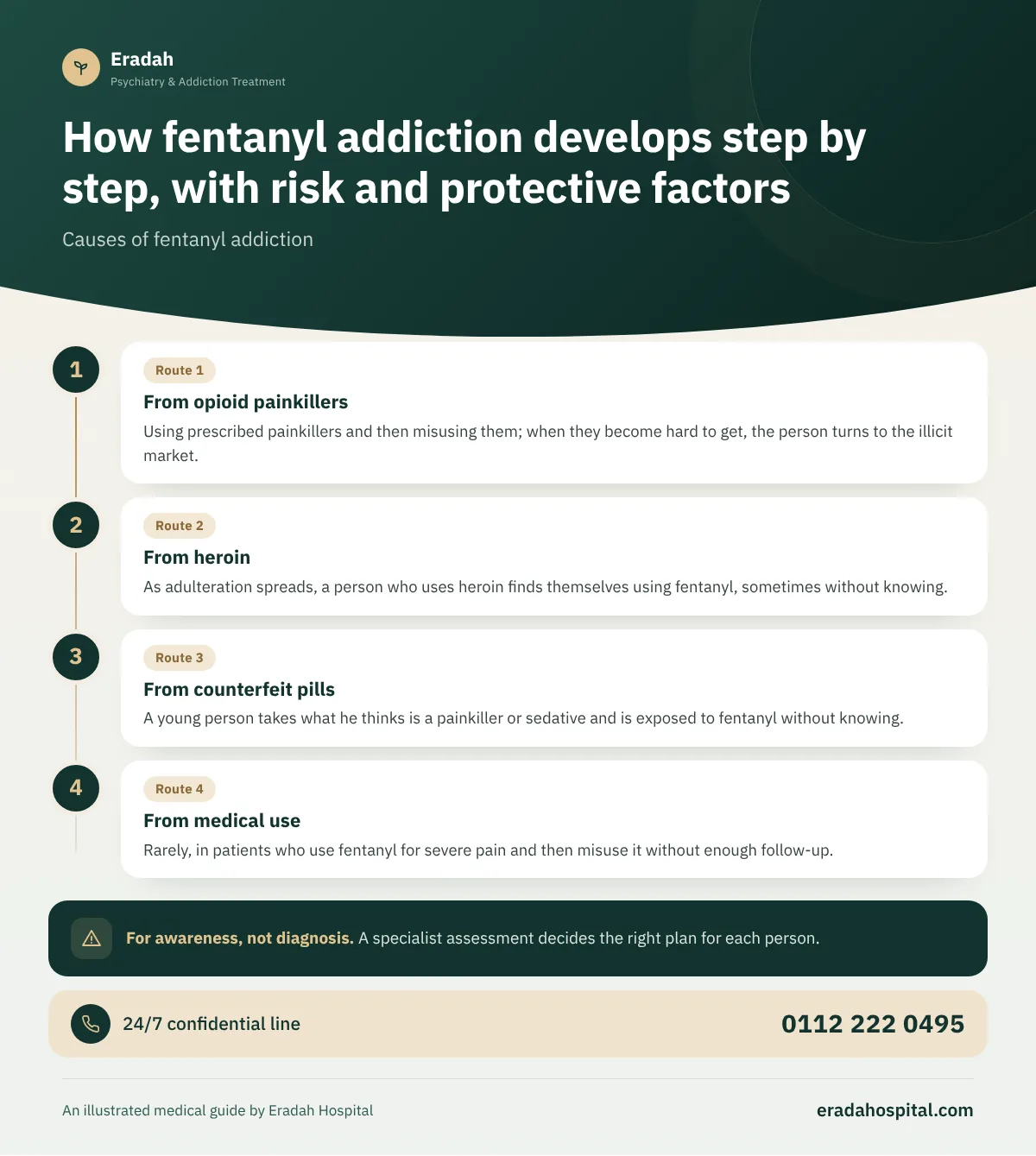
Few people start with fentanyl directly. Research and clinical experience show several common routes to it:
- Route 1From opioid painkillers
Using prescribed painkillers and then misusing them; when they become hard to get, the person turns to the illicit market.
- Route 2From heroin
As adulteration spreads, a person who uses heroin finds themselves using fentanyl, sometimes without knowing.
- Route 3From counterfeit pills
A young person takes what he thinks is a painkiller or sedative and is exposed to fentanyl without knowing.
- Route 4From medical use
Rarely, in patients who use fentanyl for severe pain and then misuse it without enough follow-up.
Can a person become addicted to fentanyl without knowing?
Yes, and this is one of the strangest features of the fentanyl crisis. A person who regularly uses a drug adulterated with fentanyl develops a dependence on fentanyl itself, then notices that the substance they were "used to" is no longer enough, or that withdrawal has become more severe. That is why everyone being treated for opioid addiction needs a careful assessment that includes a specific test for fentanyl.
Do psychiatric disorders play a role in fentanyl addiction?
Yes. Depression, anxiety, post-traumatic stress disorder and chronic pain are among the most common conditions that accompany opioid addiction. Fentanyl gives a rapid emotional numbing of painful feelings, and so becomes a way to escape them. The presence of both conditions together is known as dual diagnosis, and treating it means dealing with both at once.
Is genetics a cause of fentanyl addiction?
Genetics explains a large share of vulnerability to addiction in general, so people with first-degree relatives who have addiction are more likely to develop it. But genetics is not destiny; it only raises the likelihood, and interacts with environment and personal experiences. Knowing the family history helps with prevention and early intervention.
What are the environmental and social factors?
Childhood trauma, violence and loss clearly raise the risk of addiction.
Friends or family members who use, or an environment where drugs are available.
Trying drugs in adolescence, when the brain is still developing, increases the likelihood of addiction.
Unemployment, loneliness, constant stress and weak social support.
Risk factors versus protective factors
| Factors that raise risk | Protective factors |
|---|---|
| Earlier dependence on opioid painkillers or heroin | Early treatment of any opioid dependence |
| Untreated depression, anxiety or trauma | Psychological therapy and skills for coping with stress |
| Family history of addiction | An informed family and open conversation |
| Using pills or substances from unreliable sources | Sticking to medications from the pharmacy with a prescription |
| Isolation and weak support | Supportive relationships, meaningful activities, and work or study |
Why is it hard to stop even when you want to?
Many people dependent on fentanyl truly want to stop, but find themselves stuck in a closed loop. The effect of fentanyl is relatively short, and withdrawal starts quickly and is painful, so the person goes back to the drug to get rid of the pain, not to enjoy it. Over time the brain's ability to feel pleasure from ordinary things declines, and anxiety and depression grow, so the drug becomes the only refuge available in the person's eyes.
Understanding this loop matters for the family: insisting on "willpower" alone is not enough, and stopping suddenly without help usually ends in going back. Structured medical treatment, including approved medications, breaks this loop and gives the brain a chance to recover.
Stages in the development of fentanyl addiction
- Trying or exposure: knowingly or unknowingly, or through other opioids.
- Repeated use: the drug is used again and tolerance begins quickly.
- Dependence: painful withdrawal symptoms when the supply drops push the person to continue.
- Addiction: compulsive use and loss of control despite the risk of death and obvious harm.
With fentanyl these stages can pass very quickly, which is why early intervention is essential. Learn about the signs of fentanyl addiction.
Who is most vulnerable to fentanyl addiction?
There is no single profile of someone who becomes addicted to fentanyl, but some groups have a higher risk and deserve special attention from families and doctors:
- People with earlier opioid dependence: such as tramadol, opioid painkillers or heroin, even if they have stopped for a while.
- Teenagers and young adults: because they are more inclined to experiment and less aware of the danger of counterfeit pills, and because the brain at this age is more sensitive to addiction.
- People with chronic pain and no comprehensive treatment plan: they may look for stronger relief outside the medical framework.
- People with untreated psychiatric disorders: such as depression, post-traumatic stress disorder and severe anxiety.
- Health care workers: because of their closeness to powerful medications and intense work pressure, which is why special support programs exist for them.
How do we reduce the risk of reaching fentanyl?
- Do not take any pill or medication from outside the pharmacy or without a prescription, however familiar it looks.
- Use opioid painkillers for the shortest time possible and under medical follow-up.
- Treat any opioid dependence early, before it develops.
- Don't neglect depression, anxiety or chronic pain; each deserves its own treatment.
- Talk to your children about counterfeit pills and adulterated drugs clearly and calmly.