What is fentanyl?
Fentanyl is an entirely synthetic opioid, meaning it is not extracted from the opium poppy like morphine and codeine but made chemically in a laboratory. It was developed in the early 1960s as a powerful painkiller and anesthetic for surgery.
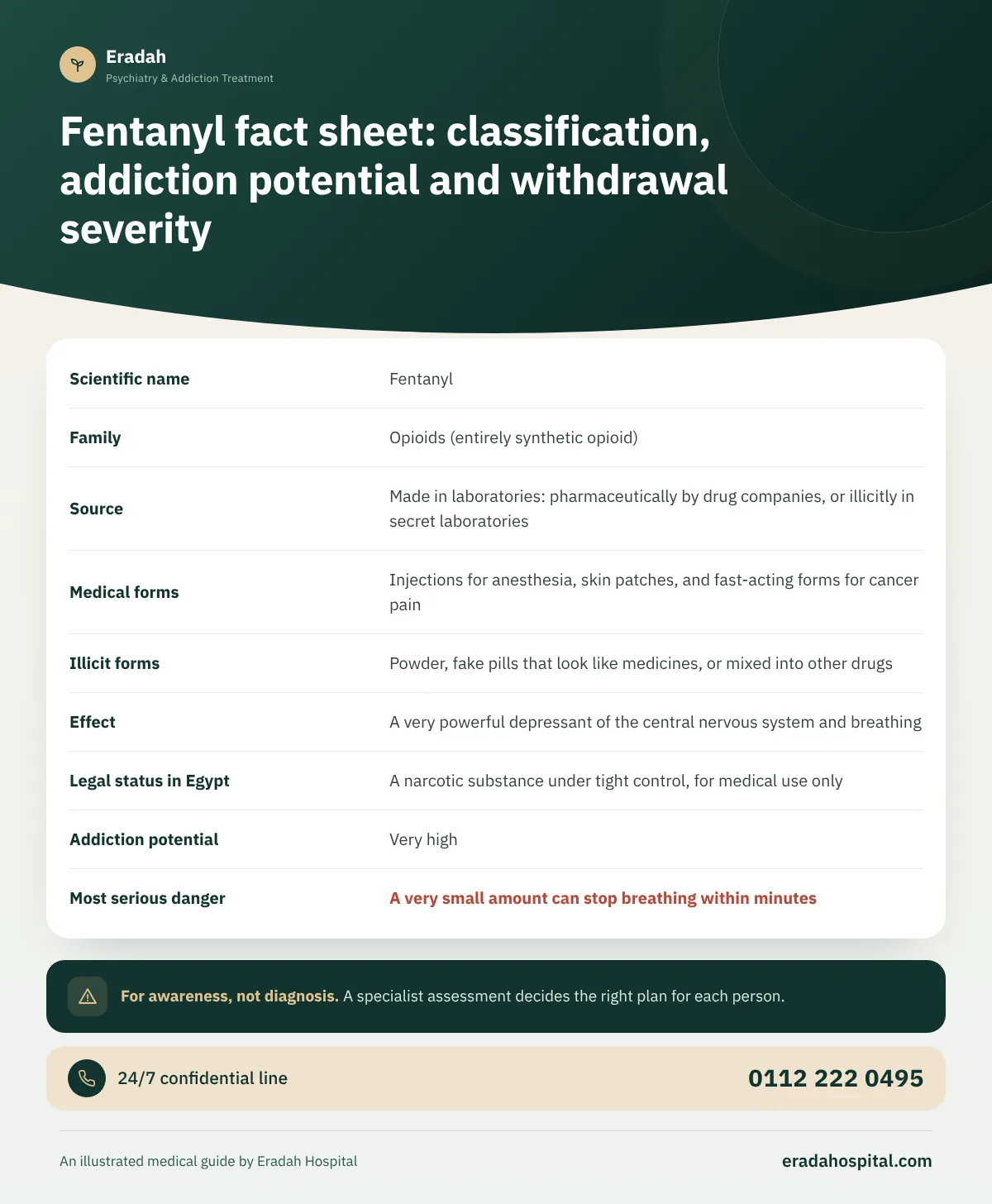
Fentanyl belongs to the opioid family, along with morphine, heroin, codeine and methadone. It acts on the same opioid receptors, but it binds to them far more strongly and reaches the brain quickly because it dissolves very easily in fat.
Today there are two completely different forms of fentanyl: pharmaceutical fentanyl, made by drug companies and used under tight control, and illicit fentanyl, made in secret laboratories with no control over its purity or strength. Confusing the two causes a great deal of misunderstanding.
Does fentanyl have a medical use?
Yes, and fentanyl is one of the essential medicines in hospitals. It is used for anesthesia during operations, in intensive care, and to relieve severe pain that does not respond to weaker painkillers, especially cancer pain. The doctor chooses the right form for each case:
Used in anesthesia and intensive care under constant monitoring of breathing and pulse.
Used for severe chronic pain in patients whose bodies are accustomed to opioids; not suitable for anyone who has not used opioids before.
Such as dissolving tablets and nasal sprays, used for sudden breakthrough pain in cancer patients.
Dispensed by special prescription, and stored and recorded under strict rules at every stage of handling.
What is illicit fentanyl?
Illicit fentanyl is made in secret laboratories and smuggled, and it appears as powder or pressed pills designed to look like well-known medicines such as opioid painkillers or Xanax tablets. More dangerous still, it is often mixed with other drugs such as heroin, cocaine and methamphetamine, because it is cheap and strong.
- Adulteration without the user’s knowledge: a person may think they are taking another substance or a pharmaceutical pill, when it actually contains fentanyl.
- Unknown strength: you cannot tell by looking how much fentanyl is in a powder or pill, and it can differ from one pill to another in the same batch.
- Stronger derivatives: there are chemically related substances, some of them far stronger than fentanyl, that appear in the illicit market.
How does fentanyl affect the brain and body?
Fentanyl binds very strongly to the mu-type opioid receptors in the brain and spinal cord, and reaches them within minutes. This results in:
- Powerful pain relief, drowsiness and calm, and it can cause euphoria in people who misuse it.
- Suppression of the breathing center in the brainstem, which is the effect that kills in an overdose, and it happens very quickly with fentanyl.
- Stiffening of the chest muscles in some cases, which makes breathing harder.
- With repeated use: rapid tolerance and strong physical dependence, then addiction.
Why is fentanyl so dangerous?
The danger comes from three things together: enormous strength, speed of action, and not knowing how much is in an illicit substance. The gap between an amount that produces an effect and an amount that stops breathing is very small, and it cannot be estimated outside a laboratory.
| Substance | Nature | Relative strength | Status |
|---|---|---|---|
| Codeine | Natural / medicine | Relatively weak | Prescription painkillers and cough medicines |
| Morphine | Natural / medicine | The reference for comparison | Severe pain in hospitals |
| Heroin | Semi-synthetic | Stronger than morphine | Prohibited in Egypt |
| Fentanyl | Entirely synthetic | About 50 to 100 times stronger than morphine | A tightly controlled medicine, and a dangerous illicit version |
With illicit fentanyl, nobody knows, not even the person selling it, how much a pill or powder contains. That is exactly why the first time can be the last.
What are fentanyl analogs?
Fentanyl analogs are substances chemically close to fentanyl. Some have a specific medical or veterinary use, and some appear only in the illicit market. Some of these analogs are far stronger than fentanyl itself, such as carfentanil, which is used in veterinary medicine to sedate very large animals. Other synthetic opioids from different chemical families have also appeared recently, carrying the same danger. The message is the same: any opioid from an illicit source may contain something stronger than anyone expects.
The legal status of fentanyl in Egypt
In Egypt, fentanyl is a narcotic substance under tight control. Its use is limited to medical purposes in hospitals and by special prescription, under the rules of the Ministry of Health and the Egyptian Drug Authority. Any possession of or dealing in it outside this framework falls under Law No. 182 of 1960 on drug control. The Fund for Drug Control and Treatment of Addiction offers free, confidential treatment through hotline 16023.
This is general educational information and not legal advice.
Is fentanyl a problem in Egypt, or only in America?
The biggest fentanyl crisis is currently tied to North America, where illicit fentanyl has become the leading cause of overdose deaths. But the danger knows no borders: fake pills and adulterated drugs move across markets, and believing that “this doesn’t happen here” can be fatal. That is why the World Health Organization and the United Nations warn about the global spread of synthetic opioids.
Fentanyl guide: everything you need to know
We have gathered everything about fentanyl into 6 pages, each answering one question in detail. Choose what you are looking for:
Harms of fentanyl
Sudden overdose, brain damage from lack of oxygen, its effect on mood, hormones and pregnancy, and the danger of mixing it with other substances.
Causes of fentanyl addiction
Why does fentanyl addiction develop so quickly? Its strength, switching from other opioids, unintended exposure, and psychological and environmental factors.
Symptoms of fentanyl addiction
The physical and behavioral signs a family may notice, the diagnostic criteria, and how to start the conversation.
Fentanyl withdrawal symptoms
They begin within hours of the last use and can be severe. The timeline, and why starting medication treatment needs special expertise.
Treatment of fentanyl addiction
From assessment and detox to approved medications for opioid use disorder, psychotherapy and relapse prevention.
How long fentanyl stays in the body
Why it does not show up on a standard opioid test, and how long it remains in urine, blood and hair.
What can a family do to protect their children from fentanyl?
- Talk to your children plainly: any pill from outside a pharmacy may be fake and deadly.
- Store any opioid medicines or patches at home safely, and dispose of whatever is left over.
- Learn the signs of overdose, and remember the ambulance number, 123.
- If a family member is using opioids, do not wait; ask for a specialist assessment now.
Sources: the US Centers for Disease Control and Prevention (CDC), and the World Health Organization fact sheet on opioid overdose.
Signs of fentanyl overdose: call an ambulance (123) immediately
- Loss of consciousness, with no response to calling or touch
- Very slow, irregular or stopped breathing
- Pupils that are extremely small, like pinpoints
- Blue or pale lips and fingernails and cold skin
- Gurgling or snoring sounds, or unusual stiffness of the body
Call an ambulance at 123 immediately, place the person on their side (recovery position) so they do not choke, and stay with them until help arrives. A fentanyl overdose can happen within minutes, and in emergency care the patient may need more than one dose of naloxone and monitoring for hours after improving.
Call the ambulance 123