How does the body get rid of fentanyl?
Fentanyl is broken down mainly in the liver by the enzyme CYP3A4, and most of it is converted into an inactive substance called norfentanyl. The kidneys then clear most of these breakdown products in the urine. Because fentanyl dissolves very easily in fat, it spreads into body tissues and may be released from them slowly in people who have used it regularly.
Some medications that inhibit or speed up the CYP3A4 enzyme affect how quickly fentanyl is broken down, which is why a doctor reviews all of a patient's medications before prescribing it.
Does fentanyl show up on a standard drug test?
Usually not. The common first-line opiate screen is designed to detect morphine and chemically similar substances such as codeine and heroin. Fentanyl has a different structure, so the test does not usually react to it. To detect fentanyl, the laboratory needs:
- A fentanyl-specific immunoassay: available in many laboratories and as separate test strips, it detects fentanyl or its breakdown products.
- A confirmatory test: using precise techniques such as chromatography with mass spectrometry, it identifies fentanyl, its breakdown products and some of its analogues.
- Expanded panels: these cover a range of synthetic opioids in specialized laboratories.
How long does fentanyl stay in the body, by type of test?
Urine
Blood
Saliva
Hair
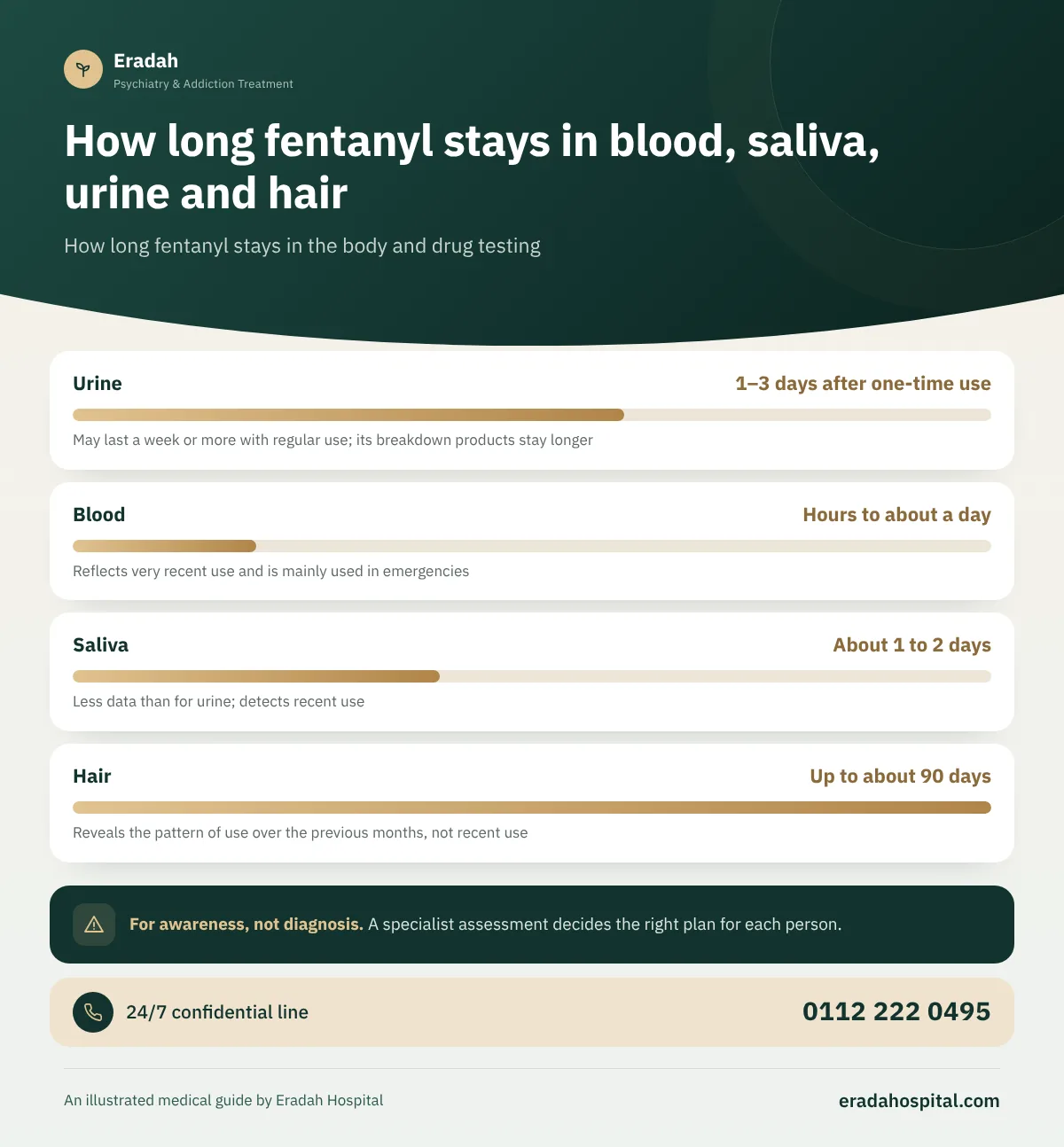
These times are approximate and vary with the laboratory, the sensitivity of the test, the pattern of use and the person's health. For an accurate interpretation of a specific result, consult your doctor or the laboratory.
Why does fentanyl stay longer in people who use it regularly?
A 2020 study of patients receiving inpatient treatment for opioid use disorder found that fentanyl and its breakdown products continued to appear in urine for about a week on average after the last use, with its breakdown products lasting longer, and in some patients far longer than that. The likely reason is that fentanyl is stored in the body's fatty tissue and released slowly.
This finding matters for treatment, because it helps explain why starting some opioid treatment medications after fentanyl requires careful timing set by the doctor.
What factors affect how long fentanyl stays in the body?
- Frequency and length of use: regular use clearly lengthens the detection time.
- Amount and potency: often unknown with illicit fentanyl.
- Body fat percentage: because fentanyl spreads into fat.
- Liver and kidney function: when impaired, they slow its elimination.
- Other medications: some slow the breakdown of fentanyl in the liver.
- Type of test and cutoff level: these differ between laboratories.
Does fentanyl show up on a test after surgery?
Yes, it can. Fentanyl is among the most commonly used drugs in anesthesia, intensive care and emergency medicine, and a person who received it during surgery or a medical procedure may test positive for a period afterward. The same applies to patients using medical patches. For this reason, tell the laboratory or the requesting party about any recent operation or treatment, and keep your medical reports.
What is the difference between a screening test and a confirmatory test?
| Specific immunoassay | Confirmatory test | |
|---|---|---|
| What it detects | Fentanyl or its breakdown products in general | Fentanyl, its breakdown products and some analogues, with high precision |
| Speed | Minutes to hours | Usually days |
| Accuracy | May give false positives or miss some analogues | High accuracy; accepted for medical and legal purposes |
| Use | Rapid screening and monitoring | Confirming important results and complex cases |
Can a result be falsely positive or falsely negative?
- Some medications can interfere with certain fentanyl immunoassays and give a false positive result.
- Some fentanyl analogues may not be detected by the immunoassay, so the result appears negative despite use.
- Medical fentanyl given during surgery or through patches produces a true positive result that does not indicate illicit use.
- Errors in collecting or storing the sample can affect the result.
For this reason, medical bodies recommend confirming any important result with a confirmatory test and interpreting it in light of the medical history.
What is the difference between how long fentanyl's effects last and how long it shows on a test?
The noticeable effect of illicit fentanyl is relatively short, usually a few hours, while its breakdown products stay in the urine much longer. So a person waking up and seeming back to normal does not mean fentanyl has left the body. Conversely, the effects of fentanyl can return after an overdose has been reversed with naloxone, because the effect of naloxone may wear off before the effect of fentanyl does. This is why the patient stays under observation in the hospital.
Why is a fentanyl test requested?
- In emergencies: to explain loss of consciousness or stopped breathing, especially if the standard opiate result is negative.
- At the start of treatment: to find out which substances are actually being used, since many people do not know they have been exposed to fentanyl.
- Before starting certain opioid treatment medications: because the presence of fentanyl affects the timing of the start.
- During follow-up: to support commitment to the recovery plan in a non-punitive way.
- In employment or legal screening: according to the regulations in force.
Why don’t we publish ways to hide a test result?
In the context of treatment, testing is a tool to protect the patient, especially with fentanyl, which may be present in other substances without the user's knowledge. Knowing it is there can save a life and change the treatment plan. The recipes circulating for hiding results are ineffective and some are harmful. If a test worries you, this is an opportunity to ask for help. Learn about fentanyl addiction treatment.