Why do benzodiazepine withdrawal symptoms happen?
“I stopped the pill a week ago, and since then I can't sleep, my heart is pounding, and I feel like the world isn't real.” This description is most often withdrawal from a drug the brain has become used to, even if the person thinks it is their “nerves” coming back.
The Ashton manual describes withdrawal as a mirror image of the drug's effects: deep sleep becomes insomnia and nightmares, muscle relaxation becomes tension and cramps, calm becomes anxiety and panic, and protection against seizures becomes susceptibility to them. The reason is that the nervous system adapted to the presence of the drug, so when it is withdrawn quickly, the alarm systems that had been held back are released before the brain has readjusted.
Who is at risk of benzodiazepine withdrawal symptoms?
Not everyone who has taken a pill is at risk of withdrawal. The 2025 American Society of Addiction Medicine guidelines estimate the risk according to how long and how often the drug has been used:
| Pattern of use | Risk of significant withdrawal |
|---|---|
| Three days a week or fewer, for any length of time | Not expected |
| Four or more days a week for less than a month | Lower, but possible |
| Four or more days a week for one to three months | Possible, and rises with higher doses |
| Four or more days a week for three months or longer | Likely, and rises with longer duration and higher doses |
The guidelines add that alprazolam in particular is associated with faster onset of dependence, so someone taking it daily may need a gradual taper even after two to four weeks. The risk also rises with a previous history of withdrawal or seizures, or mixing with alcohol and opioids.
When do benzodiazepine withdrawal symptoms start, and how long do they last?
A StatPearls review notes that benzodiazepine withdrawal symptoms usually appear 2 to 10 days after stopping and can last weeks, and that their onset and duration depend on the drug's half-life and how long it was used. Short-acting types such as Xanax cause symptoms earlier, while symptoms are delayed with long-acting types such as Valium. Here is an approximate timeline when stopping after long-term use:
- The first daysThe start
Symptoms appear first with short-acting types: anxiety, insomnia, tension, and irritability.
- Roughly days 2 to 10Acute withdrawal
Sweating, tremor, palpitations, nausea, and sensitivity to light and sound. This is the period of seizure risk if the drug is stopped abruptly.
- The following weeksWaves of ups and downs
Symptoms come and go, then “windows” of feeling better appear and gradually lengthen.
- Within a few monthsRecovery for most people
With slow tapering, symptoms disappear within a few months for most people.
- In a minorityProtracted withdrawal
Symptoms of anxiety, insomnia, and tingling may last for months or longer, then improve over time.
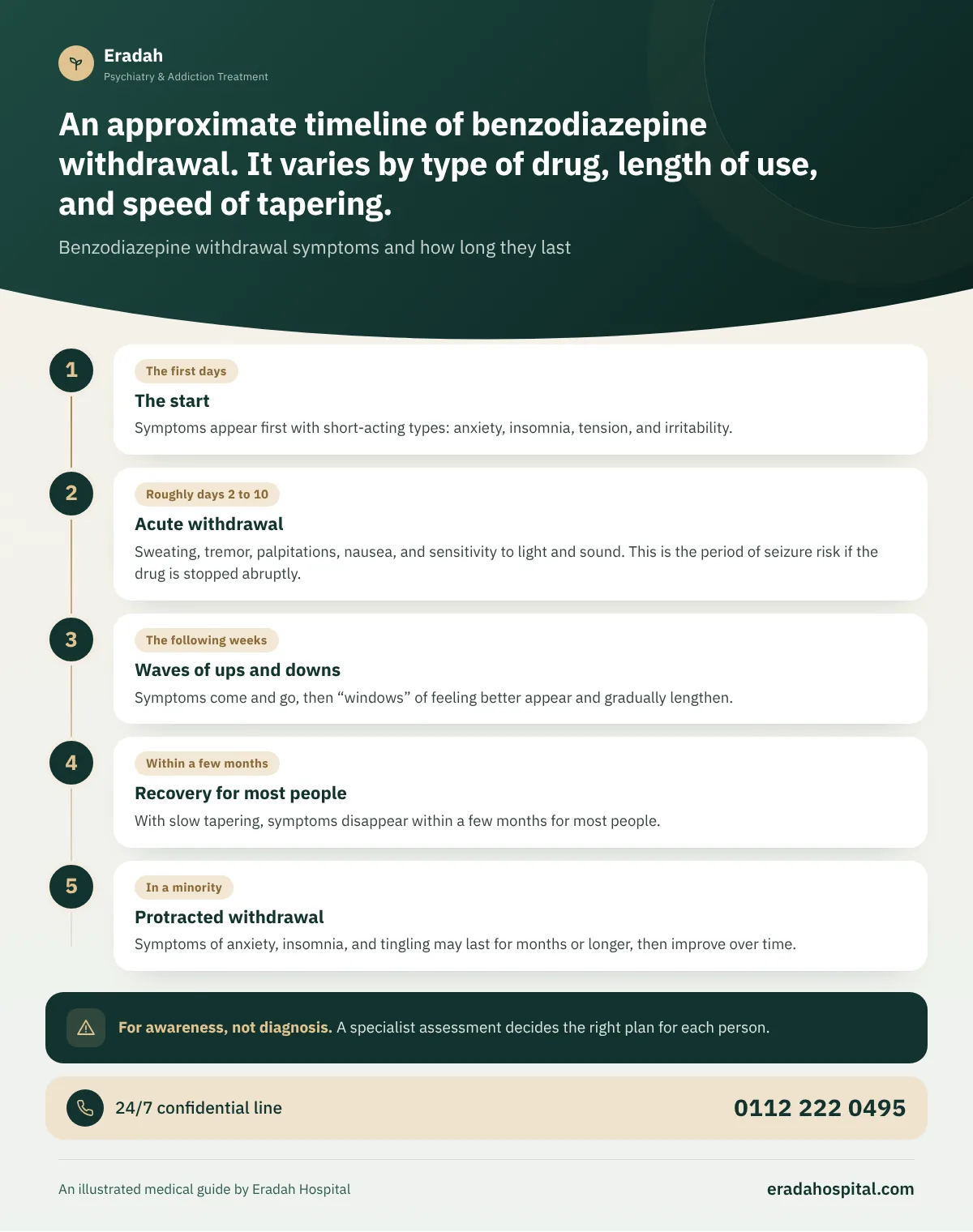
Sources: StatPearls review of withdrawal syndromes (symptom onset), and chapter 3 of the Ashton manual (waves, windows, and recovery).
What are the symptoms of benzodiazepine withdrawal?
The 2025 guidelines group the common symptoms into clusters, and not everyone experiences all of them:
| Group | Examples |
|---|---|
| Mood and temper | Anxiety and panic attacks, depression, irritability, and agitation |
| Heart and circulation | Palpitations, rapid heartbeat, chest pain, and high blood pressure |
| Digestive system | Nausea, vomiting, abdominal cramps, and diarrhea |
| Nerves and senses | Headache, impaired memory and concentration, extreme sensitivity to light, sound, and smell, tingling, and tinnitus |
| Muscles and movement | Tremor, muscle pain and spasms, shakiness, poor balance, and restlessness |
| Sleep | Insomnia, nightmares, and night sweats |
| Serious symptoms | Seizures, delirium, psychosis, and suicidal thoughts |
Is benzodiazepine withdrawal dangerous? Seizures and delirium
Yes, it can be. The US Food and Drug Administration says that abrupt discontinuation or rapid dose reduction can cause withdrawal reactions, including seizures that can be life-threatening, and lists catatonia, delirium, hallucinations, mania, psychosis, and suicidal thoughts among the severe symptoms. Ashton explains that seizures are linked especially to rapid withdrawal from high-potency drugs, and that they are very rare with slowly eliminated drugs or with slow tapering.
Protracted benzodiazepine withdrawal
The 2025 guidelines describe protracted withdrawal symptoms that may last months or years after stopping in some patients, and recommend reassuring them that these usually improve with time as the brain adapts, which may take months. By Ashton's estimate, roughly 10% to 15% of people who have used benzodiazepines for years develop a “post-withdrawal syndrome.” Many of them had used the drug for twenty years or more or had bad withdrawal experiences, and the proportion is likely far lower among those who tapered slowly.
The most common protracted symptoms are anxiety, insomnia, depression, sensory and motor symptoms such as numbness and tingling, and digestive problems. The UK's National Institute for Health and Care Excellence (NICE) guidance notes that withdrawal can be difficult and take several months or longer, and that symptoms may appear late or change over time.
Withdrawal, or a return of the original anxiety?
The 2025 guidelines say it is often difficult to tell withdrawal symptoms from a return of the condition the drug was prescribed for, because the most common withdrawal symptoms (anxiety, insomnia, and irritability) resemble the symptoms of the original illness. The deciding factor is follow-up over time with a psychiatrist: withdrawal tends to recede, while a returning anxiety disorder or panic needs its own treatment.
Why gradual tapering rather than abrupt discontinuation?
NICE guidance recommends not stopping dependence-forming medications suddenly except in exceptional medical circumstances. The American Society of Addiction Medicine recommends not stopping benzodiazepines abruptly for anyone likely to be dependent on them, tailoring the taper to each patient and adjusting it according to their response, and considering hospital admission when the risk is too great to be managed in the clinic. It also warns against using flumazenil, the benzodiazepine antagonist, to speed up withdrawal because of the risk of seizures and heart rhythm disturbances. We do not give schedules or doses here, because your doctor sets the plan after assessment; you can find its stages in the guide to benzodiazepine addiction treatment.
How can the family support someone going through benzodiazepine withdrawal?
- Believe what they feel; the symptoms are real even if test results look normal.
- Do not pressure them to stop faster than the doctor has set.
- Help them keep appointments and a consistent sleep routine, and keep alcohol and stimulants out of the home.
- Know the danger signs and keep the ambulance number, 123, at hand.
- Encourage psychotherapy, and seek support for the family itself through the family program.
Danger signs after using benzodiazepines: call ambulance (123) immediately
- Deep sleep from which the person cannot be woken by calling or shaking.
- Slow, shallow or irregular breathing, or bluish lips.
- Severe slurred speech, unsteadiness and confusion after taking a sedative with alcohol, tramadol or any opioid painkiller.
- Seizures, hallucinations or severe confusion within days of suddenly stopping a sedative that was used for a long time.
- Taking tablets of unknown origin that are said to be “Xanax” or “Rivotril.”
Call ambulance (123) immediately and do not wait for them to “sleep it off.” If the person is unconscious but breathing, place them on their side in the recovery position, stay with them and watch their breathing until the paramedics arrive, and do not give them any sedative, stimulant or food. Tell the paramedics what they took, the approximate amount and the time, bring the medicine box if you find it, and tell them if the person also drank alcohol or took an opioid painkiller.
Call the ambulance 123