"It's a medicine from the pharmacy, not drugs." This sentence protects many people from feeling guilty, but it delays discovering the problem. Prescription drug addiction is one of the hardest types of addiction to detect, because the substance is in the home, its packaging is official, and sometimes a doctor wrote it.
What is prescription drug addiction?
The US National Institute on Drug Abuse defines misuse of prescription medicines as taking a medicine in a manner or dose other than prescribed, taking someone else's prescribed medicine even for a genuine complaint such as pain, or taking it to feel euphoria. When this pattern continues despite harm and the person loses control over it, it becomes addiction in the medical sense.
It is important to distinguish this from expected physical dependence: a person with chronic pain or epilepsy may become physically dependent on their medicine without being addicted, as long as they take it as prescribed and it serves their life rather than destroying it. The guide What is addiction explains this difference.
The best-known medicines that cause addiction
| Opioid painkillers | Sedatives and sleeping pills | Stimulants | |
|---|---|---|---|
| Examples | Tramadol, codeine, morphine, and nalbuphine | Xanax, Rivotril, Valium, and zolpidem | Ritalin and amphetamines |
| Medical use | Pain relief | Anxiety, insomnia, and epilepsy | ADHD (attention-deficit/hyperactivity disorder) |
| Biggest risk | Stopped breathing and overdose | Mixing with opioids, and withdrawal that may cause seizures | High blood pressure, high pulse, and psychosis |
| Withdrawal | Painful but rarely life-threatening | Can be dangerous and needs gradual reduction | Exhaustion, depression, and long sleep |
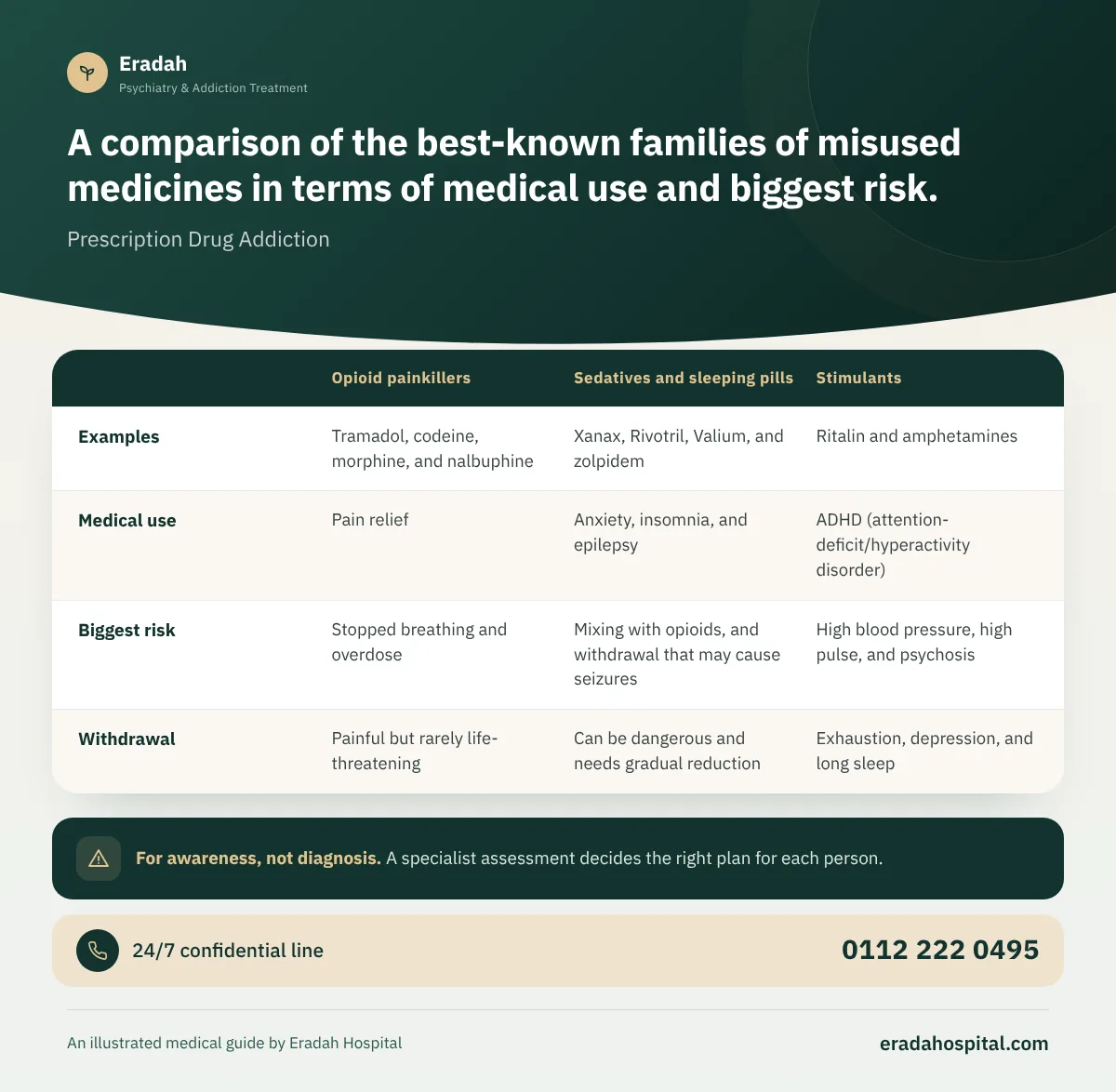
Each family has its own guide: opioids, sedatives and sleeping pills, and Ritalin.
Prescription drug addiction in Egypt: the best-known names
- Tramadol: An opioid painkiller. In 2018 Egypt presented the problem of its non-medical use before the United Nations Office on Drugs and Crime, and today it is among the most common substances among people seeking treatment, according to the Addiction Control Fund. Tramadol guide.
- Pregabalin (Lyrica): A nerve and epilepsy medicine that is misused on its own or with tramadol. Pregabalin guide.
- Parkinol: A medicine for Parkinson's symptoms. MedlinePlus lists hallucinations and confusion among its side effects, and it is misused at high doses. Parkinol guide.
- Mydriabid eye drops: An eye drop that is misused in dangerous ways. Mydriabid guide.
- Sedatives: Xanax, Rivotril, Lexotanil, and others. Benzodiazepines guide.
How does a medicine turn into addiction?
- Stage 1A prescription for a genuine reason
Pain after surgery, or anxiety, or insomnia, and the medicine works well.
- Stage 2Continuing after the reason has ended
The wound heals or the crisis passes, but the medicine stays "in reserve".
- Stage 3Tolerance and dose increases
The effect weakens, so the person raises the dose without consulting anyone.
- Stage 4Seeking the medicine
More than one doctor, pharmacies that sell without a prescription, or buying from the street.
- Stage 5Loss of control
They cannot stop, and withdrawal symptoms appear if a dose is late.
Signs of prescription drug addiction
- The medicine running out before it should, or the prescription repeatedly being "lost".
- Visiting more than one doctor for the same complaint.
- Taking the medicine for a reason other than the one it was prescribed for, such as a painkiller for mood or a sedative for everyday problems.
- Drowsiness, slurred speech, or mood swings after doses.
- Anxiety, nervousness, or physical symptoms if a dose is late.
- Mixing the medicine with alcohol or another drug.
Do all psychiatric medicines cause addiction?
No. Antidepressants, antipsychotics, and mood stabilizers do not cause addiction in the usual sense, although stopping some of them suddenly causes unpleasant symptoms. This confusion leads some patients to stop a treatment they need out of fear of "addiction". The guide Do psychiatric medicines cause addiction explains the difference for each type.
The family's role in preventing prescription drug addiction
- Keep painkillers and sedatives locked away, and dispose of leftovers after treatment ends.
- Do not give anyone a medicine prescribed for someone else, even with good intentions.
- Keep an eye on the quantities of medicines in the home, especially when there are teenagers.
- Ask the doctor from the start how long the treatment will last and what the plan for stopping is.
How is prescription drug addiction treated?
Treatment begins with a careful assessment of what the person actually takes and in what amounts, then detox under medical supervision through gradual reduction or substitute treatments depending on the medicine, then treating the original problem the medicine was started for, such as chronic pain, anxiety, or insomnia, by methods that do not cause dependence. The path differs between outpatient treatment and residential care according to the type of medicine, how long it was used, and whether other substances were mixed in.