What is Ritalin?
Ritalin is a brand name for the medicine methylphenidate, a central nervous system stimulant dispensed by prescription, and it is one of the most widely used medicines for treating attention-deficit/hyperactivity disorder (ADHD) in children and adults.
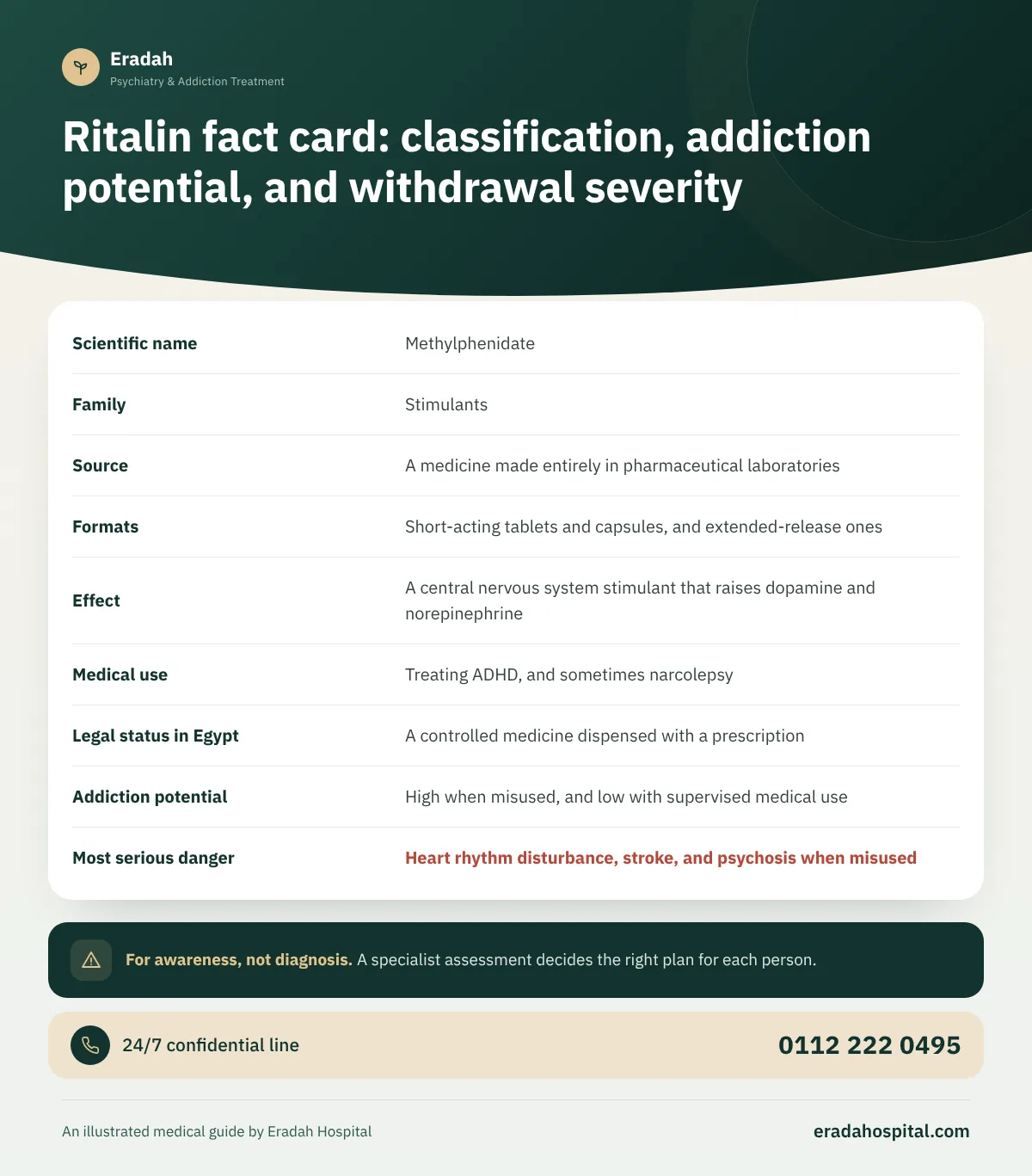
Methylphenidate has other brand names around the world, including extended-release forms taken once a day. All contain the same active substance but differ in how quickly they start working and how long they last, and the doctor chooses the right form for each patient.
Ritalin belongs to the stimulant family along with amphetamine, cocaine, and crystal meth (shabu), but it differs from them in being an approved medicine with a clear medical use, dispensed in measured doses under follow-up. This very difference disappears when it is misused.
Why do doctors prescribe Ritalin?
Doctors prescribe Ritalin after a careful diagnosis, not merely because of a complaint of poor concentration. Its approved uses include:
It improves attention and reduces impulsivity and hyperactivity in children over the age of six and in adults, as part of a plan that includes behavioral support.
It is sometimes used in adults to reduce sudden episodes of sleepiness during the day.
The doctor monitors blood pressure, pulse, weight, sleep, and mood, and a child's height and growth, throughout treatment.
Who is Ritalin not suitable for?
Ritalin is not dispensed to everyone who asks for it. There are conditions in which the doctor avoids it or prescribes it with great caution after additional tests. The most important include:
- Structural heart disease, serious rhythm disorders, or coronary artery disease.
- Severe or uncontrolled high blood pressure.
- Angle-closure glaucoma.
- Motor tics or Tourette syndrome, or severe anxiety and tension.
- Currently taking MAO-inhibitor antidepressants, or having taken them in the previous two weeks.
- A personal or family history of mania, psychosis, or addiction, which are conditions that need closer assessment.
This is why taking the medicine from someone else's box bypasses all of these precautions, and could put a person with a heart problem not yet discovered at real risk.
How does Ritalin affect the brain and body?
Methylphenidate works by blocking the reuptake of two neurotransmitters, dopamine and norepinephrine, so their amounts increase in the gaps between nerve cells, especially in the front part of the brain responsible for attention, planning, and impulse control.
- In a diagnosed patient at the medical dose: It improves attention and behavior regulation, usually without notable euphoria.
- On the body: It slightly raises heart rate and blood pressure, reduces appetite, and may delay sleep, which is why the doctor monitors these regularly.
- When misused: Dopamine levels in the reward circuits rise more and faster, producing a feeling of euphoria, energy, and confidence, and this is where the risk of addiction begins.
The same medicine can be a treatment or a danger; the difference lies in diagnosis, dose, and follow-up, not in the box.
How does Ritalin turn from treatment into misuse?
In its drug label, the US Food and Drug Administration warns that Ritalin has a high potential for misuse that can end in a substance use disorder or addiction. Misuse takes several forms:
- Taking it without a prescription, often from a friend's or family member's medicine.
- Increasing the dose or number of times without the doctor's knowledge, or using it in a way other than prescribed.
- Using it to stay up late before exams or to extend working hours.
- Using it to lose appetite and weight.
- Using it for euphoria, or mixing it with alcohol or other substances.
The agency's own data indicate that the highest rates of misuse of prescription stimulants are among young people aged 18 to 25 and university students, and that most of those who use them without a prescription get them from friends or relatives.
Ritalin compared with other stimulants
| Substance | Medical use | Status in Egypt | Main danger when misused |
|---|---|---|---|
| Ritalin | ADHD and narcolepsy | A controlled medicine by prescription | Heart problems, psychosis and addiction |
| Amphetamine | ADHD medicines in some countries | Prohibited outside the medical framework | Addiction, psychosis, and heart strain |
| Captagon | None; illicit tablets | Prohibited | Unknown composition and addiction |
| Cocaine | Very limited topical use | Prohibited | Heart attacks, even in young people |
The shared danger is that a person who gets used to one stimulant is more likely to try others. The US agency has also warned of the spread of counterfeit pills sold as stimulant medicines while containing other, more dangerous substances, so any pill from outside the pharmacy has unknown contents.
Does Ritalin raise intelligence and grades?
This is one of the most widespread ideas among students, but the evidence does not support it in the common form. The medicine may give a healthy person a sense of alertness and enthusiasm, but its actual effect on learning and achievement is limited and variable, while its harms remain.
| The myth | The truth |
|---|---|
| The "smart pill" that raises grades | It does not increase intelligence, its effect on the achievement of healthy people is limited, and the sleep loss it causes weakens memory. |
| Safe because it's a medicine | It is relatively safe only with diagnosis, dose, and medical follow-up; outside that it carries real risks. |
| Treating children with ADHD with it makes them addicts | Many studies indicate that supervised treatment does not raise the risk of later addiction, and may reduce it. |
| A good way to lose weight | Loss of appetite is a side effect, and using it for weight loss puts the heart and mental health at risk. |
Legal status of Ritalin in Egypt
Ritalin and methylphenidate in general are controlled medicines in Egypt, dispensed by prescription only and subject to special rules on dispensing and circulation, and they are also listed among psychotropic substances under international control. Possessing the medicine, selling it, or giving it to others without a prescription exposes a person to legal liability. The Fund for Drug Control and Treatment of Addiction offers free, confidential consultation and treatment through hotline 16023.
This is general educational information and not legal advice.
Ritalin guide: everything you need to know
We have gathered everything about Ritalin into 3 pages, each answering one question in detail. Choose what you are looking for:
Harms of Ritalin
When misused it raises blood pressure and heart rate, and may cause rhythm disturbance, stroke, insomnia, anxiety, and psychosis, and harms that are specific to teenagers and pregnant women.
Symptoms of Ritalin addiction
How do you tell medical use from misuse? Physical, behavioral, and psychological signs, diagnostic criteria, and how to start the conversation.
Ritalin addiction treatment
From assessment and review of the ADHD diagnosis to safe supervised stopping, behavioral therapy, and relapse prevention, and the duration of each stage.
Found out your son is using Ritalin without a prescription?
The story often begins with pills from a classmate before exams, then turns into a habit. These are practical steps to help you:
- Talk to him calmly about the reason: study pressure? Weight? Staying up late? Understanding the motive is half the solution.
- Explain the real risks to the heart, sleep, and mental health without exaggeration.
- If he truly suffers from chronic poor concentration, take him to a psychiatrist to assess for ADHD instead of self-treatment.
- If there is a medicine prescribed for a family member in the home, keep it in a safe place and monitor the quantity.
- Seek specialist advice if you notice increasing quantities, difficulty stopping, or psychological changes.
- Learn the signs of poisoning and save the ambulance number, 123.
Signs of poisoning from Ritalin and stimulants: call an ambulance on 123 immediately
- A very fast or irregular heartbeat with chest pain or pressure
- A severe rise in body temperature with heavy sweating or hot, dry skin
- Severe agitation, hallucinations, or confusion and loss of awareness of place and time
- Seizures or severe tremors that do not stop
- Signs of a stroke: sudden weakness on one side of the body, difficulty speaking, or loss of consciousness
Call an ambulance on 123 immediately, move the person away from heat and from objects that could hurt them, and do not put anything in their mouth during a seizure. If they lose consciousness but are breathing, place them on their side, stay with them, and keep the medicine box to show the paramedics.
Call the ambulance 123