When is Ritalin use normal, and when is it misuse?
Before looking for signs, it is important to tell apart a patient who takes their medication as the doctor prescribed from a person who misuses it. Mild side effects such as reduced appetite or difficulty sleeping can appear in both, but the context is completely different:
| Medical use | Misuse |
|---|---|
| By prescription, from a doctor who follows the case | Without a prescription, or from someone else's medication |
| Dose and timing as set by the doctor | Increasing the dose or frequency without the doctor's knowledge |
| Only in the prescribed way | In ways that were not prescribed, or mixed with other substances |
| The aim is to treat diagnosed symptoms | The aim is staying awake, losing weight, or a high |
| The quantity lasts until the next appointment | The medication runs out early and is repeatedly requested |
Physical signs of Ritalin misuse
These signs appear while the drug is active or after using large amounts:
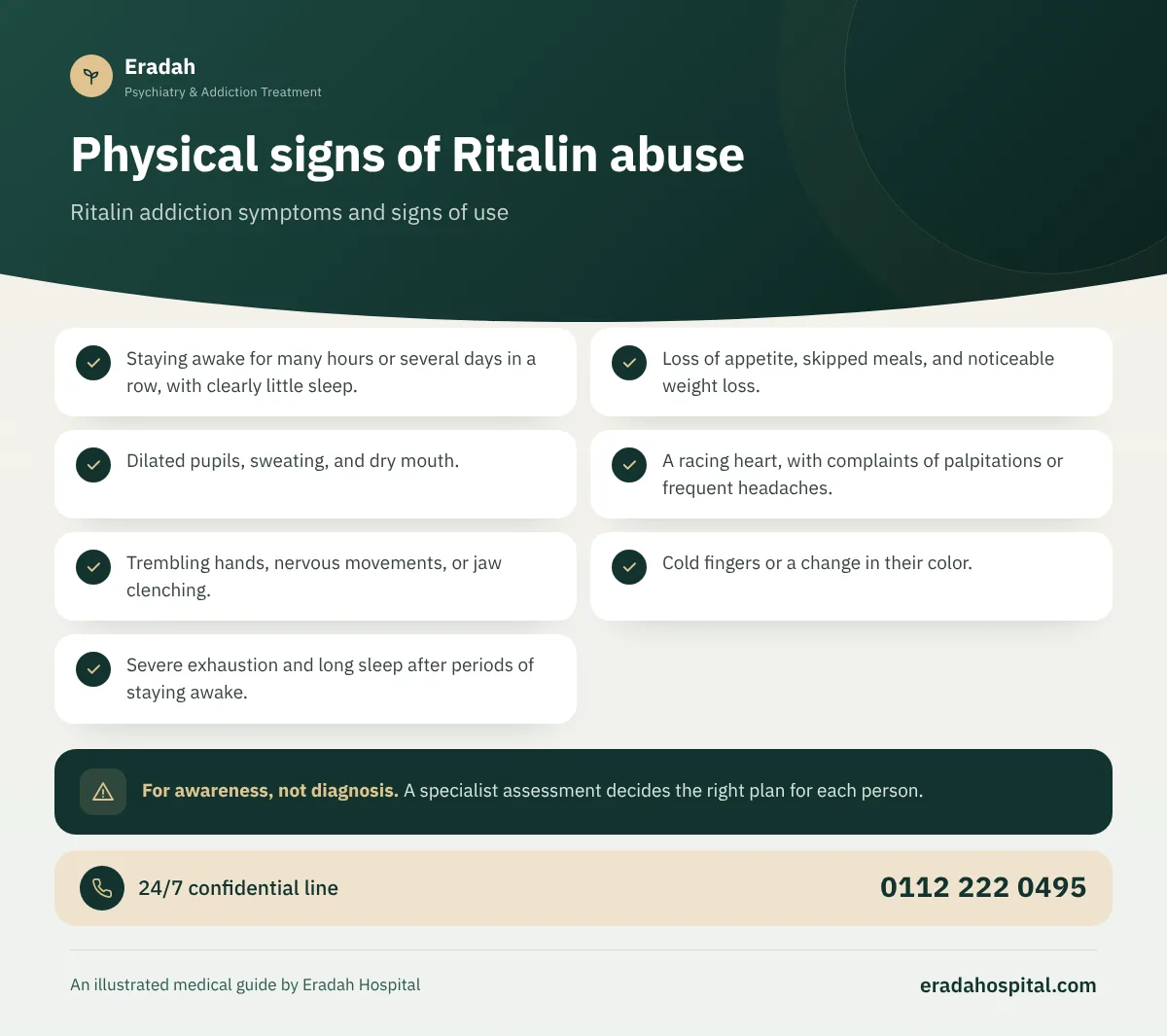
- Staying awake for many hours or several days in a row, with clearly little sleep.
- Loss of appetite, skipped meals, and noticeable weight loss.
- Dilated pupils, sweating, and dry mouth.
- A racing heart, with complaints of palpitations or frequent headaches.
- Trembling hands, nervous movements, or jaw clenching.
- Cold fingers or a change in their color.
- Severe exhaustion and long sleep after periods of staying awake.
Behavioral signs
Families often notice the behavioral changes before anything else:
- The prescribed medication running out before it is due, or claiming it was lost and asking for a new prescription.
- Visiting more than one doctor to get extra prescriptions.
- Asking for the drug from classmates or relatives who take it, or pills disappearing from a family member's pack.
- Fast, pressured speech and exaggerated activity followed by sluggishness.
- Secrecy about the pills and where they are kept, and unexplained spending.
- Use tied to exam seasons or work pressure that then becomes a permanent habit.
Psychological signs
- Irritability, a short temper, and sharp mood swings.
- Constant anxiety and tension, and sometimes panic attacks.
- Unjustified suspicion or a feeling of being watched.
- Sadness, exhaustion, and emotional numbness when the effect wears off or the medication runs out.
- Constant preoccupation with the drug and fear that it will not be available.
Signs parents notice during exam season
Taking Ritalin without a prescription is often linked to studying, so exam periods deserve special attention: unusual continuous staying up, excessive tension and irritability, and loss of appetite, followed by a crash and long sleep after the last exam. If this comes with talk of "focus pills" taken from classmates, it is a chance for a calm, early conversation before the experiment turns into a pattern.
When does misuse become addiction? Diagnostic criteria
Doctors use the DSM-5 diagnostic criteria for stimulant use disorder, which are eleven criteria over a twelve-month period, including:
- Using in larger amounts or for longer than intended.
- A persistent desire, or failed attempts, to cut down.
- Spending a long time getting the drug or recovering from its effects.
- A strong, intense craving to use.
- Neglecting responsibilities, or continuing despite clear health and psychological problems.
- Tolerance and needing a larger amount, and symptoms when stopping.
| Number of criteria | Level |
|---|---|
| 2 to 3 | Mild |
| 4 to 5 | Moderate |
| 6 or more | Severe |
After suddenly stopping heavy use, a person may go through a period of exhaustion, depression, and disturbed sleep. The page on Ritalin addiction treatment covers how to manage it safely.
How do you tell Ritalin apart from other stimulants?
The signs of stimulants are generally similar: staying awake, loss of appetite, activity, and irritability. But Ritalin misuse is often linked to a prescribed medication being around, to study- or weight-related motives, and to a seasonal pattern at first. Illicit stimulants such as Captagon and crystal meth (shabu) come from outside the pharmacy, and their psychological effects are often more violent and faster. Telling them apart precisely is the doctor's job, and may require a specific test.
Signs that call for a doctor's review in someone taking it by prescription
Even a patient who follows their prescription may show signs that deserve quick notice to the doctor, not because they are addicted, but because the medication may need adjusting:
- Palpitations, irregular heartbeats, or chest pain.
- A clear change in mood or personality, or aggression or new depression.
- Hallucinations or unusual, strange thoughts.
- New motor or vocal tics in the face or body.
- Cold, numb, or discolored fingers.
- A desire to raise the dose on their own or use it outside the scheduled times.
In these cases the medication is not stopped suddenly. Instead the doctor is informed so they can decide on the right adjustment, unless emergency signs appear, in which case an ambulance is called immediately.
How do you talk to someone who is misusing Ritalin?
- Choose a calm time, away from exam pressure or moments of crashing.
- Start with concern, not accusation: "I've noticed you aren't sleeping or eating, and I'm worried about you."
- Ask about the motive: study pressure? Weight? Real difficulty concentrating?
- Offer a practical alternative: an assessment with a psychiatrist may reveal ADHD that needs proper treatment.
- If the medication is prescribed to someone at home, store it safely without turning it into searches and confrontation.
- Ask for specialist family consultation if they refuse to talk.
Signs of poisoning from Ritalin and stimulants: call an ambulance on 123 immediately
- A very fast or irregular heartbeat with chest pain or pressure
- A severe rise in body temperature with heavy sweating or hot, dry skin
- Severe agitation, hallucinations, or confusion and loss of awareness of place and time
- Seizures or severe tremors that do not stop
- Signs of a stroke: sudden weakness on one side of the body, difficulty speaking, or loss of consciousness
Call an ambulance on 123 immediately, move the person away from heat and from objects that could hurt them, and do not put anything in their mouth during a seizure. If they lose consciousness but are breathing, place them on their side, stay with them, and keep the medicine box to show the paramedics.
Call the ambulance 123