Who diagnoses ADHD?
The UK's NICE guidelines recommend that the diagnosis be made by a specialist psychiatrist, a pediatrician or another qualified professional with training and experience in diagnosing the disorder. The US Centers for Disease Control and Prevention notes that psychiatrists, psychologists and pediatricians can carry out the assessment.
In practice, it often starts with an observation from a teacher or the family, followed by a visit to a pediatrician or child psychiatrist, or to a psychiatrist in the case of adults. It is best if the specialist is familiar with co-occurring conditions, because they are very common.
What are the steps of diagnosis?
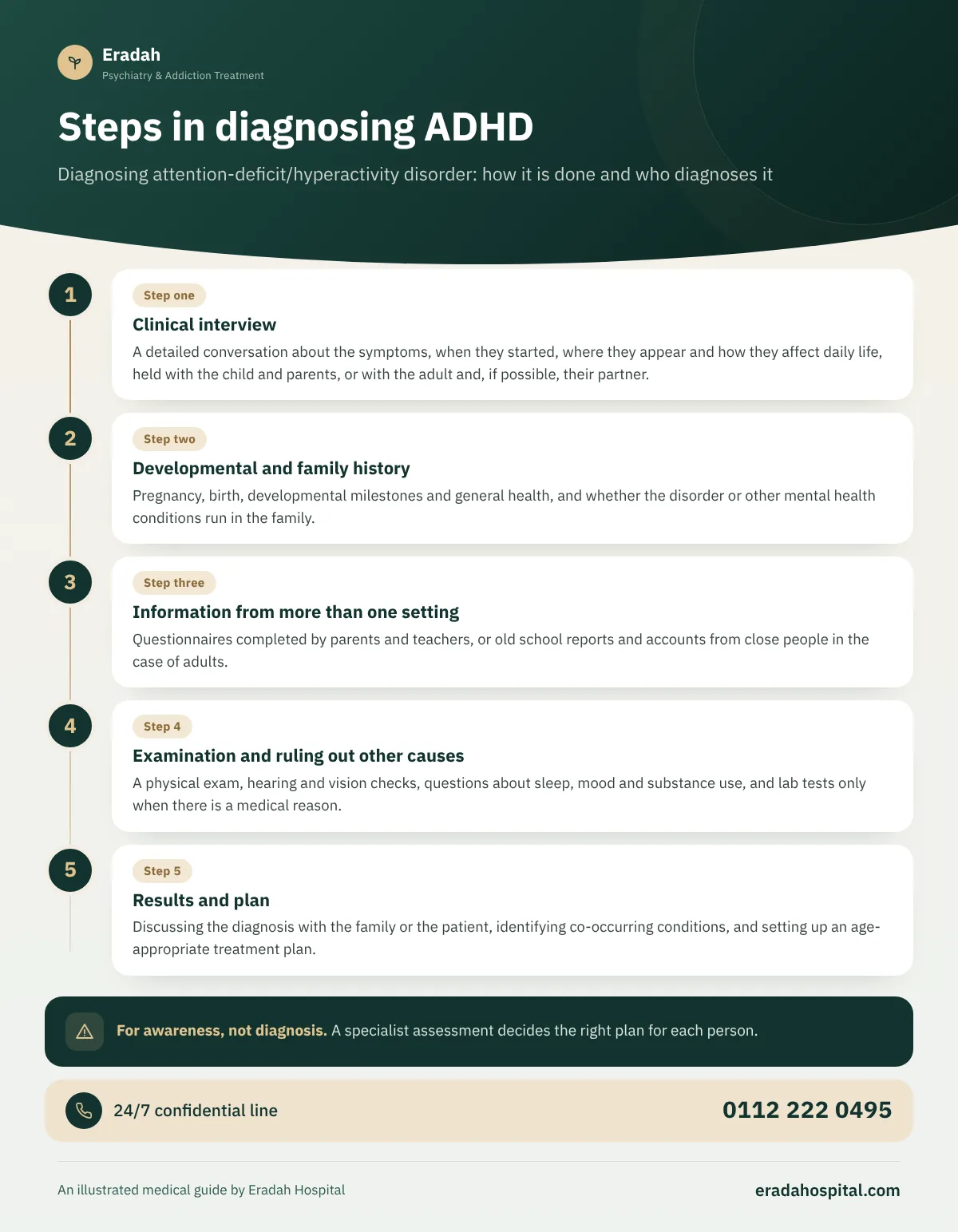
- Step oneClinical interview
A detailed conversation about the symptoms, when they started, where they appear and how they affect daily life, held with the child and parents, or with the adult and, if possible, their partner.
- Step twoDevelopmental and family history
Pregnancy, birth, developmental milestones and general health, and whether the disorder or other mental health conditions run in the family.
- Step threeInformation from more than one setting
Questionnaires completed by parents and teachers, or old school reports and accounts from close people in the case of adults.
- Step 4Examination and ruling out other causes
A physical exam, hearing and vision checks, questions about sleep, mood and substance use, and lab tests only when there is a medical reason.
- Step 5Results and plan
Discussing the diagnosis with the family or the patient, identifying co-occurring conditions, and setting up an age-appropriate treatment plan.
What criteria must be met for a diagnosis?
- A sufficient number of inattention or hyperactivity-impulsivity symptoms: six for children up to age 16, and five for those older.
- Symptoms lasting at least six months at a level that is inconsistent with the person's developmental stage.
- Several symptoms present before age 12.
- Symptoms appearing in two or more settings, such as home and school or work.
- Clear evidence that they interfere with social, academic or occupational functioning.
- They are not better explained by another condition such as anxiety, depression or psychosis.
Which validated scales are used in the assessment?
Scales help the doctor gather information in an organized way and compare symptoms with those of the person's peers. Among the best known are:
| Measure | For whom | Completed by |
|---|---|---|
| Vanderbilt scale | School-age children | Parents and teacher |
| Conners scale | Children and adolescents, with an adult version | Parents, teacher and the person themselves |
| SNAP-IV scale | Children and teenagers | Parents and teacher |
| ADHD-RS-5 rating scale | Children and teenagers | Parents and teacher |
| World Health Organization ASRS scale | Adults (initial screening tool) | The person themselves |
| DIVA-5 interview | Adults (structured diagnostic interview) | The doctor, with the patient and a close person |
| Brown scale | Adolescents and adults | The person themselves and close people |
Which conditions resemble ADHD and must be ruled out?
| The situation | How it resembles ADHD | What sets it apart |
|---|---|---|
| Anxiety | Distraction and restlessness | Anxious thoughts are what steal attention, and symptoms are tied to frightening situations |
| Depression | Poor concentration and slowness in completing tasks | Sadness and loss of pleasure, with a more recent onset rather than since childhood |
| Learning difficulties | Falling behind at school and avoiding homework | A specific difficulty with reading, writing or math |
| Autism spectrum disorder | Social difficulties and excess movement | Difficulty with social communication and restricted, repetitive interests; the two conditions may occur together |
| Sleep problems | Distraction and daytime irritability | Snoring, pauses in breathing during sleep, or too few hours of sleep |
| Hearing or vision problems | Does not respond to instructions and does not follow the board | They show up on hearing and vision tests |
| Bipolar disorder | Impulsivity and talkativeness | Episodes with a clear beginning and end, with an obvious change in mood and sleep |
| Substance use | Distraction and impulsivity | Symptoms are linked to periods of use or withdrawal |
| Trauma and family stress | Heightened alertness and distraction | Linked to a particular event or environment, and need a specific assessment |
Keep in mind that ADHD can occur alongside any of these conditions. It is not always “either this or that,” which is why the assessment needs experience and enough time.
How is an adult diagnosed?
Diagnosing an adult is a little harder, because the doctor needs to confirm that the symptoms began in childhood. For that reason the doctor may ask for old school reports, or for a recent conversation with a parent or partner, and will ask carefully about anxiety, depression and substance use, because they cause similar symptoms. If the person uses substances regularly, the doctor may delay the final judgment until after a period of abstinence.
Can a child be diagnosed before school age?
According to US guidelines, children can be diagnosed from around age four, but with greater caution, because extra activity is a normal part of this stage. The doctor focuses on how severe the symptoms are compared with peers and how clearly they affect nursery and home life.
Why is an online test or a social media video not enough?
- Everyone is absent-minded sometimes: quick tests do not measure severity, persistence, or onset in childhood.
- Other conditions cause the same symptoms: such as anxiety, depression, poor sleep and thyroid problems, and their treatment may be missed.
- Self-diagnosis may lead to taking medication without a prescription: a real danger, especially with stimulants.
- A person may also be wrongly reassured: and put off an assessment they actually need.
What happens after diagnosis?
A diagnosis is the start of better understanding and should not be seen as a stigma. The doctor explains the result to the family or the patient, identifies co-occurring conditions, discusses treatment options suited to the person's age and circumstances, and may write a report to help the school provide support. Learn about the options on the ADHD treatment page.