What causes ADHD?
There is no single cause, but a group of genetic and environmental factors that affect brain development from before birth. The major health centers agree that genetics ranks first among these factors.
It matters to understand the causes not to assign blame, but to ease parents’ guilt, to understand why the disorder recurs in families, and why it does not go away with punishment or advice alone.
Is ADHD hereditary?
Yes, to a large degree. Medical references describe it as one of the most heritable psychiatric conditions, and twin studies estimate that genetics explains about 70–80% of the differences between people in its symptoms. The risk for the siblings of an affected child is higher than for the general population.
There is no “single gene” for the disorder, but a large number of genes, each with a small effect, that combine to form a predisposition. This is why, when a child is diagnosed, parents are advised to notice similar difficulties in themselves or in the child’s siblings.
What happens in the brain?
Imaging studies show that some brain regions responsible for planning and for controlling attention and behavior may mature at a slightly slower pace in people with ADHD than in their peers on average, and that connectivity between the attention and reward networks works differently. Dopamine and norepinephrine signals also play a role in regulating these networks.
How do genetics and environment interact?
Genetic predisposition does not work in a vacuum; a child with a strong predisposition may show symptoms more severely in a chaotic or stressful environment, while adapting better in an organized home and a supportive school. This interaction explains why the course of the disorder differs between two brothers with the same predisposition, and why organizing the environment is an important part of the plan, without the environment being the original cause.
An affected parent may themselves find routine and organization at home difficult, which multiplies the effect of the disorder on the child. That is why assessing and supporting the parent is sometimes one of the most useful steps for the whole family.
What is the role of pregnancy and birth?
Children born well before their due date are more likely to have the disorder.
Linked to a higher likelihood, especially with premature birth.
Affects the development of the fetal brain and is linked to attention and behavior difficulties.
The US Centers for Disease Control and Prevention lists it among possible risk factors.
Exposure to drugs before birth may affect brain development and attention functions.
Does the environment play a role after birth?
Known environmental factors include lead exposure in pregnancy or early childhood, and head injuries that affect the frontal lobe. The US Centers for Disease Control and Prevention also lists parental mental health and family circumstances among linked factors. But these factors explain a smaller share of cases than genetics does.
Severe deprivation and neglect in early childhood may cause attention and behavior difficulties resembling the disorder, and here the doctor needs a careful assessment to tell the two effects apart.
Does wrong parenting cause ADHD?
No. Parenting style does not create the disorder, but it greatly affects its course. A home that relies on shouting and constant punishment may increase stubbornness, anxiety and low self-esteem, while clear routine, rewards and warmth help reduce problems. That is why parent training is part of the treatment plan, without meaning that parents are the cause.
What makes difficulties worse without causing them?
- Lack of sleep: increases distractibility and irritability in anyone, and more in people with ADHD.
- Stress and major changes: such as moving to a new school or family problems.
- An environment crowded with distractions: such as studying in front of the TV or phone.
- Lack of routine: during vacations or with disrupted household schedules.
- Substance use: such as hashish and alcohol, which weaken attention and memory further.
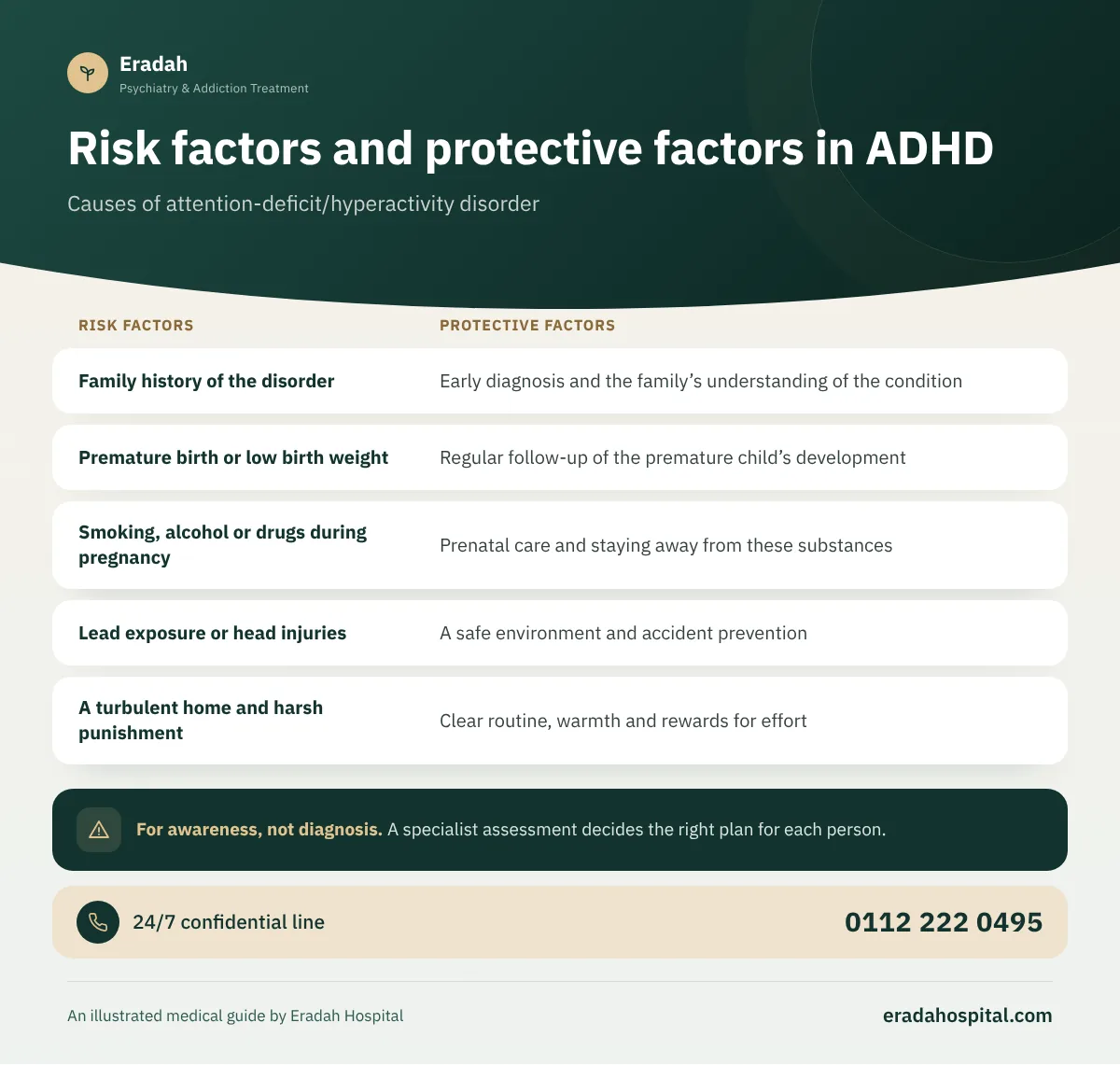
What are the risk factors and protective factors?
| Risk factors | Protective factors |
|---|---|
| Family history of the disorder | Early diagnosis and the family’s understanding of the condition |
| Premature birth or low birth weight | Regular follow-up of the premature child’s development |
| Smoking, alcohol or drugs during pregnancy | Prenatal care and staying away from these substances |
| Lead exposure or head injuries | A safe environment and accident prevention |
| A turbulent home and harsh punishment | Clear routine, warmth and rewards for effort |
Common myths about the causes of ADHD
Research does not show that sugar causes the disorder, although a healthy diet is beneficial for everyone.
Excessive screen time may increase distractibility and harm sleep, but it is not a proven cause of the disorder.
There is no scientific evidence of any link between vaccines and the disorder.
The disorder has a neurological and genetic basis, and firmness alone does not treat it.
Can ADHD be prevented?
The genetic predisposition cannot be prevented, but some risk factors can be reduced: prenatal care, avoiding smoking, alcohol and drugs during pregnancy, avoiding lead exposure, and preventing head injuries. Most important is early detection, because it prevents many secondary complications such as academic failure and low self-esteem.