What are the symptoms of inattention?
Diagnostic manuals such as the DSM-5 list nine symptoms of inattention, and the doctor looks for at least six of them in children up to age 16, and five in those aged 17 and over.
- Repeated mistakes from not paying attention to details in homework or work.
- Difficulty staying focused during a lesson, while reading or in a long conversation.
- Seems not to hear when spoken to directly, with their mind somewhere else.
- Does not follow instructions through to the end and does not finish homework or tasks.
- Difficulty organizing tasks, time and belongings, and constantly missing deadlines.
- Avoiding or disliking tasks that need long mental effort.
- Losing necessary items such as pens, keys, the phone and papers.
- Easily distracted by any sound, movement or passing thought.
- Forgetfulness in daily activities such as appointments, paying bills and replying to messages.
What are the symptoms of hyperactivity and impulsivity?
- Fidgeting, tapping the hands or feet, or squirming in the seat.
- Leaving their seat in situations where sitting is expected.
- Running or climbing at inappropriate times, or, in adults, an inner feeling of restlessness.
- Difficulty playing or doing activities quietly.
- Seems “driven by a motor” that never stops, and others find it hard to keep up.
- Talking excessively.
- Blurting out an answer before the question is finished and finishing other people's sentences.
- Difficulty waiting their turn in line, in play or in conversation.
- Interrupting others or intruding on their conversations, games and belongings.
What do the signs look like in young children?
In the preschool years, extra activity is largely normal, so judging it calls for caution. But some signs deserve attention if they are clearly more severe than in peers and persist: restlessness that does not settle even during favorite activities, repeated injuries caused by impulsivity, being expelled from nursery because of behavior, and great difficulty playing with other children.
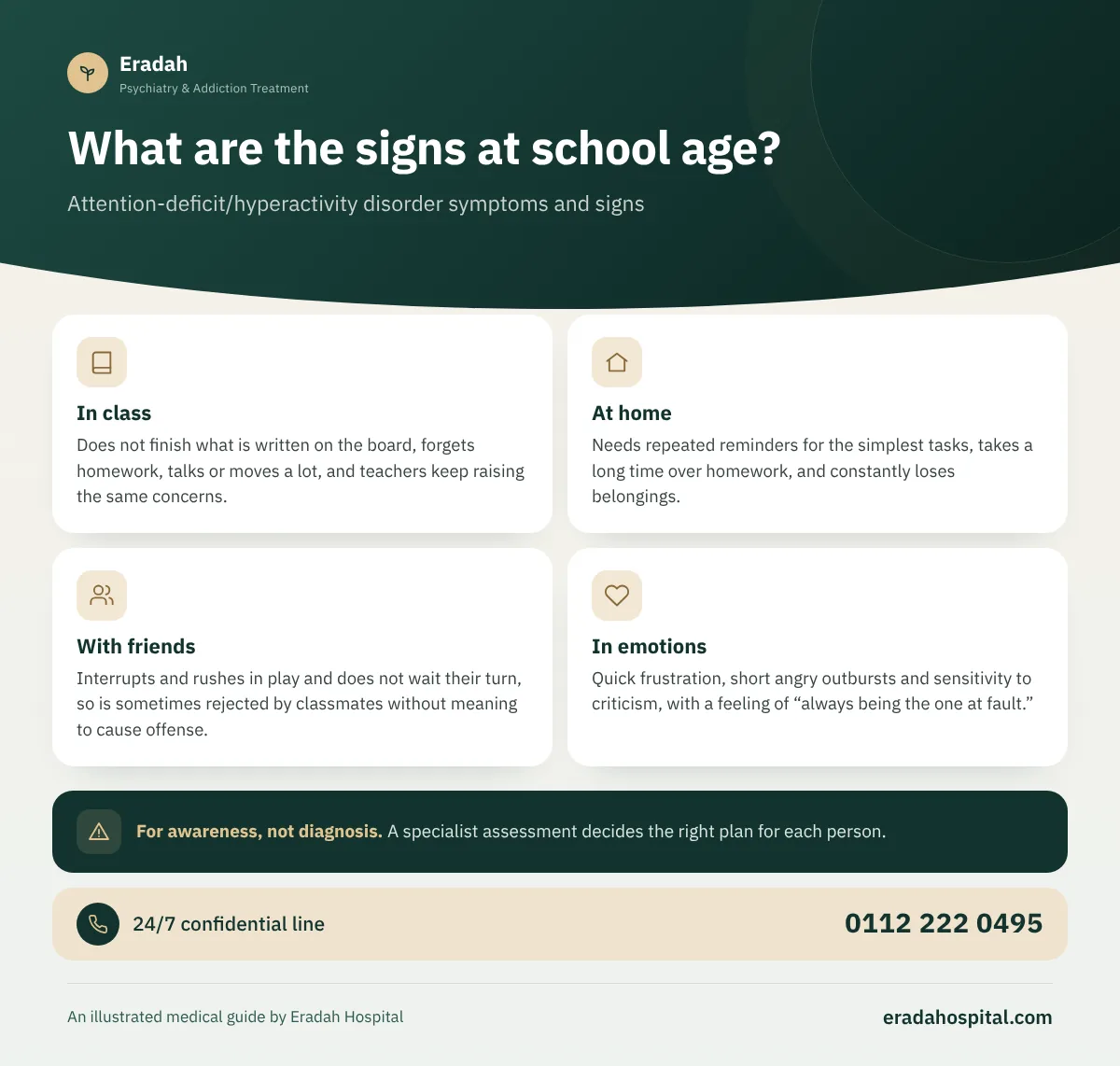
What are the signs at school age?
Does not finish what is written on the board, forgets homework, talks or moves a lot, and teachers keep raising the same concerns.
Needs repeated reminders for the simplest tasks, takes a long time over homework, and constantly loses belongings.
Interrupts and rushes in play and does not wait their turn, so is sometimes rejected by classmates without meaning to cause offense.
Quick frustration, short angry outbursts and sensitivity to criticism, with a feeling of “always being the one at fault.”
How do symptoms change in adolescence?
Visible movement often lessens, but the demands for organization and studying increase, so the problem shows up as falling grades, procrastination and forgotten appointments. Impulsivity increases in the form of reckless decisions, hasty driving, trying smoking or substances early, and sharp conflicts with the family. A teenager may need help understanding themselves beyond the labels “failure” or “irresponsible.”
What are the symptoms of attention deficit in adults?
| Area | Common signs |
|---|---|
| Work | Putting tasks off until the last minute, mistakes in details, difficulty in long meetings, and moving between jobs |
| Time | Frequent lateness, poor estimates of the time needed, and forgotten appointments |
| Money | Impulsive spending, late payment of bills, and forgotten commitments |
| At home | Accumulating clutter, tasks that are started and never finished, and difficulty keeping a routine |
| Relationships | Interrupting a partner, forgetting what matters to them, and quick emotional reactions |
| Feelings | Inner restlessness, quick boredom, brief mood swings, and a feeling of not fulfilling one's potential |
Why are symptoms missed in girls and women?
The UK's National Health Service notes that the disorder is identified less often in girls than in boys, because girls more often have quiet inattention rather than visible movement. A dreamy, absent-minded girl who bothers no one is rarely referred for an assessment.
- Working twice as hard to hide the difficulty, ending in severe exhaustion.
- Talking a lot or jumping between topics instead of physical movement.
- Anxiety or sadness that draws more attention than the distraction itself.
- Difficulties worsening as responsibilities grow after marriage or having children.
When are symptoms mild and when are they severe?
| Level | What it looks like |
|---|---|
| Mild | Few symptoms beyond the number required, with limited impact on school or work |
| Moderate | Symptoms and impact between mild and severe |
| Severe | Many symptoms beyond the number required, or extremely severe symptoms, with clear disruption of social, academic or occupational life |
Does the disorder come with difficulty controlling emotions?
Although emotional dysregulation is not an official symptom, many doctors and families notice that people with ADHD get worked up quickly, are frustrated by small obstacles, and are strongly affected by rejection or criticism, then calm down quickly. This aspect sometimes causes more problems in relationships than the distraction itself, and is worth mentioning to the doctor.
Self-reflection questions: do I need an assessment?
These questions are for awareness only and are not a diagnosis, since many conditions such as anxiety, depression and lack of sleep cause similar distraction:
- Have I had ongoing difficulty since childhood finishing tasks after completing the enjoyable part?
- Do I forget appointments and commitments despite my repeated attempts to organize them?
- Do I feel an inner restlessness that makes sitting for long tiring?
- Do I make hasty decisions I regret, with money or in what I say?
- Did teachers tell me as a child that I was smart but did not focus?
If most of your answers are yes and they clearly affect your life, learn about the steps of ADHD diagnosis with a specialist.
Suicidal thoughts or danger to self? Get help now
- Talk of wanting to die or of the family being better off without them
- Severe hopelessness after failing, being dismissed, a breakup or harsh punishment
- Sudden dangerous impulsiveness: reckless driving, heavy substance use or self-harm
- Sudden withdrawal from friends and family and saying goodbye to them
- Severe agitation or sleeplessness for days, or strange symptoms after taking stimulants without a prescription
Do not leave the person alone. Listen calmly without blame or lectures, and keep dangerous objects out of their reach in general. Call an ambulance (123) or go to the nearest emergency room, or call the mental health support line 16328 around the clock, and inform their treating doctor.
Ambulance 123 Mental health support line 16328