How are hallucinations treated?
There is no single “hallucination medicine” that suits everyone; the voice heard by a person with schizophrenia, the insects seen by someone in alcohol withdrawal, and the images seen by a grandmother who has lost her sight are three completely different situations in terms of treatment. So the first step in treating hallucinations is a careful assessment to find the cause.
The NHS says treatment depends on the cause: therapy or medication for someone with a mental illness such as schizophrenia, and advice on cutting down on alcohol, staying away from drugs, and getting enough sleep in other cases. Added to this is an equally important goal: reducing the fear and distress that accompany hallucinations, even if some of them remain.
When is treatment of hallucinations an emergency?
Before any long-term plan, conditions that need emergency care right away must be ruled out: hallucinations with sudden confusion or fever, or after stopping alcohol or sedatives, voices that command harm, or severe agitation. Delirium tremens, for example, can be life-threatening, and delirium from an infection in an older adult needs the infection treated, not a sedative. In these cases call the ambulance (123) or the mental health support line 16328 (24 hours).
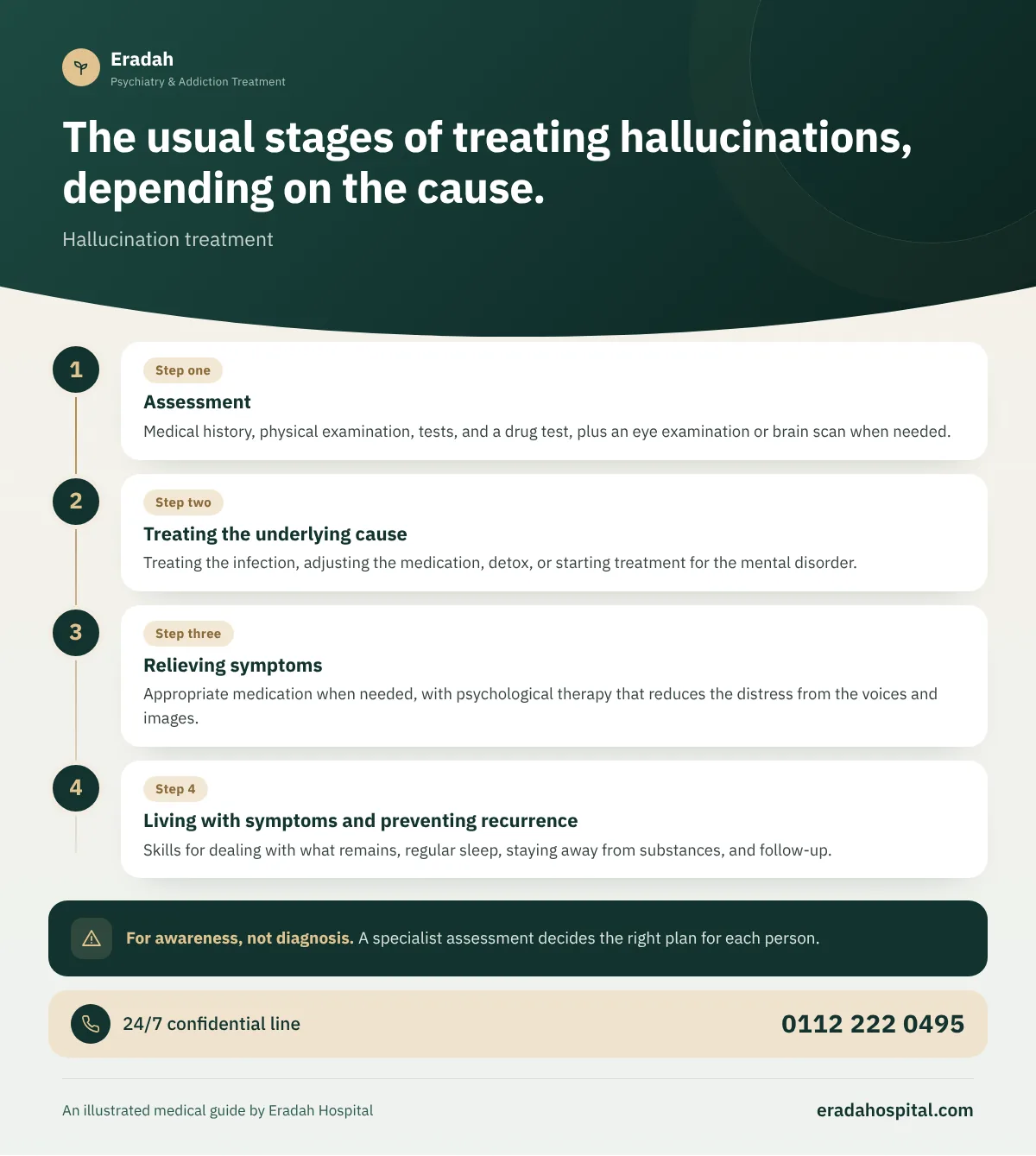
What are the stages of treating hallucinations?
- Step oneAssessment
Medical history, physical examination, tests, and a drug test, plus an eye examination or brain scan when needed.
- Step twoTreating the underlying cause
Treating the infection, adjusting the medication, detox, or starting treatment for the mental disorder.
- Step threeRelieving symptoms
Appropriate medication when needed, with psychological therapy that reduces the distress from the voices and images.
- Step 4Living with symptoms and preventing recurrence
Skills for dealing with what remains, regular sleep, staying away from substances, and follow-up.
What is the role of medication in treating hallucinations?
When hallucinations are part of psychosis, schizophrenia, or a manic episode, antipsychotics are usually a core part of treatment, and StatPearls says auditory hallucinations respond well to psychiatric medication. Their effect often takes days to weeks, and the doctor chooses the type and dose according to the case and side effects.
But medication is not the answer in every case. For older adults with dementia, the Alzheimer’s Association warns that antipsychotics are linked to a higher risk of stroke and death, and that non-drug approaches come first. In Parkinson’s disease, the doctor may review the disease medicines themselves before adding a new one.
Does psychotherapy help with auditory hallucinations?
Yes. The UK guidelines (NICE) recommend offering cognitive behavioral therapy to everyone with psychosis, and among its stated aims are reducing distress and developing alternative ways of dealing with the symptom. It does not rely on denying the voice, but on examining what it says and how powerful it claims to be, and changing how the person responds to it.
One modern approach is avatar therapy: the person talks with a digital image representing the source of the distressing voice, played by the therapist so that it gradually becomes less hostile and gives up its power. In a randomized trial published in Lancet Psychiatry that included 150 people whose voices persisted despite treatment, this approach reduced the severity of the voices after 12 weeks more than supportive counseling sessions did. The researchers noted that about a quarter of people with psychosis continue to have auditory hallucinations despite treatment, and that broader studies are needed before it is widely adopted.
How are drug-related and withdrawal hallucinations treated?
If the hallucinations are an effect of crystal meth (shabu), Strox, or hallucinogens, the foundation is stopping the substance completely in a safe place, then treating the addiction itself. In alcohol or sedative withdrawal, stopping suddenly at home is not safe; instead, medically supervised detox is needed because complications can be serious. If the hallucinations continue after the effect of the substance has gone, they may be drug-induced psychosis, which needs treatment and follow-up.
How are non-psychiatric hallucinations treated?
Charles Bonnet syndrome: there is no cure, according to the NHS, but the hallucinations usually become less frequent over time. The NHS suggests that, when you are hallucinating, you can change the lighting, move your eyes from side to side without moving your head 15 to 30 times, then stop and repeat, get up and move around, or reach out to touch the image, along with getting good sleep, keeping the home well lit, and having regular eye checks.
Delirium, infection, and medications: the cause itself is treated, such as the infection or dehydration, or the medication responsible is adjusted under the doctor’s supervision. Lack of sleep: improve sleep and treat insomnia, since hallucinations linked to exhaustion usually go away with rest.
How does a person live with the remaining voices?
Even with treatment, some people may still hear some voices, and the goal then is for the voices to lose their power to control life. Skills a patient usually learns with their therapist include:
- Recording when the voices appear and what comes before them, such as tiredness, loneliness, or stress, in order to avoid triggers.
- Reminding yourself that the voice is a symptom of the condition, not a command to be obeyed.
- Occupying the mind with an activity that needs concentration, or talking with someone you trust.
- Keeping a regular sleep routine and avoiding alcohol, cannabis, and stimulants.
- Sharing the experience honestly with the doctor, especially if the content of the voices changes or they begin to order something.
How do you support someone who sees or hears what you do not?
- Stay calm and speak in a low voice and short sentences.
- Do not mock their experience, and do not say that what they see is real.
- Say something like: “I can’t hear that voice, but I believe you hear it and that it’s upsetting you.”
- Reduce noise, bright light, and crowding around them.
- Ask them calmly what the voices are saying, especially if they are ordering them to do something.
- Remove dangerous objects, and call for urgent help if any danger appears.
At Eradah, the path begins with a confidential assessment by a psychiatrist to identify the cause, then a plan that may be in the outpatient clinic, or inside the psychiatric hospital if the condition needs intensive care, or in the dual diagnosis program when hallucinations occur together with substance use.
Hallucinations with danger or confusion? Get help now
- Voices that command the person to harm themselves or others, or a stated wish to do so
- Hallucinations getting worse quickly, or severe agitation and aggression
- Sudden confusion, unintelligible speech or a high fever
- Hallucinations with tremors and sweating days after stopping alcohol
- Severe headache, weakness on one side of the body or seizures along with the hallucinations
Stay with the person and talk to them calmly. Do not mock what they see or hear, and do not confirm it either. Keep dangerous objects out of their reach without confrontation, and do not let them drive. Call the ambulance on 123 or take them to the nearest emergency room, bring their medications, and tell the medical team about any alcohol or substance they used. You can call the mental health support line 16328 (24 hours) for advice.
Ambulance 123 Mental health support line 16328