What are the goals of schizophrenia treatment?
The goal goes beyond silencing the voices; it is to restore life: for the person to return to study or work, keep relationships, live as independently as possible, and have fewer relapses. That is why the UK’s NICE guidelines recommend that treatment be delivered in partnership with the patient and family and in an atmosphere of hope and optimism.
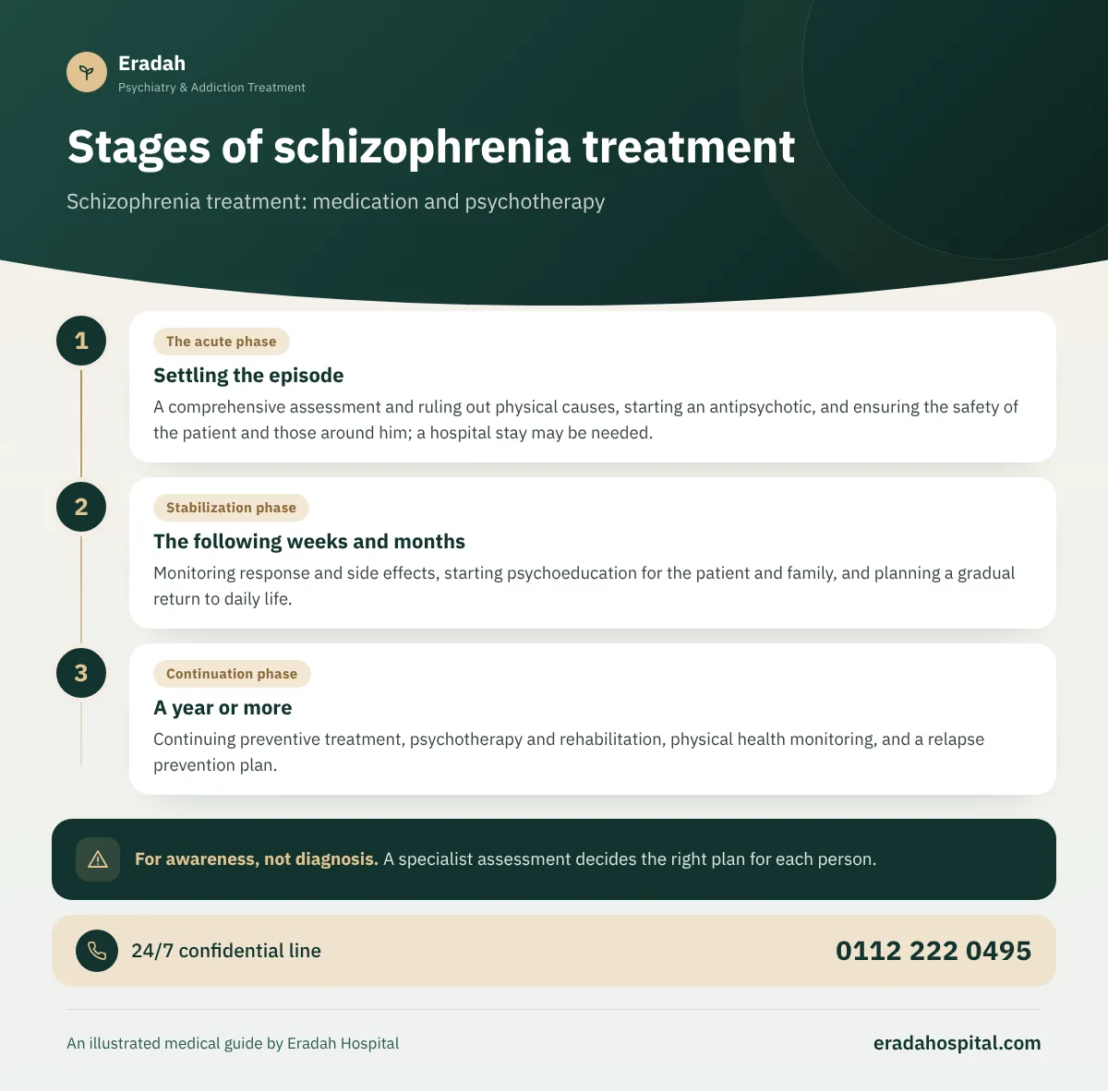
- The acute phaseSettling the episode
A comprehensive assessment and ruling out physical causes, starting an antipsychotic, and ensuring the safety of the patient and those around him; a hospital stay may be needed.
- Stabilization phaseThe following weeks and months
Monitoring response and side effects, starting psychoeducation for the patient and family, and planning a gradual return to daily life.
- Continuation phaseA year or more
Continuing preventive treatment, psychotherapy and rehabilitation, physical health monitoring, and a relapse prevention plan.
Why does early intervention after the first episode matter?
In many countries there are specialized services called early intervention in psychosis or coordinated specialty care, which bring together in one team the psychiatrist, therapist, social worker, and employment and education specialist, working with the young person and family during the first years. Research shows this model improves return to study and work and reduces hospital admissions.
The practical lesson for Egyptian families: do not settle for a prescription after the first episode, but ask for a plan that includes regular follow-up, rehabilitation, family education, and a carefully planned return to daily life.
What are antipsychotics and how do they work?
Antipsychotics are the main medication for schizophrenia. They work mainly by adjusting dopamine activity, and some also affect serotonin. They fall into two generations:
| Category | Examples | General notes |
|---|---|---|
| First generation (typical) | Haloperidol, chlorpromazine, flupentixol | Effective for positive symptoms, and cause more movement symptoms such as stiffness and tremor |
| Second generation (atypical) | Risperidone, olanzapine, quetiapine, aripiprazole, paliperidone | Usually fewer movement symptoms, and some raise weight, blood sugar, and lipids |
| Clozapine | Clozapine | The most effective in resistant cases, and requires regular blood tests |
There is no single “best” medication for everyone; the doctor chooses based on symptoms, medical history, likely side effects, and the patient’s own preference. The response can take days to weeks to become clear: agitation and insomnia settle first, then hallucinations and delusions gradually recede.
What are the common side effects and how are they monitored?
- Weight gain and changes in blood sugar and lipids: these need regular measurement of weight, blood pressure, and blood tests, along with dietary advice and physical activity.
- Drowsiness and sluggishness: common at the start, and may improve with time or by changing the time of day the medication is taken.
- Movement symptoms: stiffness, tremor, inner restlessness, or involuntary movements. They are treated by adjusting the plan and should not be ignored.
- Raised prolactin: with some medications, which may cause menstrual disturbance or sexual dysfunction, and which can be discussed openly with the doctor.
- Rare but urgent signs: high fever with severe stiffness and confusion, which needs emergency care immediately.
Many patients stop treatment because of effects that could have been eased if they had told the doctor. Speaking openly about every troublesome symptom is part of successful treatment.
What are long-acting injections and who are they suitable for?
Long-acting injections, or “depot” injections, are a form of antipsychotic given into the muscle at intervals ranging from one week to several weeks or more depending on the medication, instead of daily tablets. They suit people who find it hard to remember tablets, who prefer not to think about medication every day, or who have relapsed repeatedly because they stopped treatment.
Among their advantages is that the doctor and family know clearly that the patient is receiving treatment, and they reduce daily friction at home over “Did you take your medication?” The decision is made in agreement with the patient and not imposed on him, unless his condition requires otherwise under the law.
When is clozapine used?
The UK’s NICE guidelines recommend offering clozapine to people whose condition has not improved enough despite trying at least two different antipsychotics for an adequate time and dose, at least one of them a second-generation drug. Clozapine is the most effective medication in these resistant cases, and it is also linked to fewer suicidal thoughts in some patients.
But it requires regular blood tests to monitor white blood cells, along with monitoring of the heart, constipation, and metabolism. Smoking also changes its level in the blood, so if the patient quits smoking or starts again, the doctor must be told right away so the plan can be reviewed.
What are the psychological and social treatments for schizophrenia?
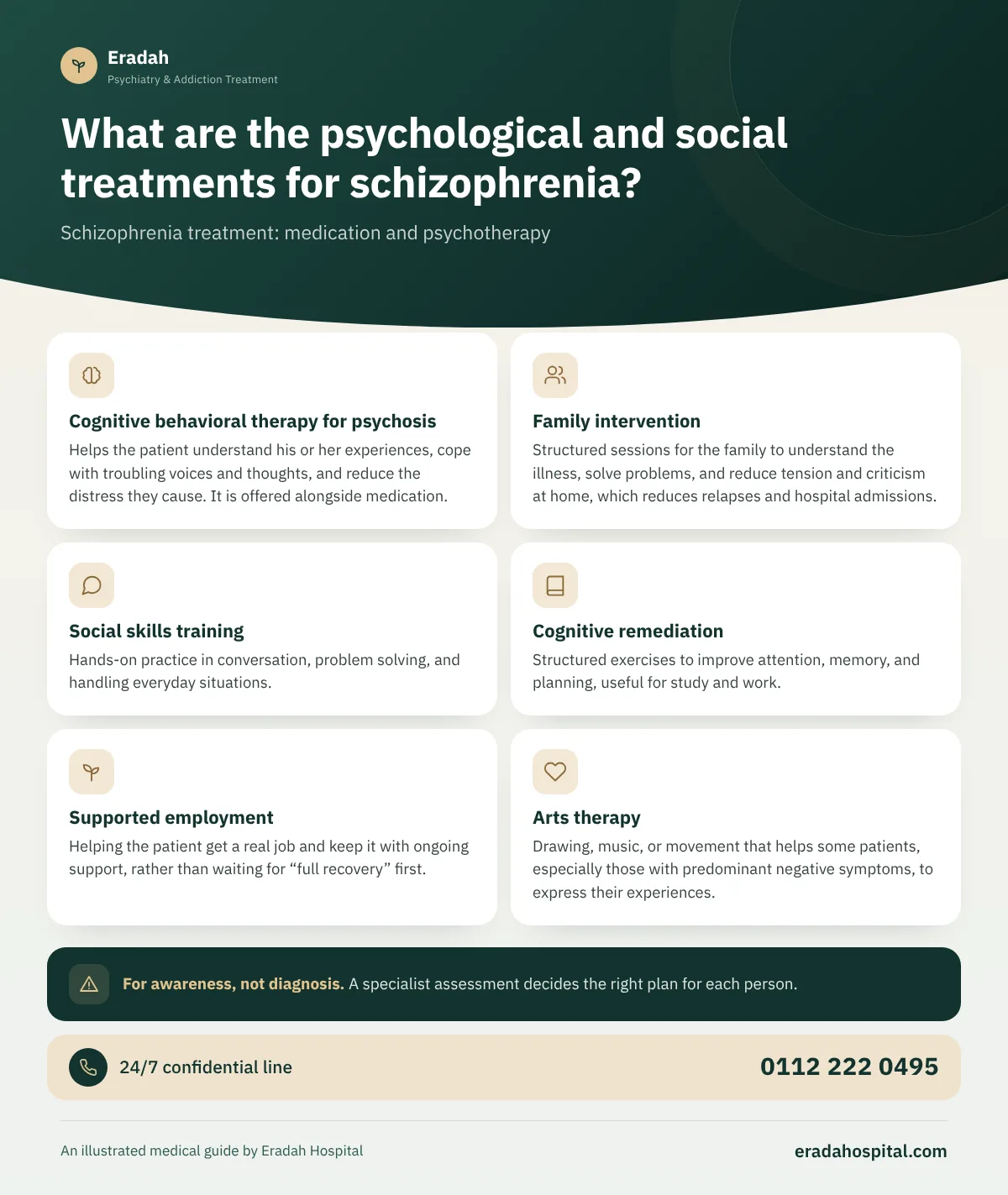
Helps the patient understand his or her experiences, cope with troubling voices and thoughts, and reduce the distress they cause. It is offered alongside medication.
Structured sessions for the family to understand the illness, solve problems, and reduce tension and criticism at home, which reduces relapses and hospital admissions.
Hands-on practice in conversation, problem solving, and handling everyday situations.
Structured exercises to improve attention, memory, and planning, useful for study and work.
Helping the patient get a real job and keep it with ongoing support, rather than waiting for “full recovery” first.
Drawing, music, or movement that helps some patients, especially those with predominant negative symptoms, to express their experiences.
Does a person with schizophrenia need to be admitted to hospital?
Most patients are treated as outpatients. Hospital admission is usually needed when there is danger to the person or others, when the patient refuses food and drink, when the episode is so severe that treatment at home is not possible, or when substance use requires medical detox. The aim is a short, safe stay followed by an organized return to outpatient follow-up.
Egypt’s Mental Patient Care Law No. 71 of 2009 regulates patients’ rights and the conditions for compulsory admission in specific cases, with safeguards for review. This is general educational information, not legal advice.
What are the signs of relapse and how do we prevent it?
Relapse rarely happens suddenly; it is usually preceded by warning signs that repeat in the same pattern in the same person. That is why a relapse prevention plan is written with the patient and family, setting out these signs and what to do when they appear:
- Disturbed sleep or increasing late nights for no clear reason.
- Return of irritability, suspicion, or withdrawing to the room.
- Neglecting medication or appointments, or saying “I don’t need treatment anymore.”
- Return of faint voices or strange thoughts, or difficulty concentrating.
- Going back to hashish, alcohol, or any other substance.
When these signs appear, the patient or family should contact the doctor early, since a small adjustment to the plan may prevent a full episode. NICE also recommends physical health monitoring, support to quit smoking, regular sleep, physical activity, and complete avoidance of drugs.
How does the family help treatment succeed?
- Attend some appointments with the patient’s consent, and ask about the treatment plan and the signs of relapse.
- Encourage rather than monitor with hostility; praise for small steps works better than blame for lapses.
- Keep a calm daily routine: sleep, meals, and a simple activity.
- Learn calm communication: short sentences, clear requests, and no shouting or hurtful criticism.
- Ask for support for yourselves; an exhausted family cannot sustain support for long.
What to Look for in a Hospital for Schizophrenia Treatment
Choosing where to be treated for schizophrenia is a long-term decision, not just about the current episode. The illness needs years of follow-up for antipsychotics and their side effects, some medications used in resistant cases require regular blood tests, and a fair number of patients use hashish or stimulants, which alone can trigger a relapse. So compare facilities using the following:
| Criterion | Good sign | Warning sign |
|---|---|---|
| Residential treatment | Short, aimed at stabilization and then an organized return to follow-up | Open-ended confinement with no discharge plan |
| Medicine | Explanation for the patient and family, and a chance to discuss long-acting injections | Frequent medication changes with no explanation |
| Side effects | Monitoring of weight, blood sugar, and movement | Ignoring complaints until the patient stops treatment |
| Co-occurring substance use | Addiction treatment within the same plan | Simply keeping the substance away during the stay |
| Rights | Compliance with the Mental Patient Care Law | Vague admission and discharge procedures |
At Eradah, the psychiatric hospital receives schizophrenia episodes under the supervision of Dr. Mahmoud El-Sawy, with doctors and nursing around the clock; the dual diagnosis program treats co-occurring substance use; and families learn in their program how to catch the first signs of relapse early.
How is schizophrenia treated at Eradah?
At Eradah, treatment begins with a comprehensive psychiatric and medical assessment that rules out physical causes and asks about any substance use. An individual plan is then built combining medication, psychological treatment, family education, and a relapse prevention plan, with residential treatment available for acute cases or those accompanied by addiction, followed by outpatient follow-up. All of this is done in full confidentiality and with respect for the privacy of the patient and family.