Why does a person see or hear things that are not there?
The brain does not simply “receive” the world as it is; it builds its picture from signals from the senses and from its own expectations. When this process breaks down, because of a mental illness, a drug, a shortage of signals from the eyes, or inflammation, the brain can fill the gap with voices and images of its own making. That is why the causes of hallucinations range across psychiatric, neurological, medication-related, and physical.
The NHS says hallucinations can result from many health conditions that affect the senses, and that some are temporary and short-lived. For this reason the doctor does not start by assuming the cause is psychiatric, but looks at the whole picture.
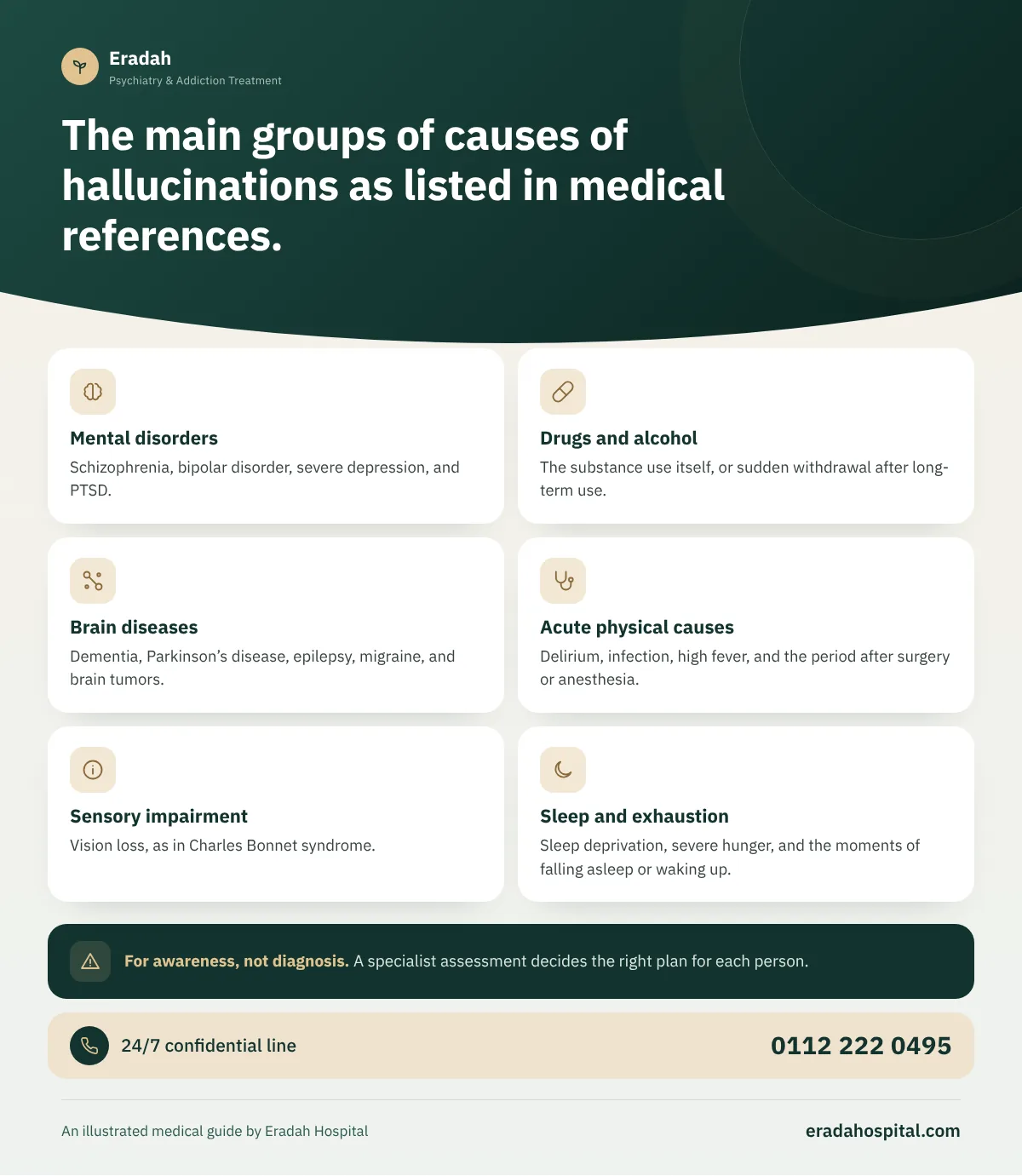
What are the main groups of causes of hallucinations?
Schizophrenia, bipolar disorder, severe depression, and PTSD.
The substance use itself, or sudden withdrawal after long-term use.
Dementia, Parkinson’s disease, epilepsy, migraine, and brain tumors.
Delirium, infection, high fever, and the period after surgery or anesthesia.
Vision loss, as in Charles Bonnet syndrome.
Sleep deprivation, severe hunger, and the moments of falling asleep or waking up.
Which mental health conditions cause hallucinations?
| Disorder | What often characterizes the hallucinations |
|---|---|
| Schizophrenia | Voices that talk about the person, comment on their actions, or give them orders, along with delusions and disorganized thinking |
| Bipolar disorder | Hallucinations during a manic episode or severe depression, often matching the mood |
| Psychotic depression | Voices that blame or belittle the person and fit with their sense of guilt |
| Post-traumatic stress disorder | Sensations and voices linked to the trauma itself |
A StatPearls review notes that hearing voices is especially associated with schizophrenia but is not exclusive to it, as it also appears in mood disorders, trauma, substance use, and neurological diseases. A review by Waters and colleagues found that visual hallucinations occur in about 27% of people with schizophrenia on average, and in 15% of psychosis associated with mood disorders.
How do drugs and alcohol cause hallucinations?
Hallucinogens such as LSD and magic mushrooms cause visual hallucinations by their nature, and these can turn into a terrifying experience. Stimulants such as crystal meth (shabu) are linked to auditory and tactile hallucinations with suspicion and paranoia, especially after nights without sleep. Synthetic cannabinoids such as Strox are known for sudden episodes of hallucinations and agitation, and Parkinol (trihexyphenidyl) causes intense hallucinations when misused.
In the European survey of more than 13,000 people, current drug use was the factor most strongly linked to tactile hallucinations, such as the feeling of insects crawling under the skin.
Can brain diseases cause hallucinations?
Yes. The NHS lists dementia, including Alzheimer’s disease and dementia with Lewy bodies, and Parkinson’s disease among the common causes of hallucinations, which are often visual, of people or animals. In Parkinson’s disease, part of the problem may be the medicines used to treat it, so the doctor reviews them and the patient should not stop them on their own.
Epileptic seizures and migraine can also cause brief, repeated hallucinations with a similar pattern, and hallucinations can appear with brain tumors and brain injuries. Any hallucinations accompanied by a severe headache, weakness on one side of the body, or convulsions need emergency care.
Why do people with low vision see things that are not there?
This is Charles Bonnet syndrome: clear, detailed visual hallucinations that appear in people who have lost a large part of their sight, for example from macular degeneration, cataracts, glaucoma, or diabetic retinopathy. StatPearls says it affects between 10% and 30% of adults with low vision depending on the diagnostic method, and that when fewer signals reach the brain from the eye, it begins to generate images on its own.
The important difference is that the person usually knows that what they see is not real, and does not hear or smell anything, and the NHS stresses that it is not caused by a mental illness or dementia. Even so, it is often wrongly diagnosed as dementia or psychosis, so older adults are afraid to mention it to their doctors.
What are the acute physical causes of hallucinations?
Delirium is one of the most important causes and the one most often missed, especially in older adults: sudden confusion that fluctuates through the day, with hallucinations that are often visual, caused by infection, dehydration, a new medication, or surgery. The NHS also lists high fever, infection, the period after surgery, anesthesia, and the side effects of some medicines. Delirium is a medical emergency that is treated by treating its cause, not by antipsychotics alone.
Does lack of sleep cause hallucinations?
Yes. Hallucinations at the moment of falling asleep were reported by 24.8% of participants in the European survey, and hallucinations on waking by 6.6%, and in more than half of cases they were not linked to any specific illness. With severe sleep deprivation over consecutive nights, hallucinations can appear even in healthy people. This is why chronic insomnia deserves treatment, not neglect.
How does the doctor find the cause of hallucinations?
The doctor gathers clues from the medical history and examination, and may order blood tests, a drug test, an eye examination, or a brain scan as needed. These are some of the clues the doctor picks up on:
| Observation | What it may suggest |
|---|---|
| Confusion and fluctuating alertness, with fever or a new medication | Delirium from a physical cause |
| Tremor and sweating a few days after stopping drinking | alcohol withdrawal |
| Clear images in a person with poor vision who knows they are not real | Charles Bonnet syndrome |
| Voices commenting on the person, with suspicion and withdrawal for months | A psychotic disorder such as schizophrenia |
| A feeling of insects under the skin after staying awake and using drugs | Stimulant hallucinations |
Once the cause is identified, the appropriate plan follows, and we explain it on the page about treatment of hallucinations.
Hallucinations with danger or confusion? Get help now
- Voices that command the person to harm themselves or others, or a stated wish to do so
- Hallucinations getting worse quickly, or severe agitation and aggression
- Sudden confusion, unintelligible speech or a high fever
- Hallucinations with tremors and sweating days after stopping alcohol
- Severe headache, weakness on one side of the body or seizures along with the hallucinations
Stay with the person and talk to them calmly. Do not mock what they see or hear, and do not confirm it either. Keep dangerous objects out of their reach without confrontation, and do not let them drive. Call the ambulance on 123 or take them to the nearest emergency room, bring their medications, and tell the medical team about any alcohol or substance they used. You can call the mental health support line 16328 (24 hours) for advice.
Ambulance 123 Mental health support line 16328