"My uncle had schizophrenia, and I'm afraid to get married and have my son turn out like him." This is a real fear that many people in families with a mentally ill member live with, and it can push some to hide the illness or put off marriage for years. This article answers with numbers the question: are mental illnesses hereditary? And what do these numbers actually mean for you?
Are mental illnesses hereditary? The short answer
The US National Institute of Mental Health (NIMH) says that some mental disorders run in families, that family history can be an important key to knowing your risk, and that having an affected relative may mean a higher risk "but does not necessarily mean you will develop it," since many other factors take part. It explains that common disorders such as depression and anxiety most likely result from a mix of life experiences, environment and genetic differences.
What does "heritability" mean?
When you read that a disorder's heritability is 80%, this does not mean that a patient's child has an 80% chance of becoming ill. It means that genes account for about 80% of the differences between people in susceptibility to this disorder within a given population. This figure is usually calculated from twin studies: if identical twins resemble each other in illness much more than non-identical twins, that points to a large role for genes. The actual risk for a specific person is estimated another way, from studies of patients' relatives.
Heritability of the best-known mental illnesses
| Estimated heritability | Source | |
|---|---|---|
| Schizophrenia | About 81% | Pooled analysis of 12 twin studies (2003) |
| Attention-deficit/hyperactivity disorder | About 74% | Review in the journal Molecular Psychiatry (2019) |
| Bipolar disorder | About 60% | Swedish population-based twin study (2019) |
| Major depression | About 37% | Pooled analysis of family and twin studies (2000) |
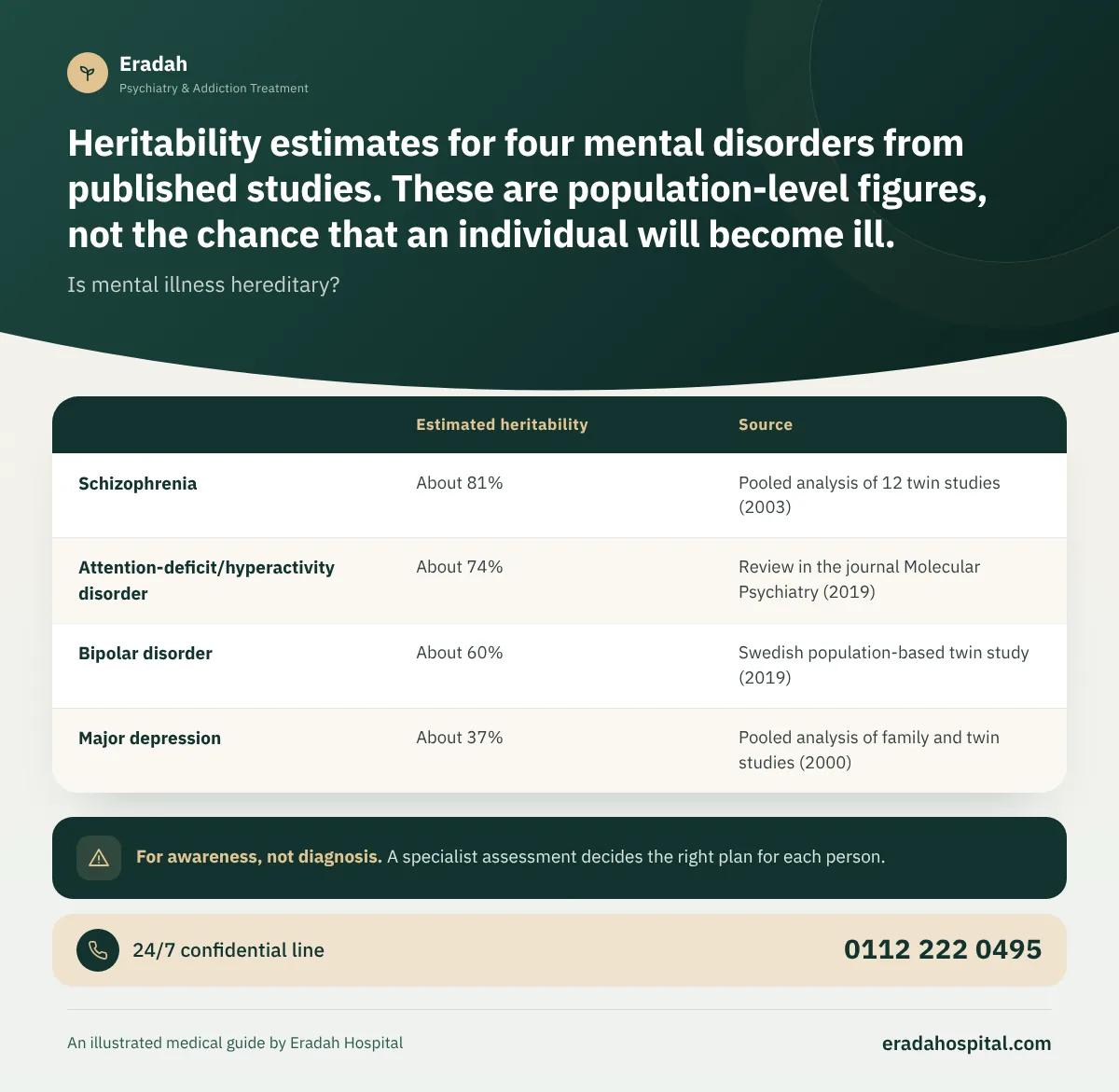
In the same analysis of depression, the odds of illness in a patient's first-degree relatives were about 2.8 times higher, while individual-specific environmental factors explained the largest share of susceptibility (about 63%). In schizophrenia, researchers also found a role for the environment shared by siblings of about 11%, and concluded that it is a "complex trait" that results from genes and environment together.
What is the risk to the children of a person with a mental illness?
In a pooled analysis published in 2014 that covered 33 studies and more than 3,800 children of parents with schizophrenia, bipolar disorder or major depression, the chance that the children would develop a severe mental disorder by adulthood was 32%, more than double that of the comparison group. The risk of developing the same disorder the parent had was about 3.6 times higher. These numbers mean two things at once: the risk is genuinely higher and deserves attention, and about two-thirds of the children did not develop a severe disorder.
Does genetic testing before marriage or having children help?
NIMH states clearly that genetic tests cannot currently accurately predict the risk of a mental disorder, that it is too early to use them for diagnosis or treatment, and that genetic reports sold directly to consumers by companies usually do not help predict this risk and may be misleading. Genetic counseling may help in rare cases where a specific genetic variant or another hereditary disease is suspected, and the doctor decides that.
There is a mentally ill person in my family: how do I lower the risk?
- Learn your family history from first-degree relatives and tell your doctor about it, as NIMH advises.
- Stay away from drugs, because substances such as hashish and stimulants can trigger psychotic symptoms and make any existing disorder harder to treat.
- Keep regular sleep, physical activity and supportive relationships, which are general protective factors for mental health.
- Learn the early warning signs of the disorder in your family, and ask for an assessment when they appear.
- Give your children a safe, supportive home, because environment shares with genes in determining the outcome.
And what about addiction?
Addiction is also influenced by both heredity and environment, and shares risk factors with mental disorders such as genes, trauma and stress, as NIDA explains. The details are on the causes of addiction page, and when the two occur in one person, dual diagnosis treatment is the most suitable.
Heredity is no reason for shame or concealment
Hiding a family member's illness out of fear for siblings' marriages delays that person's treatment and deprives others of knowledge that would help them detect problems early. It is better for the truth to be known calmly and in medical language, and for mental illness to be treated the way diabetes or high blood pressure are, which also run in families. At Eradah you can ask about your own risk or your children's risk in a free, confidential first consultation.