Why is schizophrenia said to have multiple causes?
Doctors today explain schizophrenia with a model called vulnerability and stress: some people are born with a higher susceptibility because of their genes and the course of their brain development, and then factors during life add to the load on that brain until it passes a certain threshold and symptoms appear. In most cases a single factor is not enough on its own.
This is why two brothers can grow up in the same home and face the same conditions, yet one develops the illness and the other does not. No one is "to blame" here; it is a combination of probabilities that is hard to predict in any particular person.
Is schizophrenia hereditary?
Heredity is one of the strongest known risk factors; schizophrenia is more common within some families, the risk rises the closer the relationship, and it is highest in the identical twin of an affected person. Even so, even an identical twin does not develop it in every case, which is clear evidence that the environment plays an important part.
There is no single "schizophrenia gene." Rather, there are hundreds of small genetic variations, each adding a tiny amount of risk, and some of them are shared with other conditions such as bipolar disorder. This is why there are currently no genetic tests that can predict whether a particular person will develop it.
What is the role of dopamine and glutamate in schizophrenia?
The older theory links positive symptoms to overactivity of dopamine in certain pathways in the brain. It is supported by the fact that antipsychotic drugs work mainly on dopamine receptors, and that stimulants that raise dopamine can cause psychotic symptoms.
But dopamine does not explain everything; negative and cognitive symptoms are also linked to a disturbance in glutamate, the most important neurotransmitter in communication between cells, and to changes in frontal lobe networks. Scientists are also investigating the role of inflammation and the immune system, and the picture is not yet complete.
Does schizophrenia begin before birth?
Many researchers see schizophrenia as a disorder of the course of brain development, with roots that begin early and symptoms that appear in late adolescence, when the brain "prunes" its connections and thinking networks mature. Early factors that have been linked to a slight increase in risk include:
- Exposure to certain viral infections or poor nutrition during pregnancy.
- Birth complications that cause oxygen deprivation to the baby, very premature birth or severe low birth weight.
- Older paternal age at conception, according to a number of studies.
- A slight delay in motor or language development in childhood among some of those who later develop the illness.
It is important that a mother not blame herself for these factors; the effect of each is small, and most people who were exposed to them do not develop schizophrenia.
Does cannabis cause schizophrenia?
This is one of the most important questions for the families of our young people. Research shows that using cannabis in adolescence, especially daily use and high-potency types, raises the risk of psychosis and schizophrenia several-fold in some people, and is linked to the illness appearing at an earlier age. A large European study estimated that a share of new psychosis cases in some cities could have been avoided if high-potency types had not been available.
This does not mean that everyone who uses cannabis will develop schizophrenia; cannabis acts as a factor that pushes a predisposed brain toward the illness. The same applies, perhaps more strongly, to synthetic cannabinoids such as Strox, and to stimulants such as crystal meth (known in Egypt as shabu). The relationship between the illness and addiction is explained on the page about schizophrenia and addiction.
What is the role of trauma, stress and environment?
Abuse, neglect or severe bullying in childhood are linked to an increased risk of psychosis later on.
Living and growing up in crowded cities has been linked in studies to a higher risk, possibly because of stress and isolation.
Living far from home, marginalization and social discrimination are constant stresses linked to a higher risk of psychosis.
Prolonged sleep deprivation may set off symptoms in people who are predisposed.
Losing a loved one, moving, or high-stakes exams may come before the first episode and act as a trigger.
Poverty and the stresses of making a living are also linked to increased risk, as the U.S. National Institute of Mental Health notes. Stress alone does not create schizophrenia, but it adds to the load on a brain that is susceptible.
What is the difference between a trigger and a cause?
Families often say: "He got ill after he failed the exam" or "after his father died." In reality, these events are usually triggers that came at the moment that revealed an illness that had been forming slowly, and are not the only cause. Understanding this difference eases a family's sense of guilt and directs effort to what helps: treatment and reducing triggers in the future.
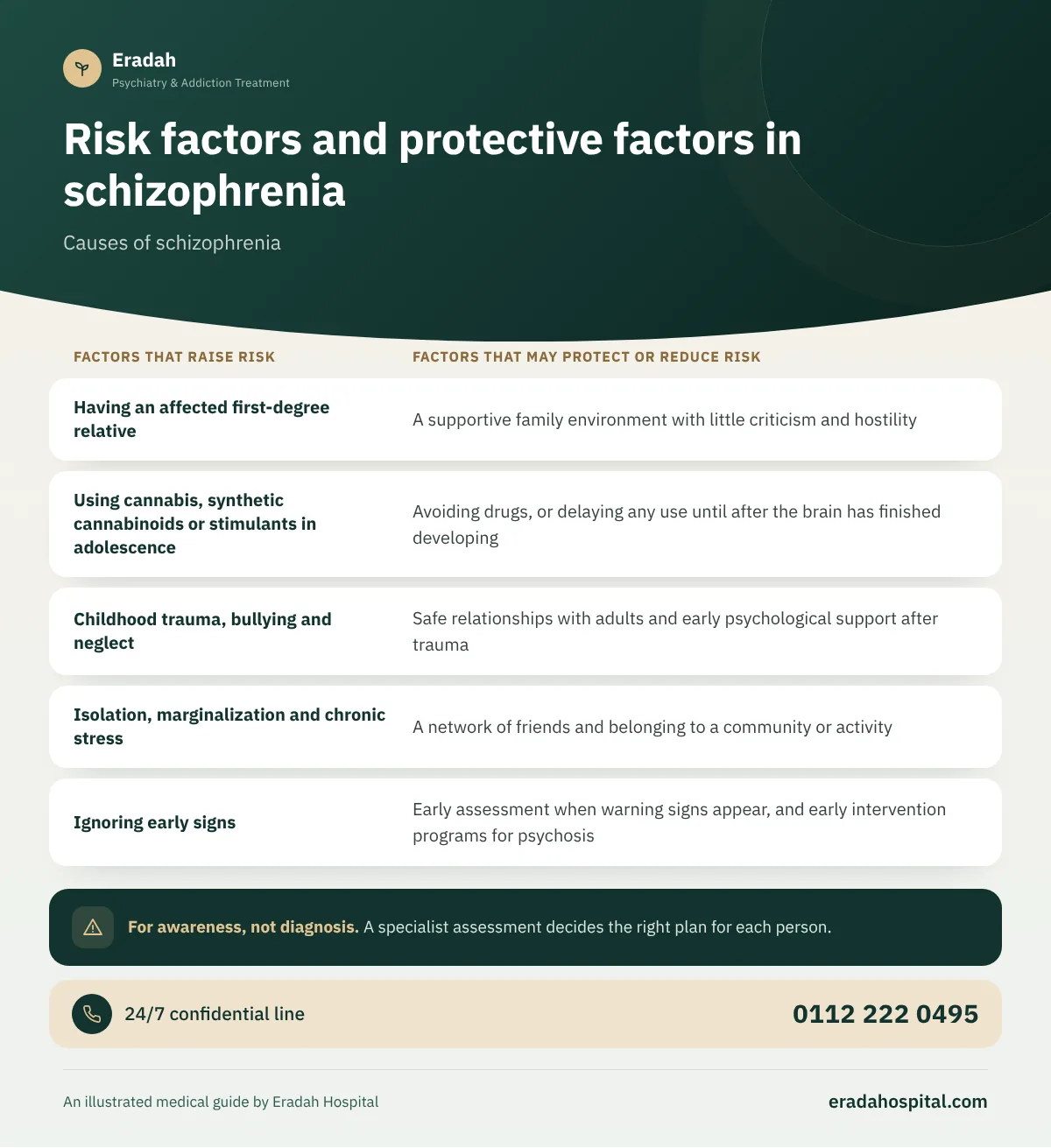
| Factors that raise risk | Factors that may protect or reduce risk |
|---|---|
| Having an affected first-degree relative | A supportive family environment with little criticism and hostility |
| Using cannabis, synthetic cannabinoids or stimulants in adolescence | Avoiding drugs, or delaying any use until after the brain has finished developing |
| Childhood trauma, bullying and neglect | Safe relationships with adults and early psychological support after trauma |
| Isolation, marginalization and chronic stress | A network of friends and belonging to a community or activity |
| Ignoring early signs | Early assessment when warning signs appear, and early intervention programs for psychosis |
Myths about the causes of schizophrenia
- "It's caused by a cold mother or harsh parenting": the "schizophrenogenic mother" theory appeared in the middle of the last century and medicine has abandoned it entirely for lack of evidence.
- "It's caused by envy, magic or possession": believing in these things does not conflict with treatment, but the symptoms have a medical explanation, and delaying seeing a doctor because of them harms the patient.
- "It's caused by too much thinking or studying": thinking and studying do not cause schizophrenia, and a decline in school performance may itself be one of the first signs of the illness.
- "It's caused by a single emotional shock": a shock may be a trigger, but the illness results from an accumulation of multiple factors.
Knowing the causes often does not change the treatment plan much, but it frees the family from blame and directs it toward prevention for younger siblings, above all awareness of the dangers of drugs.