Does bipolar disorder have a single cause?
Medical references agree that the exact cause is still unknown and that the illness results from an interaction of biological, psychological and environmental factors. You can think of it as a seed (the predisposition) that needs certain conditions (the triggers) to grow.
That is why two people can carry the same predisposition, and one becomes ill after a period of intense stress and poor sleep, while the other never has an episode in their whole life.
Is bipolar disorder hereditary?
Genetics is the strongest known risk factor. Having a parent or sibling with the condition raises the chance of developing it considerably compared with the general population, and twin studies show that genetics explains a large part of the predisposition.
However, there is no single “bipolar gene.” Dozens of genes have been linked to increased risk, each with a small effect. Most importantly, most children of people with bipolar disorder do not develop it: genetics means a predisposition, not a fixed destiny.
What happens in brain chemistry?
Research points to differences in the neural circuits that connect the brain’s emotion areas with its control and planning areas, and to an imbalance in neurotransmitters, the most important of which are:
Linked to reward and motivation. Increased activity is thought to contribute to mania, and reduced activity to depression.
Linked to alertness and energy, and affected by stress and lack of sleep.
Helps regulate mood, sleep and appetite.
The main excitatory neurotransmitter, which studies link to disrupted mood regulation.
These findings do not mean the illness is simply a “shortage of a chemical” that can easily be replaced. It is a complex picture that scientists are still studying. Learn more about these neurotransmitters in our sections on dopamine and serotonin.
How do the body clock and sleep fit in?
People with bipolar disorder seem to be especially sensitive to disruption of the body’s daily rhythm, meaning the timing of sleep, waking, eating and activity. Repeated late nights, travel across time zones or shift work can come before manic episodes.
The relationship runs both ways: lack of sleep sparks mania, and mania in turn reduces sleep, creating a vicious circle. That is why a regular sleep schedule is a core part of prevention.
Do stress and trauma cause bipolar disorder?
Stress alone does not create the illness, but it is among the best-known triggers for a first episode and for relapses. Examples include the death of a loved one, a breakup, losing a job, exams and money problems. Studies also link childhood trauma, such as neglect or abuse, to an earlier onset and greater severity.
Even major happy events, such as a wedding or a promotion, can act as a trigger because they disrupt routine and sleep.
What is the difference between causes and triggers?
| Point of comparison | Causes (predisposition) | Triggers (the spark) |
|---|---|---|
| Nature | Relatively fixed factors that make a person more susceptible | Events or circumstances that set off an episode in someone who is predisposed |
| Examples | Genetics, differences in brain circuits, and a sensitive body clock | Lack of sleep, stress, drugs and alcohol, certain medications, and childbirth |
| Can they be controlled? | They cannot be changed | Many of them can be reduced through planning and follow-up |
Do drugs and alcohol cause bipolar disorder?
In most cases drugs are not the original cause, but they are among the strongest triggers. Stimulants such as shabu and cocaine can set off a manic episode. Research links cannabis use to an earlier onset of the illness and more manic episodes, while alcohol deepens depression and increases instability.
Sometimes a mania-like state is caused by the substance itself and resolves when the substance is out of the system; the doctor distinguishes it from the underlying illness. The details are on the page about the link with addiction.
Can medications or medical conditions set off episodes?
- Antidepressants, if taken alone by someone who is predisposed, may contribute to mania or rapid mood cycling, which is why the doctor prescribes them with caution.
- Cortisone and related steroids can cause mood changes resembling mania in some people.
- Thyroid disorders can mimic mania or depression or add to instability.
- The postpartum period is one of the highest-risk times for an episode in women who have the illness or are predisposed to it.
For this reason, no prescribed medication should be stopped or started without consulting the doctor, and any doctor treating you should know that you have this condition.
Why does it often begin in adolescence and early adulthood?
The brain keeps developing until roughly the mid-twenties, especially the areas responsible for regulating emotions and controlling impulses. At the same stage of life, many triggers come together: late nights, study and exam pressure, independence from the family, and first experiences with alcohol and drugs. That is why many people have their first episode in these years.
This means that protecting a teenager with a family history of the illness starts with simple but powerful steps: regular sleep, open conversation within the family, awareness of the danger of drugs, especially cannabis and stimulants, and seeking an early assessment when there is a clear change in mood or sleep rather than waiting.
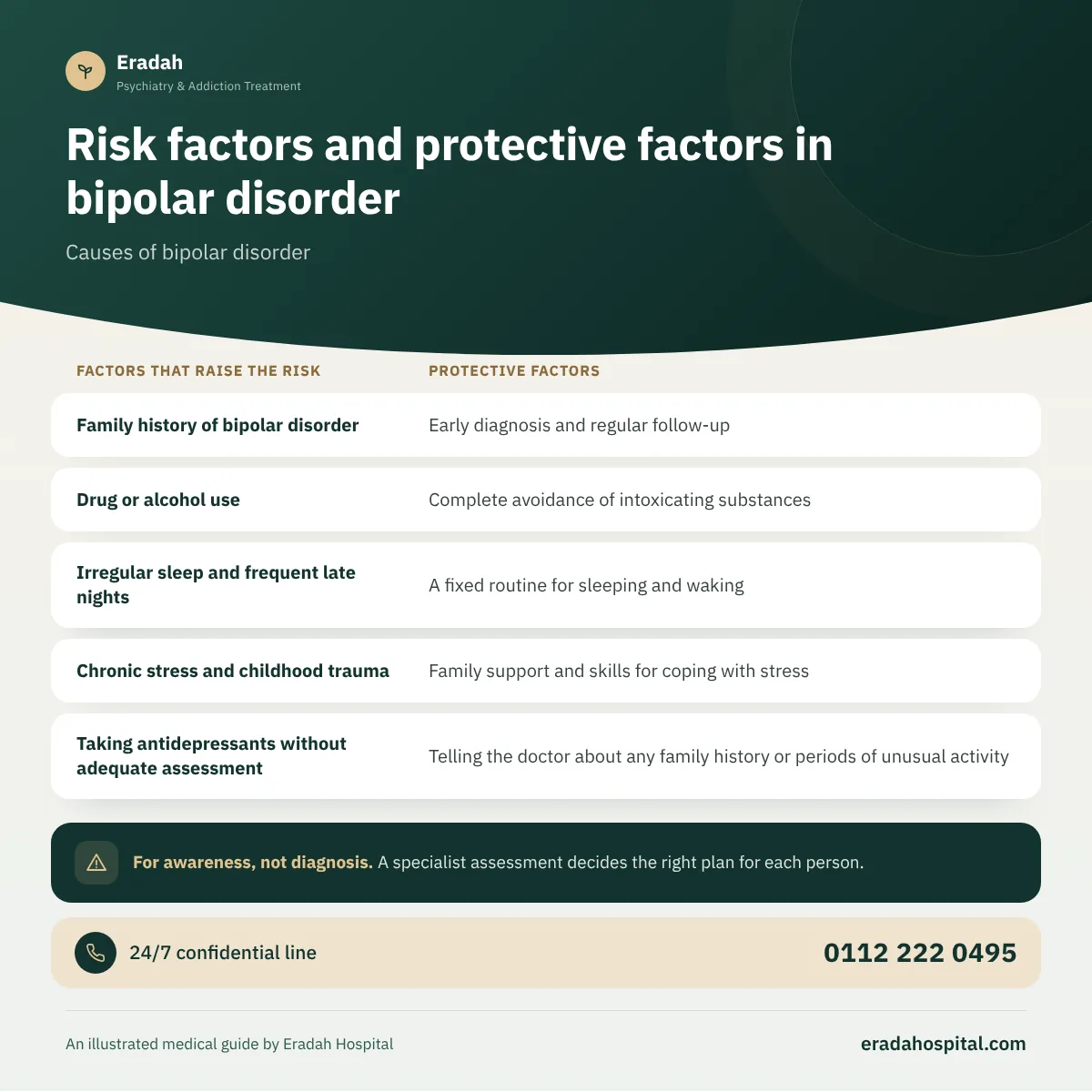
Risk factors versus protective factors
| Factors that raise the risk | Protective factors |
|---|---|
| Family history of bipolar disorder | Early diagnosis and regular follow-up |
| Drug or alcohol use | Complete avoidance of intoxicating substances |
| Irregular sleep and frequent late nights | A fixed routine for sleeping and waking |
| Chronic stress and childhood trauma | Family support and skills for coping with stress |
| Taking antidepressants without adequate assessment | Telling the doctor about any family history or periods of unusual activity |
Myths about the causes of bipolar disorder
- It is not the result of weak faith or a lack of willpower.
- It is not caused by being “spoiled” or by lenient parenting.
- It is not the evil eye or magic; it is a medical condition with a known biological basis.
- It is not caused by a single emotional shock, although stress can set off an episode.
Correcting these ideas eases the guilt felt by patients and their families, and encourages them to seek help early instead of looking for solutions that delay treatment.