Why does temporary insomnia turn into chronic insomnia?
Sleep doctors explain chronic insomnia with what is known as the three-factor model: predisposing factors that make a person more vulnerable, precipitating factors that start the problem, and perpetuating factors that keep it going. This explains why two people go through the same stress and one returns to normal sleep after a few days while the other has insomnia for years.
| Type | Examples | Why does it matter? |
|---|---|---|
| Predisposing factors | Light sleep, a tendency to worry and overthink, family history, and older age | Determine how prone a person is to insomnia |
| Precipitating factors | Work stress, exams, loss, illness, childbirth, travel, and changing shifts | Start the insomnia, and are often temporary |
| Perpetuating factors | Staying in bed for long periods, napping, irregular schedules, worry about not sleeping, and reliance on sleeping pills or alcohol | Keep the insomnia going even after the original cause has gone |
What is hyperarousal and why does it prevent sleep?
Sleep requires the body and mind to “settle down.” In many people with insomnia, the nervous system stays on alert: a faster pulse, muscle tension, and a mind that reviews the day’s events, plans for tomorrow, and worries about the night. Researchers regard this hyperarousal as the core of chronic insomnia, and it occurs day and night, which is why a person with insomnia often cannot sleep even during a nap despite being tired.
What habits keep insomnia going?
The paradox is that most of what we do to make up for lost sleep prolongs the insomnia:
- Going to bed early or staying in bed for a long time to make up for sleep, which increases the time spent awake in bed.
- Long or late naps that use up the sleep pressure that has built up.
- Irregular sleep and wake times between workdays and days off, which disrupt the body clock.
- Watching the clock and counting the hours left until morning, which raises tension.
- Using the bed for work, the phone, and thinking, so the bed becomes associated with wakefulness.
- Relying on sleeping pills or alcohol, with insomnia rebounding when they are stopped.
How does worry about not sleeping create a vicious circle?
After some difficult nights, thoughts form such as “If I don’t sleep tonight my day will be ruined” or “I will never sleep.” These thoughts raise tension as night approaches, and tension prevents sleep, so the fears are confirmed and the anxiety grows the next night. This is how fear of insomnia becomes a main reason it continues, even after the stress that started it has gone.
How are mental health conditions related to insomnia?
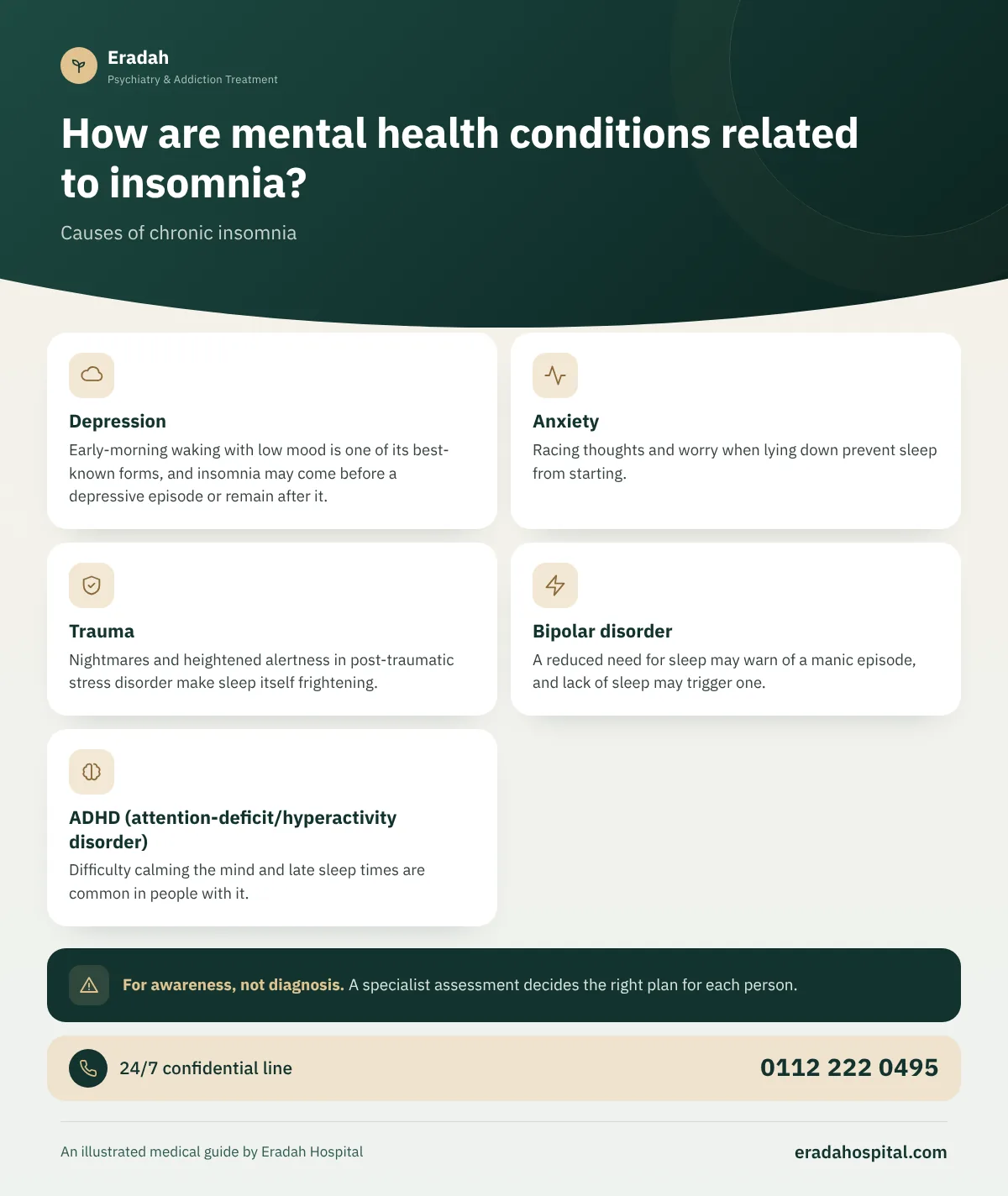
The relationship runs in both directions. Insomnia is a core feature of many mental health conditions, and persistent insomnia itself raises the likelihood that they appear later:
Early-morning waking with low mood is one of its best-known forms, and insomnia may come before a depressive episode or remain after it.
Racing thoughts and worry when lying down prevent sleep from starting.
Nightmares and heightened alertness in post-traumatic stress disorder make sleep itself frightening.
A reduced need for sleep may warn of a manic episode, and lack of sleep may trigger one.
Difficulty calming the mind and late sleep times are common in people with it.
Which physical illnesses cause insomnia?
- Chronic pain such as back pain, joint pain, and headaches.
- Thyroid disorders, especially an overactive thyroid.
- Acid reflux and heartburn when lying down.
- Frequent urination at night because of the prostate, diabetes, or other causes.
- Heart and lung diseases that cause shortness of breath at night.
- Hot flashes around menopause, and hormonal changes in pregnancy.
- Other sleep disorders such as sleep apnea and restless legs.
Do some medications cause insomnia?
Yes, and it is often overlooked. Sleep can be affected by some stimulating antidepressants, cortisone, some asthma medicines and decongestants, thyroid medicines, stimulants used to treat ADHD, and some blood pressure medicines. This does not mean stopping them; rather, ask your doctor whether the timing can be adjusted or the medicine replaced, and do not stop a prescribed medicine on your own.
How do stimulants and substances cause insomnia?
| Substance | Effect on sleep |
|---|---|
| Caffeine (coffee, tea, energy drinks, cola) | Its stimulating effect lasts many hours, so even an afternoon cup can affect nighttime sleep |
| Nicotine | A stimulant that delays sleep, and a smoker may wake at night because of nicotine cravings |
| Alcohol | Speeds up falling asleep but ruins the second half of the night and reduces deep sleep and dreaming |
| Stimulants such as shabu and cocaine | Prevent sleep for hours or days, followed by severe sleep disturbance |
| Withdrawal from sedatives, opioids, and cannabis | Severe insomnia and disturbing dreams are among the main symptoms of stopping |
We cover the relationship of insomnia with substances and sleeping pills in detail on the page about chronic insomnia and addiction.
What role do screens, shift work, and lifestyle play?
- Screens at night: stimulating content and mental alertness, and bright light, delay the feeling of sleepiness.
- Shift work and staying up late: works against the body clock and makes daytime sleep light and broken.
- Travel across time zones: causes temporary insomnia until the body clock adjusts.
- Little daylight and movement: weaken the body clock’s signals and sleep pressure.
- Heavy meals late at night: cause discomfort and reflux when lying down.
- The sleep environment: noise, heat, lighting, and discomfort.
Who is most prone to chronic insomnia?
- Women, especially around pregnancy, after childbirth, and at menopause.
- Older adults, with lighter sleep and more illnesses and medications.
- People with depression, anxiety, trauma, or addiction.
- People who work night or rotating shifts.
- People under chronic stress, such as unemployment or caring for a sick relative.
- People with a family history of insomnia or light sleep.