What does chronic insomnia do to the next day?
Sleep is a period in which the brain and body repair themselves, not wasted time as some think. With repeated sleep loss, effects build up day after day, until the person gets used to them and thinks they are “just how I am.”
A constant feeling of low energy, even on quiet days.
Slow thinking, forgetfulness, and difficulty making decisions.
Irritability, low patience, and mood swings.
Slips at work and at home, and slower reaction time.
Does insomnia increase the risk of accidents?
Yes. Lack of sleep slows reaction time and weakens attention, and can cause “microsleeps” of a few seconds that the person does not notice. This is dangerous when driving, operating machinery, or working at height. The danger rises if the person takes sleeping pills or sedatives whose effects linger in the morning.
How is chronic insomnia related to depression and anxiety?
Persistent insomnia is a known risk factor for later depression, increases anxiety and tension, and weakens the ability to regulate emotions. Also, insomnia that continues after depression has been treated is linked to a higher risk of the episode returning. So treating insomnia is part of protecting mental health, not just improving comfort.
How does insomnia affect the heart and metabolism?
The US National Heart, Lung, and Blood Institute (NHLBI) states that chronic insomnia raises the risk of high blood pressure, coronary artery disease, and diabetes. This is thought to be linked to the stress system staying active at night, disruption of the hormones that regulate appetite and blood sugar, and less movement during the day because of tiredness.
| System | What studies link to ongoing sleep loss |
|---|---|
| Heart and blood vessels | High blood pressure and an increased risk of heart disease |
| Metabolism | Disrupted blood sugar regulation and an increased risk of type 2 diabetes |
| Weight and appetite | Greater craving for fatty and sugary foods and weight gain |
| Immune system | Weaker resistance to infection in some people |
| Pain | Greater sensitivity to pain and difficulty tolerating it |
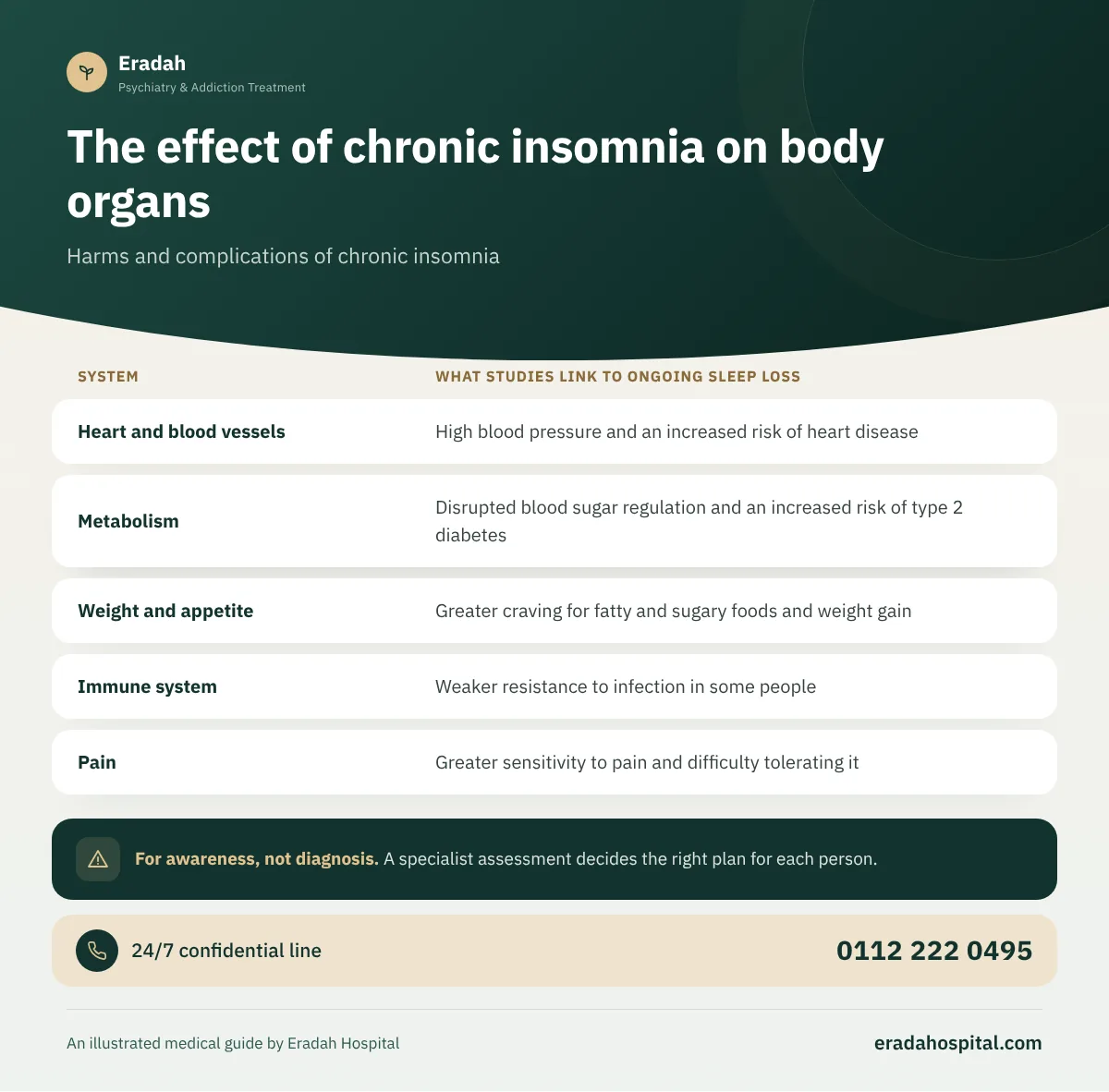
These are statistical associations in which many factors overlap, but they are enough to confirm that chronic insomnia is a serious health matter.
Why are insomnia and chronic pain intertwined?
Pain wakes the person at night, and lack of sleep in turn lowers the pain threshold and makes pain worse the next day, so a vicious circle forms. In this circle some patients turn to strong painkillers or sedatives to get both things at once, which raises the risk of becoming dependent on them.
How does insomnia affect work and study?
- Lower productivity, more mistakes, and slower work.
- Morning lateness and repeated absence because of exhaustion.
- In students: difficulty understanding and memorizing, and falling grades.
- Strained relationships with colleagues because of irritability.
- Growing reliance on coffee and energy drinks during the day, which worsens insomnia at night.
How does insomnia affect the family and relationships?
Insomnia can spread to the partner because of movement, light, or repeated waking, and couples may end up sleeping separately. With exhaustion and irritability, there is less patience with children and less social participation. Many people with insomnia feel lonely during the long night hours and feel that those around them do not understand their suffering.
How does insomnia lead to dependence on sleeping pills or alcohol?
One of the most serious complications of untreated insomnia is that the person looks for a quick fix: a sleeping pill from a pharmacy or from a friend, a sedative, or a drink before bed. It may work for some nights, then the body gets used to it and needs more, and insomnia rebounds worse when it is stopped. We explain this cycle and how to get out of it on the page about chronic insomnia and addiction.
How does insomnia affect teenagers and students?
Teenagers need more sleep than adults, yet their body clock, screens, and schoolwork push them to stay up late, and then they wake early for school. If this continues, they show sleepiness in class, poor school performance, quick anger, and mood swings, and lack of sleep may increase impulsivity and the tendency to try stimulants or substances to fight tiredness or to sleep.
Paying attention to a teenager’s sleep is one of the simplest ways to protect their mental health; setting schedules, keeping the phone away at night, and involving the family can make a big difference, and persistent insomnia in a teenager also deserves an assessment of mood.
Is insomnia more dangerous in older adults?
In older adults, insomnia and daytime sleepiness may increase the risk of falls and fractures, especially when getting up at night to go to the bathroom in the dark, and the risk rises if they take sleeping pills or sedatives. Lack of sleep can also affect memory and concentration, which may be mistaken for the start of dementia. That is why insomnia in older adults needs a careful review of their medicines and illnesses.
Is insomnia linked to suicidal thoughts?
Studies indicate that severe sleep disturbance is linked to a higher risk of suicidal thoughts, even after accounting for depression. Long night hours alone and exhausted can make dark thoughts heavier. This does not mean that everyone with insomnia is at risk, but it does mean that severe insomnia together with hopelessness deserves urgent attention.
Can the complications of insomnia be avoided?
Yes. Most complications are linked to how long the insomnia lasts and to wrong quick fixes. So early intervention, avoiding reliance on sleeping pills and alcohol, and treating co-occurring depression, anxiety, or pain clearly reduce these harms. You can find the proven options on the page about chronic insomnia treatment.
Insomnia with suicidal thoughts or severe hopelessness? Get help now
- Talking about wanting to die, or saying that eternal sleep would be better than this exhaustion
- Severe hopelessness and a feeling that the suffering will never end, with sleep collapsing for days in a row
- Taking increasing amounts of sleeping pills or mixing them with alcohol or sedatives
- Severe confusion, seizures or hallucinations after suddenly stopping a sedative or alcohol
- Irresistible sleepiness that puts the person or others at risk, such as falling asleep while driving
Stay with the person and listen calmly and without judgment, ask them directly about their thoughts, and do not leave them alone. Call an ambulance (123) or go to the nearest emergency room, or call the mental health support line 16328, and keep sleeping pills, sedatives and anything that could hurt them out of their reach.
Ambulance 123 Mental health support line 16328