Where does treatment of chronic insomnia begin?
Treatment begins with understanding the type of insomnia and what keeps it going: a two-week sleep diary, a review of illnesses, medications, stimulants, and substances, questions about mood, anxiety, and trauma, and ruling out other sleep disorders such as sleep apnea. Treating a co-occurring cause, such as depression or pain, is an essential part of the plan.
After that, treatment is built on three pillars: behavioral and cognitive therapy that targets the insomnia itself, treatment of the conditions that accompany it, and careful, limited use of medication when needed.
What is cognitive behavioral therapy for insomnia?
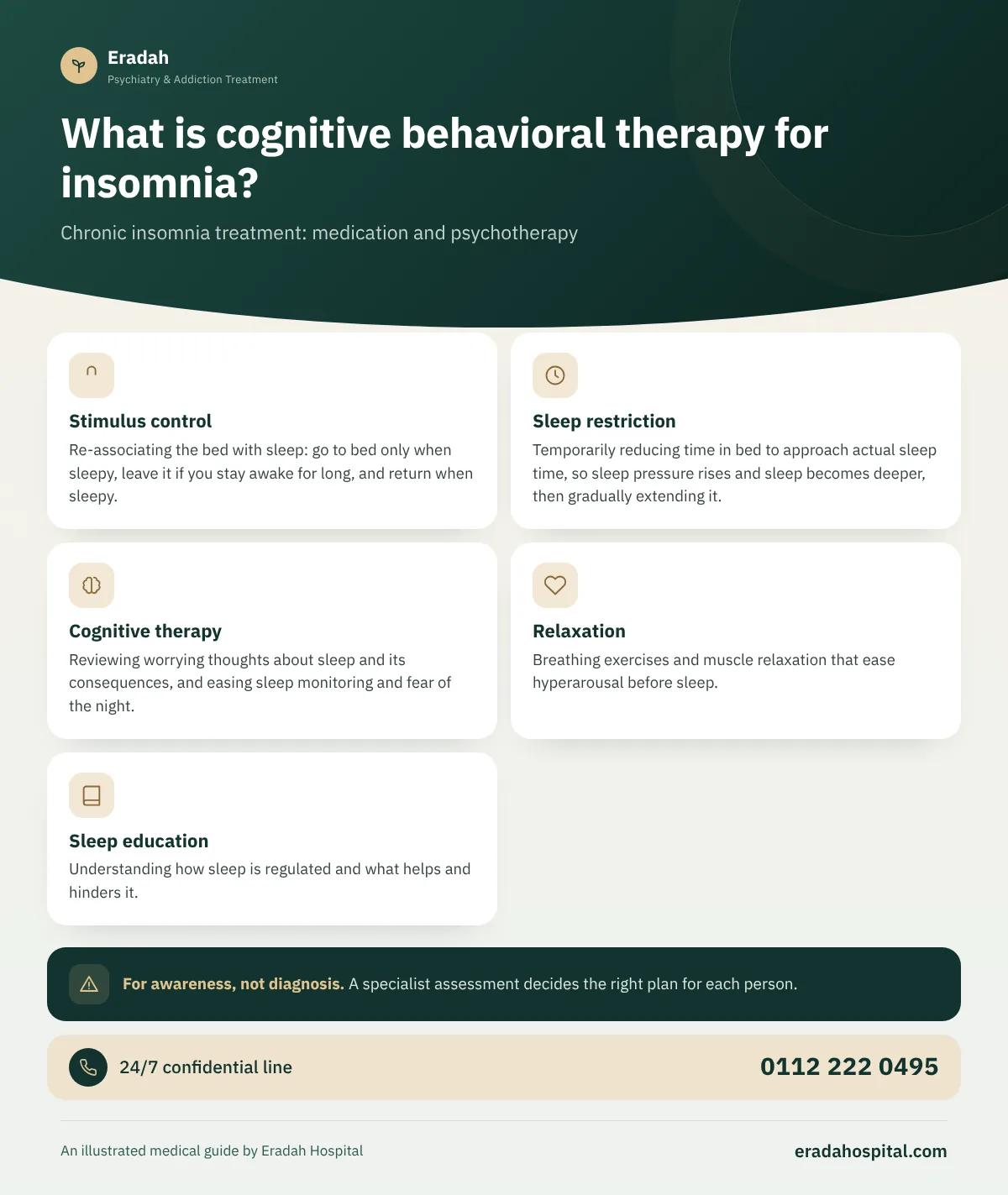
CBT for insomnia is a short structured program delivered by a specialist over a limited number of sessions across several weeks, and it can be delivered individually, in groups, or through guided digital programs. The American Academy of Sleep Medicine strongly recommends it for adults, and the US National Center for PTSD says it improves sleep in about 7 out of 10 people who complete it, and that it is preferred over medication because it is more effective in the long term. It consists of several components:
Re-associating the bed with sleep: go to bed only when sleepy, leave it if you stay awake for long, and return when sleepy.
Temporarily reducing time in bed to approach actual sleep time, so sleep pressure rises and sleep becomes deeper, then gradually extending it.
Reviewing worrying thoughts about sleep and its consequences, and easing sleep monitoring and fear of the night.
Breathing exercises and muscle relaxation that ease hyperarousal before sleep.
Understanding how sleep is regulated and what helps and hinders it.
What are the sleep hygiene rules?
Sleep hygiene rules are habits that set up the conditions for good sleep. They are helpful for everyone, but research shows that on their own they are usually not enough to treat chronic insomnia, so they come within the CBT program, not as a substitute for it:
- Wake up at the same time every day, even on days off, no matter how you slept the night before.
- Get daylight in the morning and do regular physical activity, but not right before bed.
- Avoid caffeine after midday, and nicotine and alcohol in the evening.
- Keep the bedroom dark, quiet, and at a moderate temperature.
- Set aside an hour before bed for a calm activity, and keep the phone and work away from the bed.
- Avoid heavy meals late at night, and long naps.
- Do not watch the clock at night; turn the alarm clock away from you.
When does the doctor prescribe medication for insomnia?
The NHS says doctors now rarely prescribe sleeping pills to treat insomnia, and this is usually limited to a short period in severe cases, or until behavioral therapy starts working, or in temporary circumstances such as an acute crisis. The doctor chooses the medicine according to age, other illnesses, and history of substance use, and any medicine is started, adjusted, and stopped only under their supervision.
| Category | Examples | The most important thing to know |
|---|---|---|
| “Z-drug” sleeping medicines | Zolpidem, zopiclone, eszopiclone | For short-term use; they may cause dependence, and in 2019 the FDA added a warning about complex sleep behaviors such as sleepwalking and sleep driving |
| Benzodiazepines | Such as Rivotril, Xanax, and Valium | Not preferred for chronic insomnia; risk of dependence and tolerance, morning drowsiness and falls in older adults, and stopping them suddenly after long-term use can be dangerous |
| Orexin receptor antagonists | Suvorexant, lemborexant, daridorexant | A newer class that acts on the wakefulness system; availability differs from country to country |
| Melatonin and similar medicines | Melatonin, ramelteon | May help with body clock disorders and in some older adults; its effect on chronic insomnia is modest |
| Antidepressants with a sleep-inducing effect | Determined by the doctor | Sometimes used, especially with co-occurring depression or anxiety, and not suitable for everyone |
| Over-the-counter sleep-inducing antihistamines | Allergy-type sleeping pills | Not recommended for chronic insomnia; their effect fades quickly and they may cause morning drowsiness and confusion in older adults |
Can medication be combined with behavioral therapy?
Yes, the doctor may start a medicine for a short period along with starting CBT, then the medicine is gradually withdrawn under their supervision as therapy progresses. CBT also helps people who have used sleeping pills for years to reduce or stop them safely, because it gives them a real alternative.
Is treatment different for older adults, pregnant women, and teenagers?
- Older adults: behavioral therapy is strongly preferred, and doctors avoid sedatives and antihistamines as far as possible because of the risk of falls and confusion.
- Pregnant and breastfeeding women: treatment starts with non-drug approaches, and any medicine is decided with the obstetrician and the treating doctor.
- Teenagers: the problem is often a delayed body clock combined with screens, and treatment starts with regulating schedules and light and involving the family.
- People with psychiatric disorders: the insomnia and the disorder are treated together, and behavioral therapy may be adapted to suit the condition.
How long does treatment of chronic insomnia take?
- The first two weeksAssessment
Sleep diary, review of causes and medications, and ruling out other disorders.
- The following weeksThe treatment program
CBT-I sessions; sleep may feel a little harder at first with sleep restriction.
- Within a few weeksImprovement begins
Many people notice faster, deeper, less broken sleep.
- In the long termStabilization
Maintaining the skills, and returning to them quickly on any difficult nights.
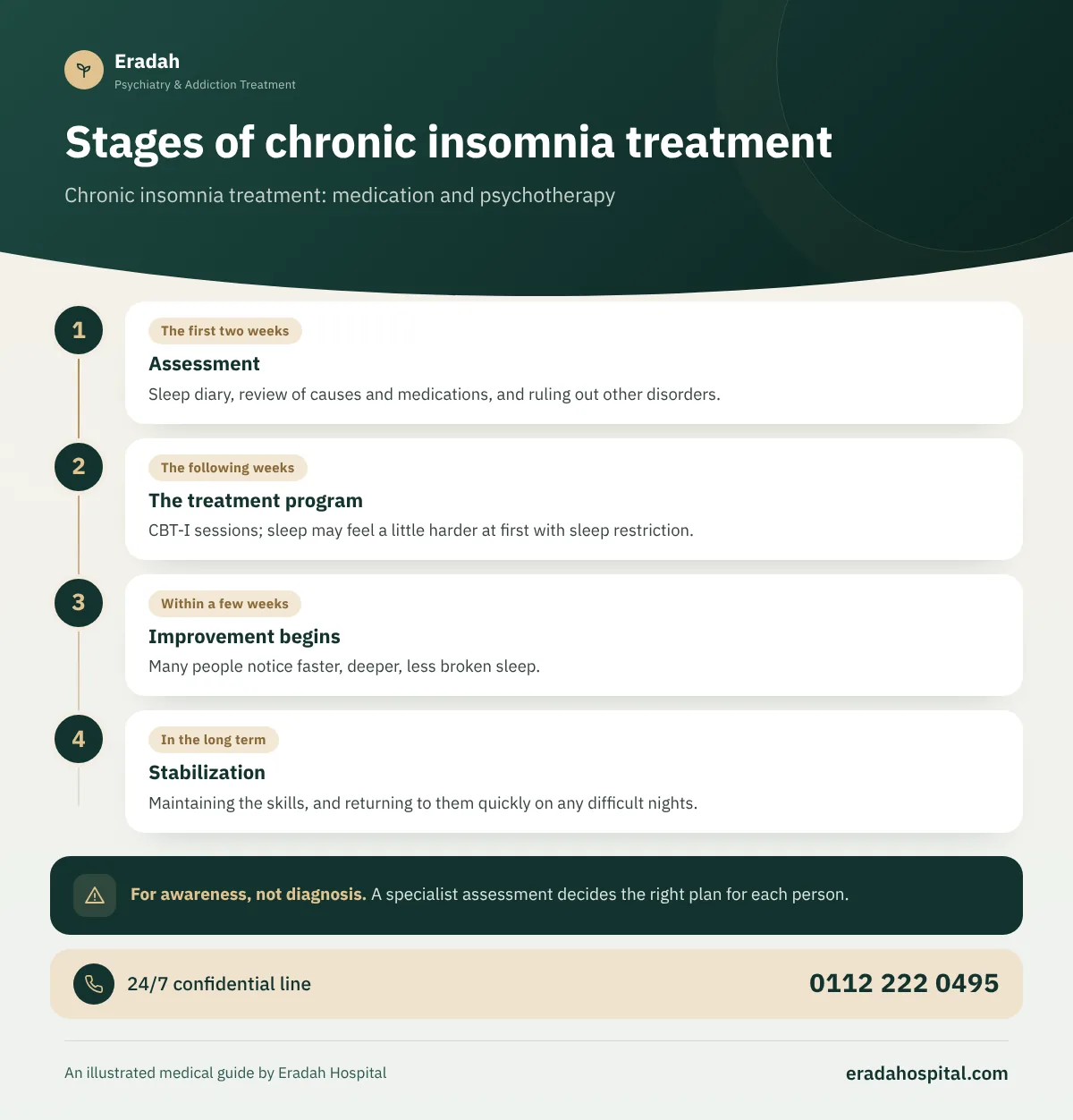
The duration is approximate and varies with the severity of the insomnia and what accompanies it, and it takes longer if there is dependence on sleeping pills that are being withdrawn gradually.
How do you prevent insomnia from coming back?
It is normal to have difficult nights with stress, travel, or illness. The difference is that you now know what to do: keep your wake-up time, do not make up for it by staying in bed or taking long naps, and do not turn to a sleeping pill or alcohol. And if the difficulty lasts more than a few weeks, a review session with the therapist is better than waiting.
How does the family support the treatment plan?
The family helps by respecting the fixed wake-up time, reducing noise and light at night, and understanding that sleep restriction can cause temporary sleepiness. It is important not to suggest medicines or “recipes” from personal experience, and to encourage the person to continue the program to the end.
Choosing a hospital for chronic insomnia treatment
Chronic insomnia is not solved by a sleeping pill prescription renewed every month; the first-choice treatment is a structured cognitive behavioral program that resets the body clock and the person’s relationship with the bed. The place worth your trust is the one that actually offers this program and looks for a hidden cause, which may be depression, anxiety, or dependence on sedatives. Compare the options on this basis:
| What you see in a serious provider | What should raise suspicion |
|---|---|
| A two-week sleep diary before the plan is made | A sleeping pill from the first visit with no questions |
| CBT-I sessions with sleep restriction and stimulus control steps | General advice about “healthy sleep” alone |
| Asking about snoring and pauses in breathing, and referral to a sleep specialist when needed | Ignoring any other sleep disorder |
| A plan to gradually withdraw sleeping pills for those who are used to them | Sudden stopping or endless renewal |
At Eradah, insomnia treatment is tied to the whole psychological picture: the doctor assesses mood and anxiety, specialists deliver the behavioral therapy program, and those who have become dependent on sedatives go through medically monitored tapering. The page on insomnia and addiction explains how each can lead to the other.
To sleep without a pill every night, start with a free, confidential consultation: call or WhatsApp 01122220495 at any time, or contact us from the contact page. Inpatient stay is available for men only when needed, and most insomnia cases are followed up as outpatients.
Chronic insomnia treatment at Eradah
At Eradah we assess insomnia as part of the whole psychological picture: mood, anxiety, trauma, and the use of sleeping pills or substances. Then we set a plan that combines CBT for insomnia with treatment of any co-occurring disorder, and we help people who depend on sleeping pills or sedatives to withdraw from them safely under medical supervision. All of this in complete confidentiality.