“My fiancé has been on treatment for depression for two years, and my family says break the engagement. Should I go on or not?” This question comes up in psychiatric clinics in many forms: can someone treated for OCD marry? Should I tell my fiancée that I take a psychiatric medication? This guide answers general questions about mental illness and marriage, without exaggerated fear and without downplaying either.
Can a person with a mental illness marry?
In principle, nothing prevents a person with a mental disorder from marrying, because mental illness comes in many kinds, ranging in severity from mild anxiety to severe psychosis. NAMI reminds us that many people with serious mental disorders have strong, supportive, long-lasting relationships, and that a good relationship provides important support in hard times, while a bad one can make symptoms worse, especially in depression.
So the more accurate question is not “is it allowed?” but: is the condition stable now? Does the other person know enough to choose knowingly? Is there a clear plan for handling any relapse?
How does mental illness affect married life?
In an international study published in 2011 as part of the World Mental Health Surveys, researchers followed more than 46,000 people in 19 countries. They found that 14 of 18 mental disorders that began before marriage were associated with a lower likelihood of marrying, and that all 18 disorders were associated with a higher likelihood of divorce, with odds ratios between 1.2 and 1.8. Specific phobia, major depression and alcohol misuse had the greatest effect at the population level.
This is a statistical relationship at the population level, not a verdict on any particular marriage. But it explains why couples need to understand how each disorder shows up at home:
| Disorder | What the partner may notice | What helps |
|---|---|---|
| Depression | Withdrawal and little talking, reduced desire, neglect of responsibilities | Understanding that it is a symptom, not personal rejection, and keeping up treatment |
| Obsessive-compulsive disorder | Repeated requests for reassurance, cleaning or checking rituals that take up household time | Not taking part in the rituals, and cognitive behavioral therapy |
| Bipolar disorder | Periods of high energy, spending and impulsivity followed by low periods | A written plan for early warning signs and sticking with medication |
| Schizophrenia and psychosis | Suspicion, isolation and unrealistic thoughts during an episode | Not arguing with the thoughts, and early medical intervention |
| Borderline personality | Intense, shifting emotions and a severe fear of abandonment | Clear, calm boundaries, and dialectical behavior therapy |
Hiding a mental illness before marriage: when must you disclose?
NAMI advises that anyone who wants a long-term relationship will eventually need to share their health history with their partner, and that disclosing during a period of stability is better than concealing until an acute episode appears. There is no need to mention everything on a first meeting, but as formal commitment approaches, that is, before signing the marriage contract, the conversation becomes a duty. It suggests choosing a time when you are not in an episode, and talking about the treatment you follow and what you have learned from your experience, not only about the diagnosis.
Disclosure has a legal side in Egypt as well. According to Article 9 of Law No. 25 of 1920, as amended by Law No. 100 of 1985, as published on the website Mohamah.net, a wife may ask for separation if she finds in her husband a chronic defect that cannot be cured, or can be cured only after a long time, and she cannot stay with him without harm, whether the defect existed before the contract and she did not know of it, or arose after it and she did not accept it. But if she married him knowing of the defect, or accepted it after learning of it, separation is not permitted. Expert doctors are consulted to assess whether the illness is chronic.
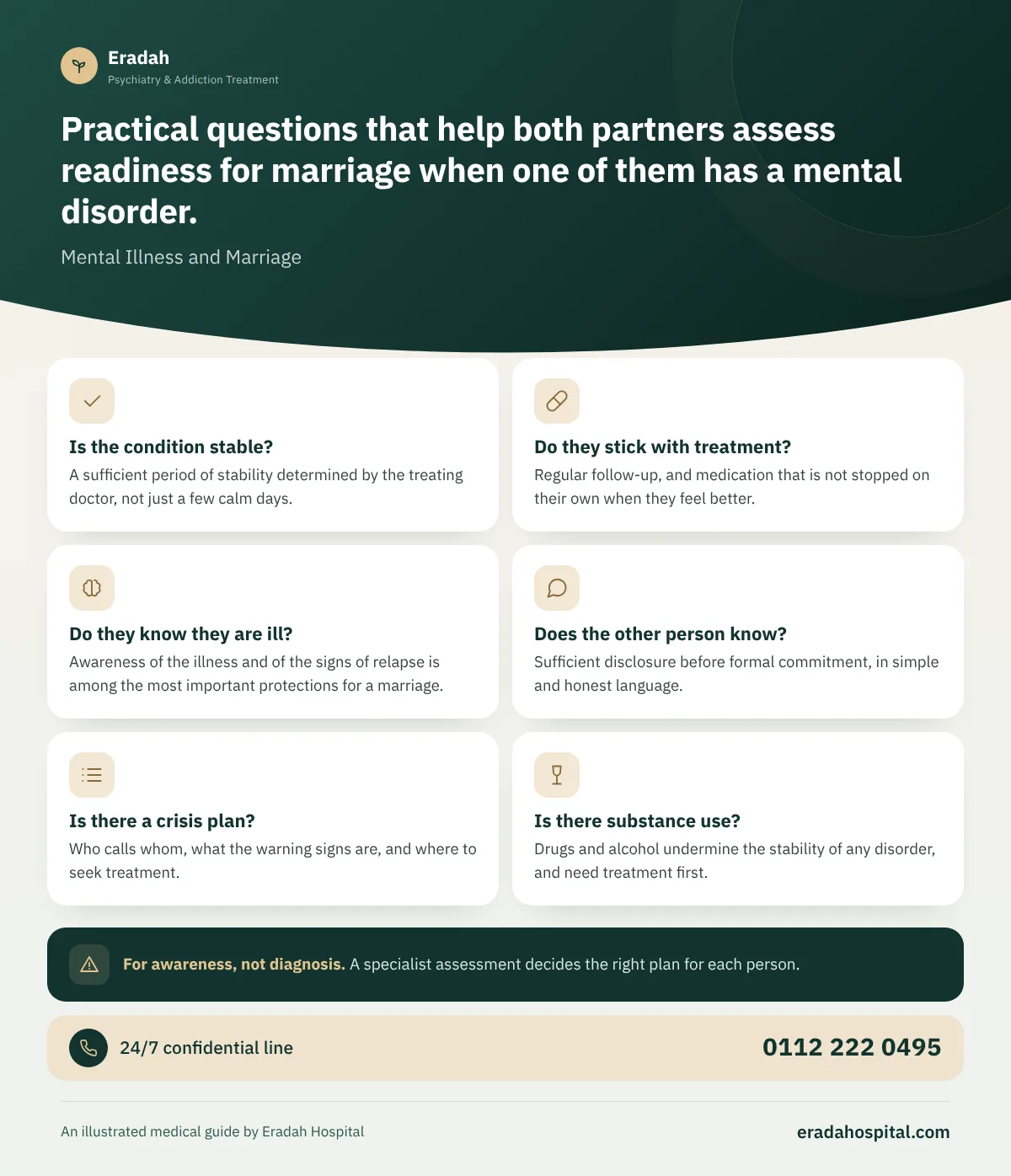
When is a person with a mental illness ready for marriage?
A sufficient period of stability determined by the treating doctor, not just a few calm days.
Regular follow-up, and medication that is not stopped on their own when they feel better.
Awareness of the illness and of the signs of relapse is among the most important protections for a marriage.
Sufficient disclosure before formal commitment, in simple and honest language.
Who calls whom, what the warning signs are, and where to seek treatment.
Drugs and alcohol undermine the stability of any disorder, and need treatment first.
With the patient's consent, the other person can attend a session with the treating doctor to ask what they want to know about the nature of the condition and what to expect.
Psychiatric medication, married life and pregnancy
Some psychiatric medications can affect sexual desire or performance, including some antidepressants. This should be discussed openly with the doctor, because it can often be adjusted. Pregnancy needs planning in advance with both the psychiatrist and the gynecologist to weigh the medication's benefits and risks, because stopping medication suddenly on learning of a pregnancy can cause a relapse. Do not start or stop any medication without a doctor.
Does mental illness pass to children?
This is among the things that worry families most when a marriage is planned. A meta-analysis of 33 studies published in 2014 found that children of parents with schizophrenia, bipolar disorder or severe depression had about a 32% chance of developing a serious mental disorder by adulthood, more than double their peers. That also means, conversely, that most of them did not develop one. Genetics raises susceptibility but does not decide destiny, and the details for each disorder are on its causes page, such as causes of schizophrenia.
Tips for the partner of a person with a mental illness
- Learn about the disorder from the doctor and from reliable sources, because understanding reduces conflict.
- Separate the person from the symptoms, and do not take withdrawal or irritability during an episode as a personal message.
- Encourage treatment without becoming a medication monitor.
- Agree together, while calm, on the warning signs and what you will do when they appear.
- Protect your time, health and relationships, because an exhausted partner cannot support for long.
You can find detailed practical steps for daily life in the guide Caring for a Person with Mental Illness at Home.
Couples therapy and Eradah's role
Many couples benefit from joint sessions in which the doctor explains the condition and both partners learn communication and conflict-resolution skills. At Eradah, follow-up begins with a free, confidential first consultation to assess the situation, and we offer outpatient follow-up and a family program. Residential treatment is for men only; women receive the first consultation free of charge and are referred to the appropriate place. When mental illness and substance use occur together, the most suitable approach is dual diagnosis treatment.