“The doctor told me Faverin is for OCD, and asked me to write down all the medications I take, even painkillers.” The doctor's request here is not routine, because fluvoxamine is among the antidepressants with the most interactions with other drugs. Below we explain its uses, effects and what to watch for.
What is Faverin (fluvoxamine)?
Fluvoxamine is an active ingredient among the antidepressants, and its brand name in circulation in Egypt is Faverin, in tablet form. According to the US National Library of Medicine (MedlinePlus), it works by increasing serotonin in the brain. The StatPearls reference notes that among SSRIs it is distinguished by high binding to receptors called sigma-1, which may play a role in its effect, a point still under research.
What Faverin is used for
- Obsessive-compulsive disorder: the best-known use, for adults and for children from age 8 in the US according to StatPearls.
- Social phobia: according to the US National Library of Medicine.
- Depression: sometimes used, although the 2018 Lancet analysis placed it among the less effective drugs and those with higher treatment dropout in head-to-head comparisons.
In OCD the medication usually gives its best result together with behavioral therapy with exposure and response prevention, as the guide to OCD treatment explains. Improvement in OCD often takes longer than in depression, so patience and follow-up are part of the treatment.
Side effects of Faverin
- Nausea, vomiting or diarrhea.
- Indigestion and changes in taste.
- Reduced appetite, and it may cause weight loss in children.
- Sweating.
- Insomnia, or anxiety and tension.
- Reduced sexual desire, difficulty with erection, or delayed ejaculation and orgasm.
Serious effects listed by the US National Library of Medicine include serotonin syndrome with fever, sweating, confusion and muscle stiffness, seizures, unusual bleeding, severe allergic reactions, and angle-closure glaucoma.
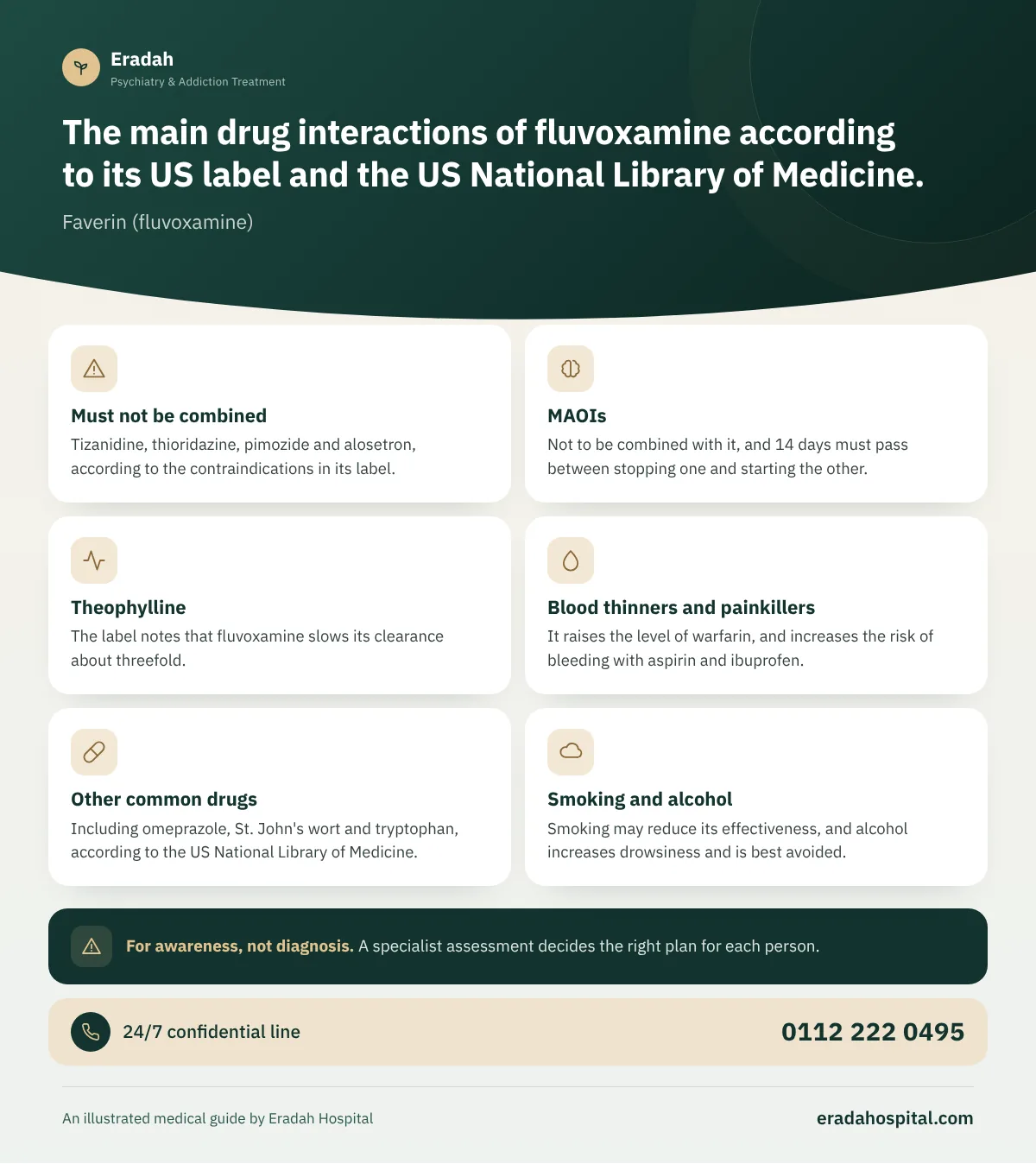
Important drug interactions with Faverin
Tizanidine, thioridazine, pimozide and alosetron, according to the contraindications in its label.
Not to be combined with it, and 14 days must pass between stopping one and starting the other.
The label notes that fluvoxamine slows its clearance about threefold.
It raises the level of warfarin, and increases the risk of bleeding with aspirin and ibuprofen.
Including omeprazole, St. John's wort and tryptophan, according to the US National Library of Medicine.
Smoking may reduce its effectiveness, and alcohol increases drowsiness and is best avoided.
Faverin in pregnancy and breastfeeding
The US National Library of Medicine asks you to tell the doctor about any pregnancy, especially in the last months, or plans for one, or breastfeeding. The decision here rests with the doctor after weighing the benefit of the drug against the risks of untreated OCD or depression, and the medication should not be stopped suddenly on discovering a pregnancy without consultation.
Is Faverin addictive? And how is it stopped?
Fluvoxamine does not cause euphoria or addiction, as the guide to whether psychiatric medications cause addiction explains. But its label notes that stopping serotonergic antidepressants, especially suddenly, can cause symptoms such as dizziness, nausea, irritability and electric-shock sensations. So it is lowered gradually under the doctor's plan, usually after a sufficient period of stability so that the obsessions do not return.
When should you ask for help?
If OCD consumes hours of your day, or has not improved despite trying more than one medication, it deserves a specialist assessment that combines medication with behavioral therapy. At Eradah this begins with a free, confidential first consultation, followed by follow-up through outpatient treatment or the psychiatry department depending on the severity of the condition.