“Why did the doctor start me on such a small dose?” This is a question most people starting Lamictal ask, frustrated by how slowly they reach the target dose. But this slowness is the most important safety measure with this drug, and it does not mean the doctor is hesitant. Here we explain why, what Lamictal offers people with bipolar disorder, and which signs must not be ignored.
What is Lamictal?
Lamictal is a brand name for lamotrigine, and it is also available in Egypt under the name Lamotrin. It was originally a medication for epilepsy, and was later approved for bipolar disorder type I as a long-term preventive treatment. It works by calming sodium channels in nerve cells, which reduces excess release of glutamate, the brain's stimulating neurotransmitter.
Uses of Lamictal
- Prevention in bipolar disorder: to delay the return of mood episodes in adults, especially depressive episodes.
- Epilepsy: alone or with other medications, for several types of seizures.
A pooled analysis of two 18-month trials, published in 2004, found that lamotrigine delayed the return of episodes compared with placebo, with a clearer effect in preventing depression, while lithium was clearer in preventing mania. For this reason Lamictal is not used to treat an acute manic episode, and it is often chosen for people whose illness is dominated by depressive episodes. The doctor discusses the full plan as part of bipolar disorder treatment.
The rash warning with Lamictal
Lamictal carries a boxed warning, the highest level of warning in the US label, about a serious skin rash that can progress to Stevens-Johnson syndrome or toxic epidermal necrolysis, conditions that may require hospital admission or cause permanent disability or death. According to MedlinePlus, the risk rises with three things: a starting dose higher than prescribed, raising the dose faster than the doctor specified, or taking it together with valproic acid.
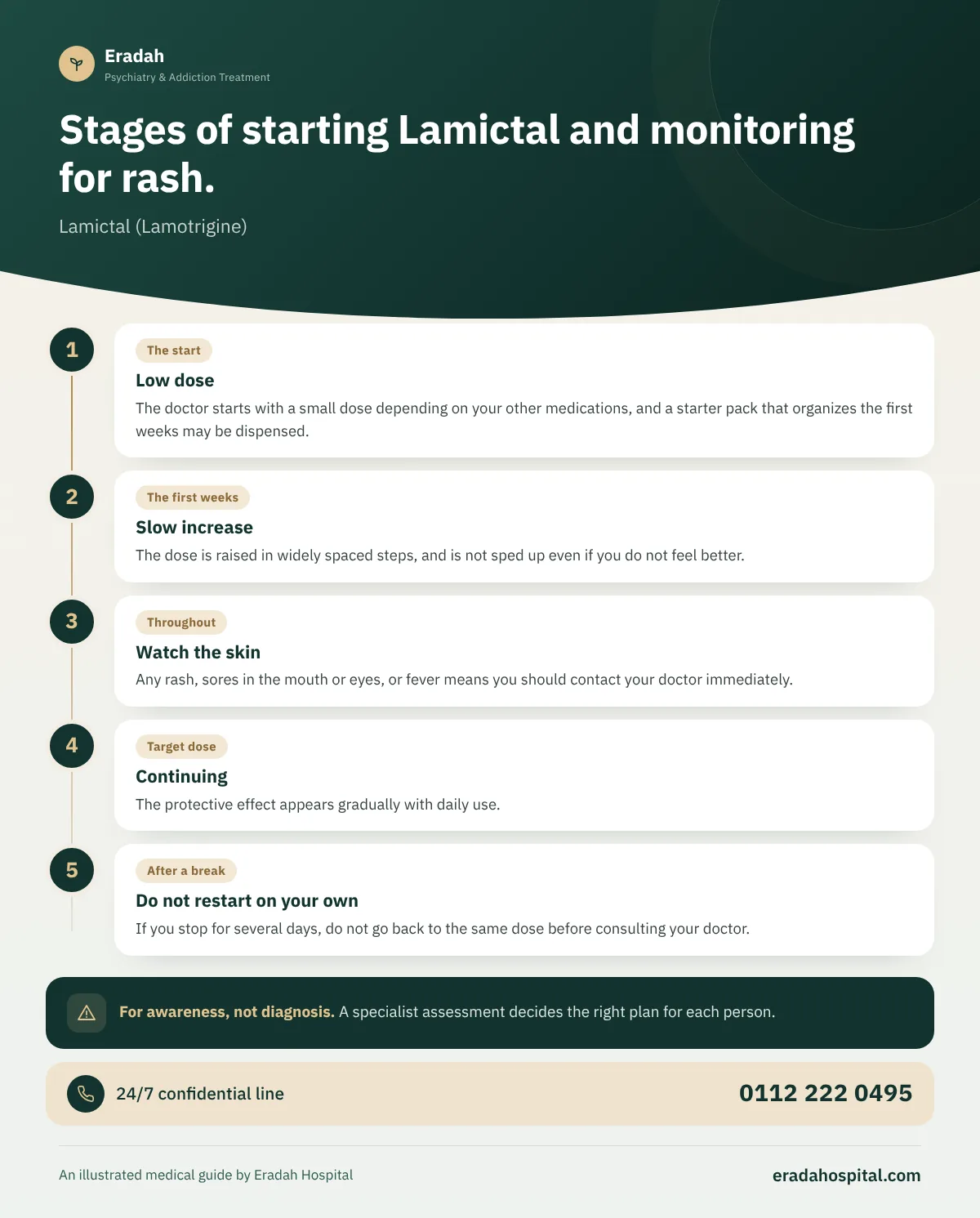
- The startLow dose
The doctor starts with a small dose depending on your other medications, and a starter pack that organizes the first weeks may be dispensed.
- The first weeksSlow increase
The dose is raised in widely spaced steps, and is not sped up even if you do not feel better.
- ThroughoutWatch the skin
Any rash, sores in the mouth or eyes, or fever means you should contact your doctor immediately.
- Target doseContinuing
The protective effect appears gradually with daily use.
- After a breakDo not restart on your own
If you stop for several days, do not go back to the same dose before consulting your doctor.
Other side effects of lamotrigine
- Dizziness and unsteadiness.
- Headache.
- Blurred or double vision.
- Nausea, and sometimes vomiting or diarrhea.
- Insomnia or drowsiness.
- Mild tremor.
In 2021 the US Food and Drug Administration announced that studies showed a possible increased risk of heart rhythm disorders in people with heart disease who take lamotrigine, so people with heart disease need an assessment before starting. Any change in mood or the appearance of suicidal thoughts is also monitored, as with all anti-seizure medications.
Lamictal interactions
Valproic acid (Depakine) raises the level of lamotrigine and increases the risk of rash, so combining them requires completely different doses. Carbamazepine (Tegretol), phenytoin, and some antibiotics lower its level. According to MedlinePlus, lamotrigine may reduce the effectiveness of hormonal contraceptives, and these contraceptives in turn lower its level. Pregnancy and breastfeeding should be planned with your doctor.
Is Lamictal addictive? And how is it stopped?
No. Lamictal does not cause addiction or euphoria and is not known to be misused. But stopping it suddenly may cause seizures in people with epilepsy and a return of mood episodes in people with bipolar disorder, so it is stopped gradually under a medical plan. For people who have both bipolar disorder and substance use, substances such as alcohol and stimulants undermine mood stability, as explained in the guide to bipolar disorder and addiction.
When should you see the doctor?
See your doctor immediately for any new rash, fever with swollen glands, palpitations and fainting, severe headache with a stiff neck, or suicidal thoughts. At Eradah Hospital, bipolar disorder treatment is tailored with medication, psychological therapy, and sleep regulation, in outpatient clinics or in residential treatment for severe episodes.