How common is addiction in people with bipolar disorder?
Dual diagnosis means that a person has a psychiatric disorder and a substance use disorder at the same time. Bipolar disorder is one of the psychiatric disorders most associated with this condition.
A systematic review of national population surveys conducted between 1990 and 2015 found that about a third of people with the disorder have a substance use disorder and about a quarter have an alcohol use disorder, and that cannabis is the most common illicit substance. Clinical references report higher rates, up to about half, among patients attending clinics, especially in type 1.
Sources: Hunt et al., Journal of Affective Disorders, and the StatPearls review on bipolar disorder. The figures are approximate global ones, and no documented published Egyptian figures are available.
Why do bipolar disorder and addiction so often occur together?
Some people turn to alcohol or sedatives to calm agitation and insomnia in mania, or to stimulants to escape the heaviness of depression.
Recklessness and thrill-seeking in manic episodes may lead to trying drugs and overusing them.
Both illnesses involve the same dopamine, reward and impulse-control circuits in the brain.
Genetic risk factors, stress and trauma overlap in both conditions.
Whatever the starting point, the person enters a vicious circle: the substance eases the suffering for hours, then makes episodes more severe and frequent, which increases the need for the substance.
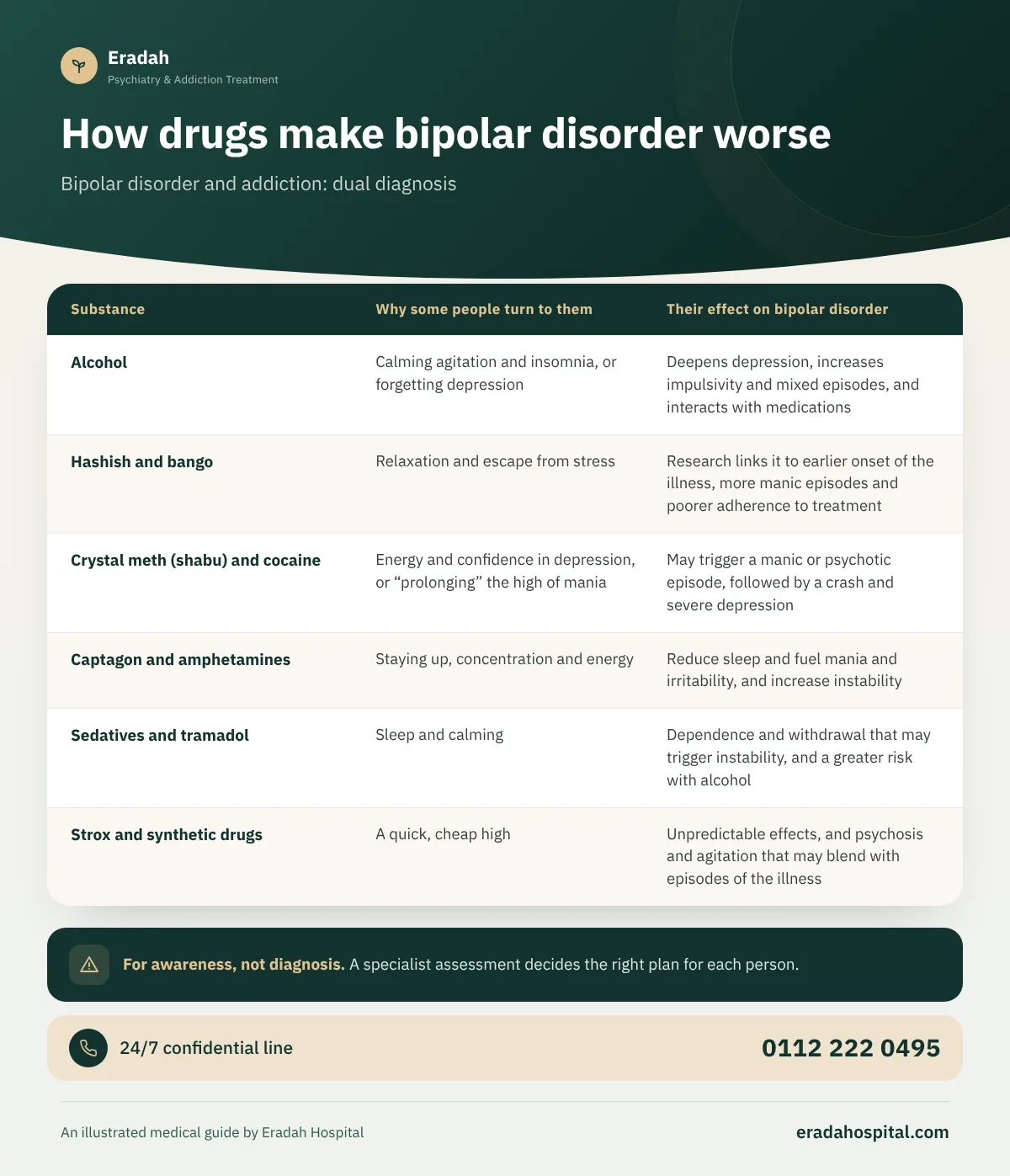
Which substances are most associated with bipolar disorder?
| Substance | Why some people turn to them | Their effect on bipolar disorder |
|---|---|---|
| Alcohol | Calming agitation and insomnia, or forgetting depression | Deepens depression, increases impulsivity and mixed episodes, and interacts with medications |
| Hashish and bango | Relaxation and escape from stress | Research links it to earlier onset of the illness, more manic episodes and poorer adherence to treatment |
| Crystal meth (shabu) and cocaine | Energy and confidence in depression, or “prolonging” the high of mania | May trigger a manic or psychotic episode, followed by a crash and severe depression |
| Captagon and amphetamines | Staying up, concentration and energy | Reduce sleep and fuel mania and irritability, and increase instability |
| Sedatives and tramadol | Sleep and calming | Dependence and withdrawal that may trigger instability, and a greater risk with alcohol |
| Strox and synthetic drugs | A quick, cheap high | Unpredictable effects, and psychosis and agitation that may blend with episodes of the illness |
How do substances trigger episodes and block improvement?
- Triggering episodes: stimulants and the lack of sleep that goes with substance use are among the strongest triggers of mania, and alcohol entrenches depression.
- More frequent and faster episodes: substance use is linked to episodes coming closer together and to mixed features.
- Poor medication adherence: a person who uses substances forgets doses or stops the medication in order to use.
- Drug interactions: alcohol and some substances interact with mood-stabilizing medications and increase their side effects.
- Higher safety risk: having both illnesses is linked to more suicide attempts and accidents.
Which came first: the illness or the drugs?
A question that preoccupies many families, and the answer varies: bipolar disorder may begin first and substance use follows as an attempt to ease it; substance use may begin first and reveal an underlying predisposition and trigger the first episode; or the substance itself may cause a mania-like state that goes away when it wears off.
That is why assessment needs an experienced doctor, and sometimes a period of abstinence under medical supervision, to see whether the symptoms continue after stopping. What matters in practice is that in every case the two are treated together.
What is integrated dual treatment?
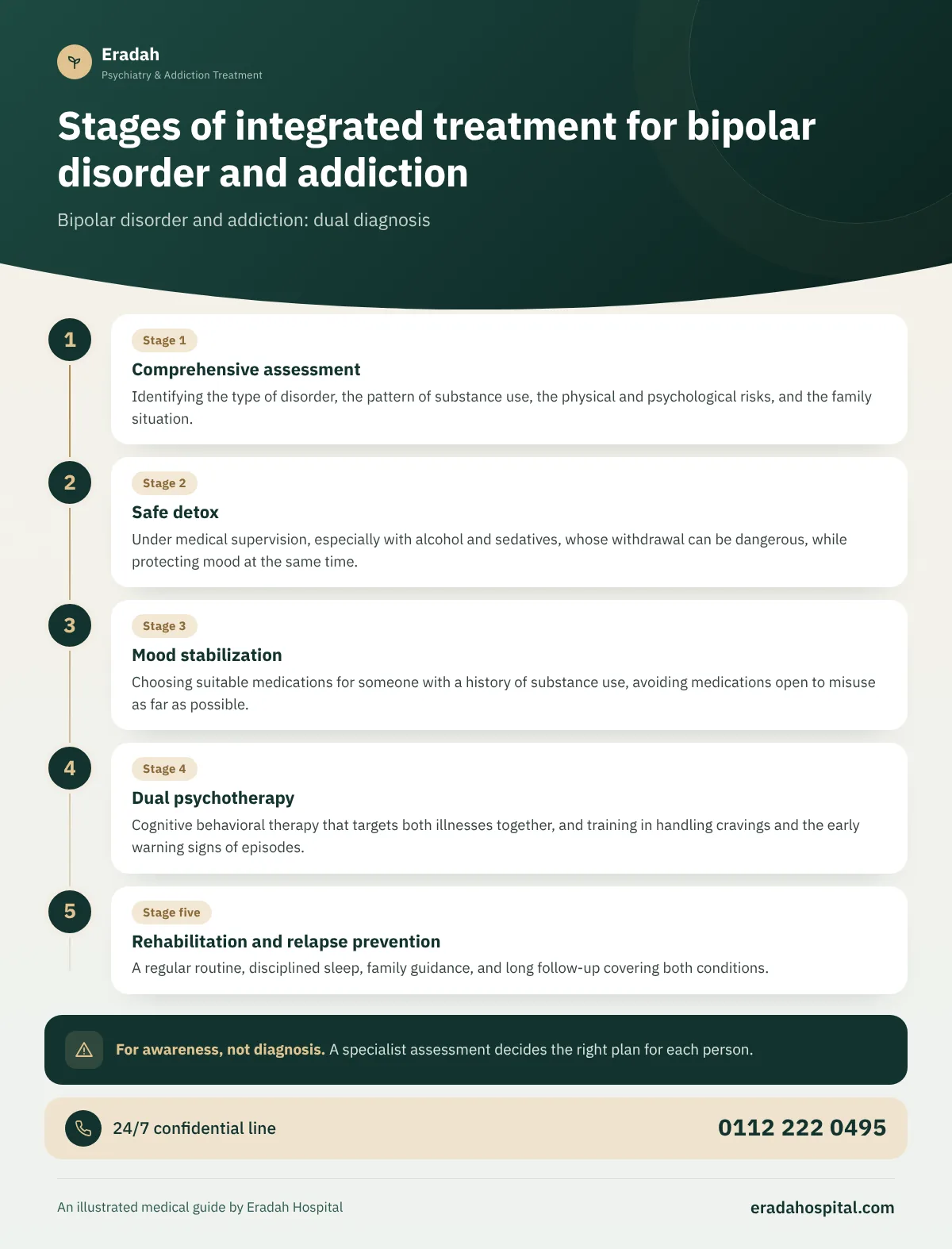
Integrated treatment means one team treats both conditions in one plan at the same time, instead of sending the patient to one place for addiction treatment and another for the psychiatric illness and letting them get lost in between. NICE guidelines stress assessing substance use in every patient with bipolar disorder and addressing it within the plan.
- Stage 1Comprehensive assessment
Identifying the type of disorder, the pattern of substance use, the physical and psychological risks, and the family situation.
- Stage 2Safe detox
Under medical supervision, especially with alcohol and sedatives, whose withdrawal can be dangerous, while protecting mood at the same time.
- Stage 3Mood stabilization
Choosing suitable medications for someone with a history of substance use, avoiding medications open to misuse as far as possible.
- Stage 4Dual psychotherapy
Cognitive behavioral therapy that targets both illnesses together, and training in handling cravings and the early warning signs of episodes.
- Stage fiveRehabilitation and relapse prevention
A regular routine, disciplined sleep, family guidance, and long follow-up covering both conditions.
Warning signs that call for intervention
- Mood episodes that have become more frequent or severe since substance use began.
- Stopping or neglecting the psychiatric medication while drinking or using more.
- Staying up for days while using stimulants, or agitation and strange thoughts.
- Debts or legal problems linked to substance use during episodes.
- Talk of hopelessness or death, especially with drinking; this is an emergency.
How can the family help a person who has both illnesses?
- See both as illnesses that need treatment, not as a moral failure.
- Do not wait for them to stop using before treating the mood, or the other way around; look for a place that treats both together.
- Notice the relationship between substance use and episodes and record it to help the doctor.
- Avoid giving cash during periods of substance use or mania.
- Keep emergency numbers: ambulance (123), the mental health support line 16328, and the addiction treatment hotline 16023.
- Ask for support for yourself; the burden on the family in dual diagnosis is heavy.
Dual diagnosis at Eradah
Treating cases where psychiatric illness and addiction occur together is the core of Eradah's work. The psychiatrist, the addiction treatment team and the psychotherapist work in one plan, which begins with a safe detox while protecting mood, moves through stabilization and dual psychotherapy, and ends with rehabilitation and long follow-up for the family and the patient. Learn more about the dual diagnosis program.
Acute mania or suicidal thoughts? Get help now
- Talking about wanting to die or being a “burden” on others, or feeling complete despair
- Saying goodbye to family, giving away belongings, or sudden isolation
- No sleep for several days in a row with severe agitation or nonstop racing speech
- Hearing voices that command them to act, or fixed strange beliefs that they are being pursued or have a special mission
- Dangerous reckless behavior that puts them or others at risk of harm, or unusual aggression
Stay with the person and do not leave them alone, and listen calmly, without arguing or blaming. Call the ambulance on 123 or take them to the nearest emergency department, or call the mental health support line 16328, available around the clock, and keep anything they could hurt themselves with out of their reach.
Ambulance 123 Mental health support line 16328