What are the goals of nervous breakdown treatment?
A nervous breakdown is not a diagnosis, so there is no single “treatment” for it. Healthdirect says treatment depends on the cause. The first goal is for the person to be safe and stable again, the second is to find out exactly what happened, and the third is to treat the cause and build skills that prevent another crisis.
This means the plans for two people who have both “broken down” can be completely different: someone whose crisis stems from depression needs depression treatment, someone whose crisis was withdrawal from sedatives needs a safe, supervised withdrawal, and someone who broke down under prolonged work pressure needs to reorganize their life before anything else.
What are the stages of recovery from a nervous breakdown?
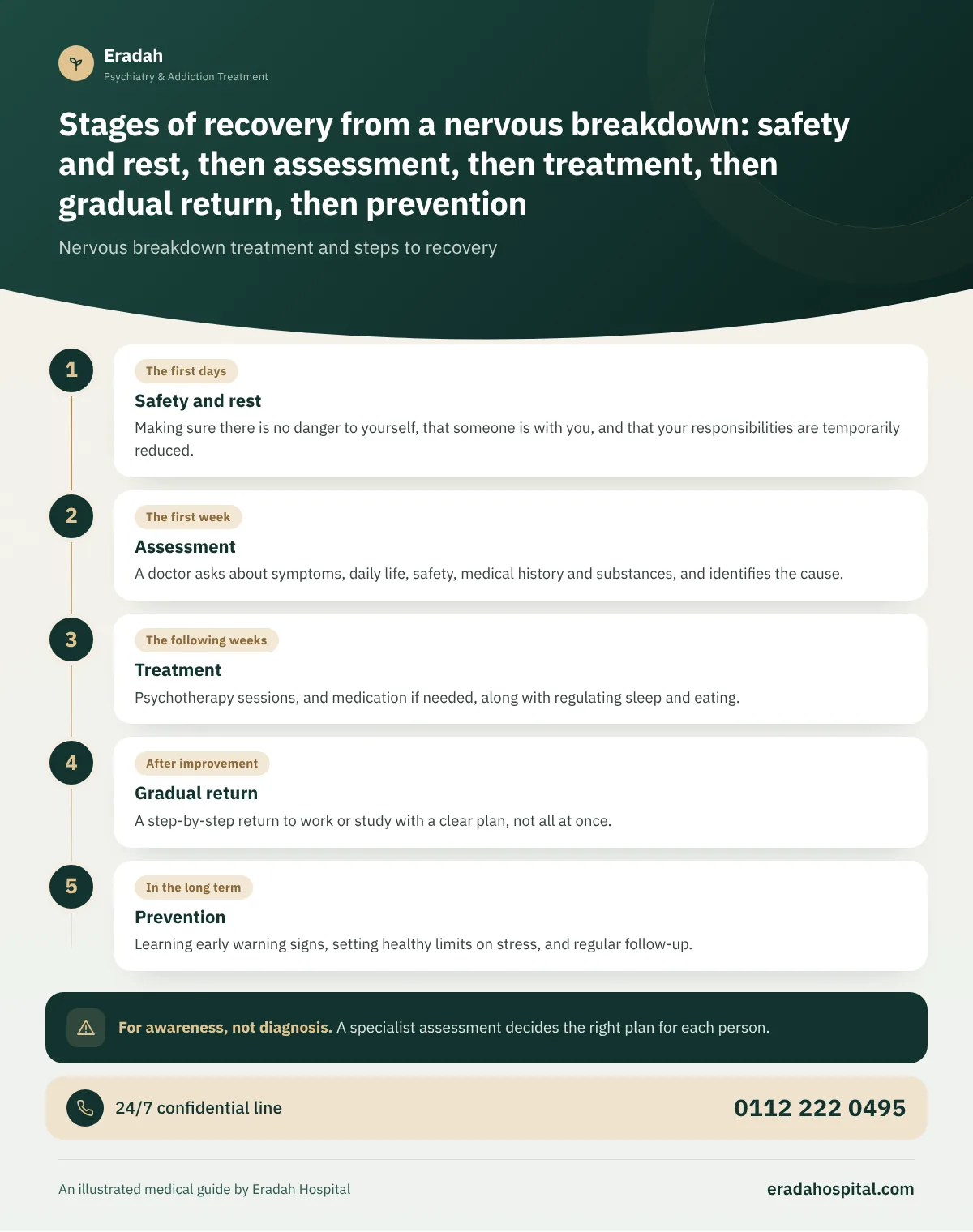
- The first daysSafety and rest
Making sure there is no danger to yourself, that someone is with you, and that your responsibilities are temporarily reduced.
- The first weekAssessment
A doctor asks about symptoms, daily life, safety, medical history and substances, and identifies the cause.
- The following weeksTreatment
Psychotherapy sessions, and medication if needed, along with regulating sleep and eating.
- After improvementGradual return
A step-by-step return to work or study with a clear plan, not all at once.
- In the long termPrevention
Learning early warning signs, setting healthy limits on stress, and regular follow-up.
Healthdirect notes that the doctor asks about symptoms, daily life, mental health and safety, and may refer you to another doctor or a psychologist for further assessment and treatment. Cleveland Clinic adds that the assessment may include a physical exam and tests to rule out another health problem, and questions about herbs, supplements, alcohol and drugs.
What psychotherapy is used for a nervous breakdown?
Cleveland Clinic says that the main treatment for psychological and behavioral stress is talk therapy, and that one of its best-known forms is cognitive behavioral therapy, which aims to manage severe stress and anxiety by changing the way you think, feel and act. During sessions, the person learns to:
- Describe their symptoms and feelings clearly and without embarrassment.
- Understand the sources of their stress in depth and how they respond to it.
- Recognize their thoughts and behaviors, and re-evaluate and change them.
- Use problem-solving skills to deal with what can be changed.
- Ways to calm the mind and body, such as relaxation and mindfulness, which healthdirect also mentions.
You can find more detail about cognitive behavioral therapy and how its sessions run, individually or in groups.
Does a nervous breakdown need medication?
Not always. But if depression or an anxiety disorder lies behind it, the doctor may prescribe medication to treat that condition. Healthdirect mentions the following classes among the options, and you can read more about antidepressants and what to expect from them:
| Category | Use | Note |
|---|---|---|
| Selective serotonin reuptake inhibitors (SSRIs) | Improve mood and ease anxiety | Their effect usually appears after weeks, and the doctor sets the dose and duration |
| Serotonin and norepinephrine reuptake inhibitors (SNRIs) | Mood, energy and concentration | Do not stop suddenly without a doctor |
| Benzodiazepines | Quick calming of severe anxiety | Healthdirect says they are recommended for short periods only |
How long does recovery from a nervous breakdown take?
No single duration applies to everyone, because stresses and the ability to cope differ from person to person, as medical sources say. But there are useful indicators:
- Healthdirect notes that if the cause is diagnosed and the person receives treatment, symptoms are expected to improve after 4 to 6 weeks, and if they do not notice improvement, they should go back to their doctor.
- Cleveland Clinic notes that with an accurate diagnosis, identification of the sources of stress and appropriate treatment, symptoms are likely to resolve within six months, except for crises tied to the loss of a loved one, which may take longer to recover from.
It usually takes longer if severe depression, trauma or substance use is behind it, or if help was sought late. Improvement is not a straight line; there may be good days and then a hard one, and that is a normal part of recovery, not a sign of failure.
When does a nervous breakdown need hospital admission?
Most people recover at home with regular follow-up in outpatient clinics. But a short stay in a psychiatric hospital may be the safest option if:
- Thoughts or attempts of self-harm have appeared.
- Hallucinations, intense suspicion or confusion have appeared.
- The person has stopped eating and drinking or is completely unable to care for themselves.
- There is substance use or withdrawal that needs medical supervision.
- There is no one at home to stay with them and ensure their safety.
In these cases, hospital admission is the start of recovery, not a sign of failure. Its aim is to get past the danger and then return home with a clear follow-up plan.
How do you return to work and life after a nervous breakdown?
- Start gradually: fewer hours or tasks at first, then a step-by-step increase agreed with your doctor.
- Organize your day: Cleveland Clinic suggests a to-do list with priorities, frequent short breaks, and reviewing what you accomplished at the end of the day without blaming yourself for what you did not.
- Move: Cleveland Clinic recommends physical activity for 30 minutes at least five days a week, and walking is an excellent option.
- Cut back on stimulants and stay away from substances: excess caffeine, alcohol and drugs strain the body, according to the same source.
- Remember the warning signs: insomnia, irritability and withdrawal are early signals that call for action before the crisis returns.
Acute mental health crisis? These signs call for emergency care now
- Talking about death, suicide or self-harm, or suddenly saying goodbye to family
- Hallucinations (seeing or hearing things that are not there) or intense suspicion of others
- Stopping eating and drinking, or being completely unable to care for oneself
- Severe confusion or strange behavior that is out of character for the person
- Heavy use of alcohol, sedatives or drugs, or severe withdrawal symptoms
Do not leave the person alone. Ask them calmly and directly how they feel and what they are thinking, and listen without blame or lectures; asking directly does not plant the idea, it opens the door to help. Call an ambulance on 123 or take them to the nearest emergency room, or call the mental health support line 16328 (24 hours), and keep medications and anything they could use to harm themselves out of reach.
Ambulance 123 Mental health support line 16328