How does stress arise?
Stress arises from the gap between the event and the person, and neither alone is enough to explain it. The UK's National Health Service puts it simply: feeling stressed usually happens when we feel we do not have the resources to cope with the challenges in front of us.
That is why two people can go through the same circumstance, such as a delayed salary or a father's illness, and one handles it with relative calm while the other loses sleep and focus. This difference does not make one morally stronger than the other; each entered the situation with a different load, different support and a different history.
What are the most common sources of stress in daily life?
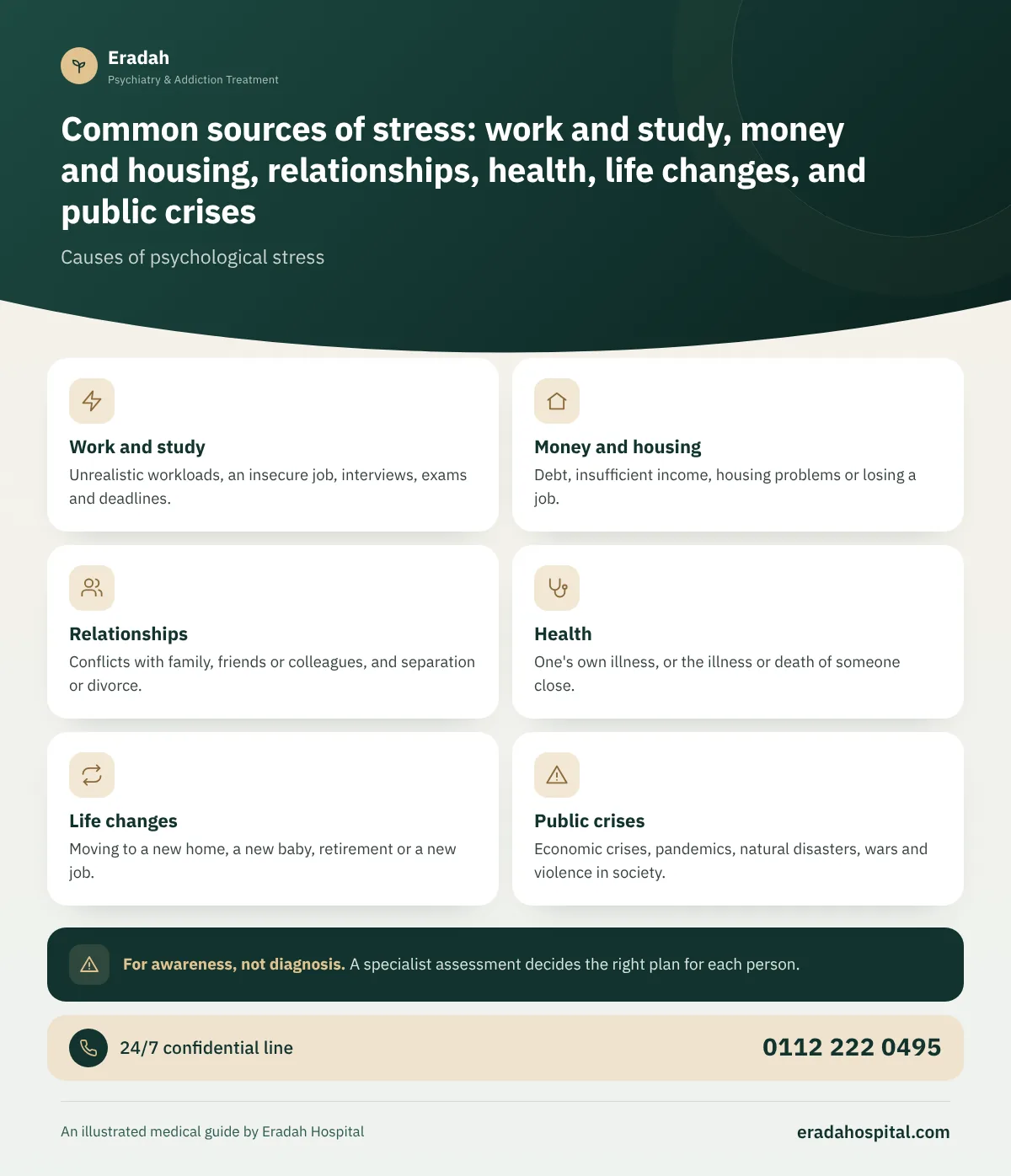
The World Health Organization and the UK's National Health Service group the common sources of stress into similar categories:
Unrealistic workloads, an insecure job, interviews, exams and deadlines.
Debt, insufficient income, housing problems or losing a job.
Conflicts with family, friends or colleagues, and separation or divorce.
One's own illness, or the illness or death of someone close.
Moving to a new home, a new baby, retirement or a new job.
Economic crises, pandemics, natural disasters, wars and violence in society.
Cleveland Clinic notes that a pile-up of small problems at the same time, such as traffic, coffee spilled on your clothes and being late for an appointment, can be enough to cause acute stress. You do not need a major disaster to feel exhausted.
Can happy events cause stress?
Yes. Cleveland Clinic counts both getting a new job and losing one as sources of stress, and lists among its causes marriage, having a baby, moving to a new home, retirement, and even going on vacation. Joy does not cancel the effort the body and mind need to adapt to a new situation and new responsibilities, which is why many people are surprised to feel tense in weeks they had long awaited.
Why are some people more affected by stress than others?
The UK's National Health Service notes that causes of stress include our genes, how we were raised, and our experiences in childhood and adulthood. Personal factors show up in:
- Temperament and predisposition: in some people the nervous system responds to threat faster and more intensely.
- Early experiences: a review by researcher Rajita Sinha says that early childhood stress, maltreatment and accumulated adversity cause changes in the body's stress-response systems.
- Thinking patterns: perfectionism, expecting the worst and difficulty tolerating uncertainty magnify the effect of a situation, and overlap greatly with overthinking.
- Difficulty setting boundaries: accepting every request and taking on others' responsibilities at one's own expense.
- Lack of support: a person who faces their crises alone carries the whole burden.
What factors weaken your ability to cope with stress?
Some causes come not from outside but from the state and habits of the body, making an ordinary situation feel heavy:
| Factor | How it increases stress |
|---|---|
| Lack of sleep | The World Health Organization says sleep restores the body and mind and helps reverse the effects of stress, and without it we lose that reserve |
| Stimulants before bed | Caffeine in the evening spoils sleep, so the next day starts with a smaller reserve |
| Following the news for long periods | The World Health Organization notes that spending a long time following the news on television and social media can increase stress |
| Chronic illness and pain | Illness is itself a source of stress, and it reduces the energy available for coping |
| Substance use and withdrawal | Substances relieve tension temporarily and then leave it higher, and withdrawal symptoms are an added strain on the nervous system |
When does a temporary cause become chronic stress?
Stress becomes chronic when its sources continue for weeks and months without breaks, as in prolonged marital problems, work pressure or financial crises, which are examples Cleveland Clinic mentions. The risk rises when several sources combine at once, or when the person is in a role that does not let them stop, such as caring for a sick person at home for years. Over time, stress itself can become the cause of new stress: insomnia weakens performance, which increases work pressure, which increases insomnia.
Has stress turned into danger? Ask for help now
- Talking about death, wanting to disappear, or being a “burden” on others
- Severe or crushing chest pain, sudden shortness of breath, or fainting (treat as a heart problem until proven otherwise)
- Complete inability to sleep, eat or do any task for several days
- Excessive use of sedatives, or mixing them with alcohol or drugs “to calm the nerves”
- Fits of anger that reach threats or violence toward oneself or others
Do not leave the person alone. Calmly and frankly ask how they feel and what they are thinking, and listen without blame; asking directly does not plant the idea, it opens the door to help. For chest pain, fainting or any threat to life, call an ambulance (123) immediately. For suicidal thoughts, call an ambulance or take them to the nearest emergency room, or call the mental health support line 16328 (24 hours), and keep medications and anything they could use to hurt themselves away from them.
Ambulance 123 Mental health support line 16328