Why does a nervous breakdown happen?
What people call a nervous breakdown happens when stress exceeds a person's ability to cope. Cleveland Clinic says that each person has their own “set point” for breaking down, and that there is no limit to the possible causes, or to the combinations of them, that can lead to a mental health crisis.
That is why it makes no sense to compare “who endured more.” The same situation may pass over one person and break another, depending on what each was already carrying, the support each has, and their physical and mental state at the time.
What are the main causes of a nervous breakdown?
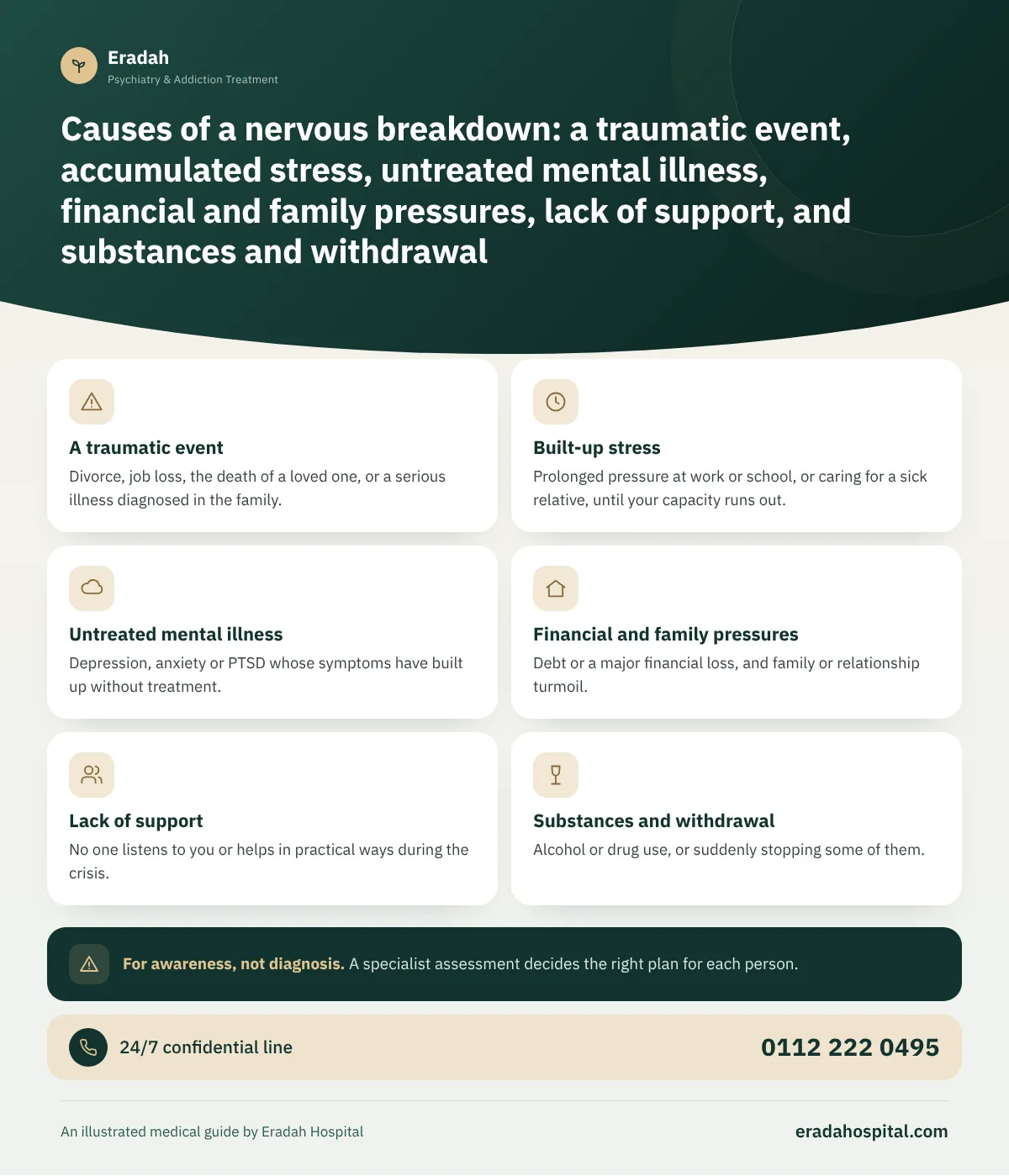
Divorce, job loss, the death of a loved one, or a serious illness diagnosed in the family.
Prolonged pressure at work or school, or caring for a sick relative, until your capacity runs out.
Depression, anxiety or PTSD whose symptoms have built up without treatment.
Debt or a major financial loss, and family or relationship turmoil.
No one listens to you or helps in practical ways during the crisis.
Alcohol or drug use, or suddenly stopping some of them.
How can a single event cause a nervous breakdown?
Healthdirect notes that a breakdown can follow a single event that causes severe stress, such as divorce, losing a job or a serious illness diagnosed in the family. Cleveland Clinic adds severe personal tragedies such as the death of a loved one, losing a home, or acute financial hardship.
What sometimes makes one event enough is that it shakes more than one foundation at once. Losing a job, for example, means less income, a sense of lost worth, tension at home and worry about the future. If the symptoms are tied to a frightening event whose memories keep intruding, it may be closer to what we explain in the causes of post-traumatic stress disorder.
Can a breakdown come from accumulated stress?
Yes, and it is a common path in the accounts of people who have been through a crisis. Healthdirect says that stress and anxiety can build up over a long time until a person reaches a point where things seem beyond them. Cleveland Clinic lists these prolonged stresses: constant work pressure or problems at school, family and relationship turmoil, chronic illness or its worsening, and lack of sleep or being unable to relax.
This path overlaps with burnout when work is the source, and with the causes of psychological stress in general. The difference is that a breakdown is the moment when daily functioning stops, not merely a feeling of tiredness.
What role do mental illnesses play in a nervous breakdown?
A breakdown is often the moment when a mental illness that had been building silently comes to the surface. Healthdirect lists depression, anxiety and PTSD among the causes, and Cleveland Clinic notes that the worsening of an existing mental health condition because of ongoing events, or a personal or family history of anxiety disorders, raises the likelihood of a crisis.
| The situation | Distinguishing sign |
|---|---|
| Depression | Sadness or loss of pleasure for two weeks or more, with exhaustion and guilt |
| Anxiety and panic disorders | Persistent worry or sudden panic attacks with a racing heart and shortness of breath |
| Post-traumatic stress disorder (PTSD) | Intrusive memories, nightmares and avoidance after a traumatic event |
| Bipolar disorder | Episodes of depression interspersed with periods of excess energy, little sleep and impulsivity |
| Adjustment disorder | Mental symptoms tied to a stressful situation that are greater than would be expected in response to it |
Who is most at risk of a nervous breakdown?
- People with a family history of mental illness, as healthdirect notes.
- People going through major hormonal changes, such as pregnancy or menopause in women, according to healthdirect.
- People with a chronic or worsening physical illness that limits their ability to function, as Cleveland Clinic notes.
- People facing financial or work pressures without enough social support.
- People who rely on alcohol or substances to cope with stress.
A concept analysis of “mental health crisis” published by Hudson and colleagues in 2024 in the International Journal of Mental Health Nursing, after reviewing 34 articles, describes the antecedents of a crisis as including underlying vulnerabilities, disrupted relationships, a breakdown in the structure of daily life, and difficulty carrying out its activities.
Do drugs and alcohol cause a nervous breakdown?
They can cause it or hasten it in two ways. The first is during use: some substances, such as stimulants and synthetic cannabinoids like Strox, can cause severe anxiety, agitation and suspiciousness. The second is when stopping: sudden withdrawal from alcohol or sedatives can cause anxiety, insomnia and tremor, and may be medically dangerous and need supervision. Relying on substances “to calm down” also postpones a crisis rather than preventing it. That is why a doctor always asks about alcohol and drugs as part of the assessment, as Cleveland Clinic notes.
It is best to stop alcohol or sedatives under medical supervision in a detox program rather than stopping suddenly at home.
Why does a breakdown seem sudden when its causes are long-standing?
Because the final moment is often small: a phone call, a comment, an extra request. People around the person think they “broke down over something trivial,” when in truth that small thing landed on top of months of poor sleep, worry and silent endurance. Understanding this changes how you respond: treatment is not just solving the last problem, but reviewing everything that built up before it, which is what the doctor does in a nervous breakdown treatment plan.
Acute mental health crisis? These signs call for emergency care now
- Talking about death, suicide or self-harm, or suddenly saying goodbye to family
- Hallucinations (seeing or hearing things that are not there) or intense suspicion of others
- Stopping eating and drinking, or being completely unable to care for oneself
- Severe confusion or strange behavior that is out of character for the person
- Heavy use of alcohol, sedatives or drugs, or severe withdrawal symptoms
Do not leave the person alone. Ask them calmly and directly how they feel and what they are thinking, and listen without blame or lectures; asking directly does not plant the idea, it opens the door to help. Call an ambulance on 123 or take them to the nearest emergency room, or call the mental health support line 16328 (24 hours), and keep medications and anything they could use to harm themselves out of reach.
Ambulance 123 Mental health support line 16328