How are the types of phobia classified medically?
You may come across strange names for hundreds of phobias, but doctors do not diagnose each name separately. In the diagnostic manual DSM-5-TR, a single diagnosis covers most of them: specific phobia, with a specifier for the group the fear belongs to.
Alongside specific phobia are two related disorders, each with its own diagnosis: agoraphobia, which involves several situations that are hard to escape from, and social anxiety disorder, which involves other people's gaze and judgment. Cleveland Clinic explains that agoraphobia is the only one among the common fears with its own diagnosis, because its triggers are so many and varied.
What are the five groups of specific phobia?
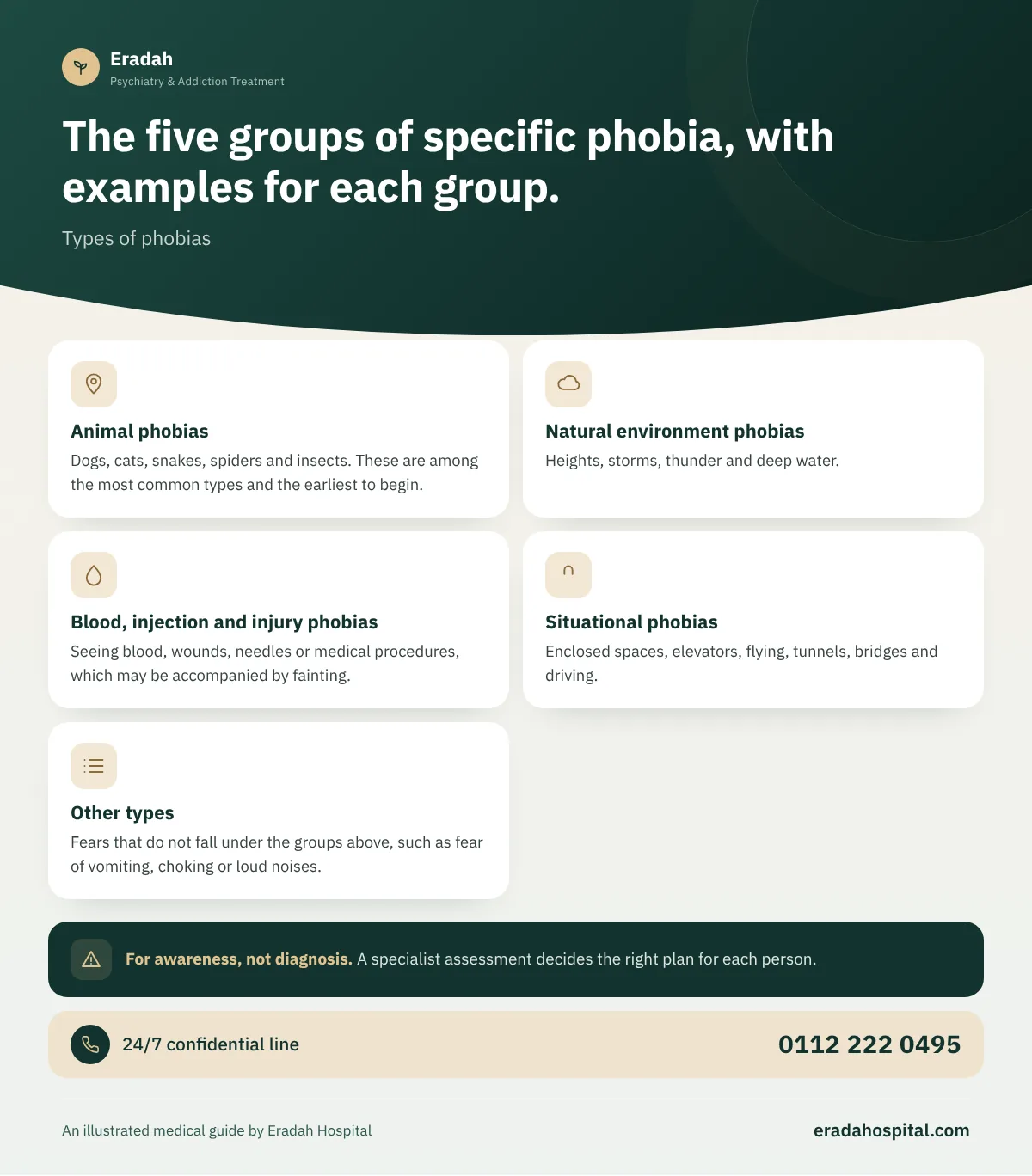
Dogs, cats, snakes, spiders and insects. These are among the most common types and the earliest to begin.
Heights, storms, thunder and deep water.
Seeing blood, wounds, needles or medical procedures, which may be accompanied by fainting.
Enclosed spaces, elevators, flying, tunnels, bridges and driving.
Fears that do not fall under the groups above, such as fear of vomiting, choking or loud noises.
A review in The Lancet Psychiatry notes that fears of heights and animals are the most common worldwide, and that the lifetime prevalence of specific phobia ranges from 3% to 15% depending on the country and the study.
What are the best-known scientific names for phobias?
| Common name | Scientific name | What is the fear of? |
|---|---|---|
| Fear of closed spaces | Claustrophobia | Elevators, small rooms and enclosed scanners |
| Fear of heights (acrophobia) | Acrophobia | High places, balconies and bridges |
| Fear of flying | Aerophobia / Aviophobia | Boarding a plane, or even just thinking about air travel |
| Fear of injections | Trypanophobia | Needles, injections and blood tests |
| Fear of blood | Hemophobia | Seeing blood or wounds |
| Fear of the dark | Nyctophobia | The dark, and sleeping without a light |
| Fear of dogs | Cynophobia | Dogs, even small ones |
| Fear of spiders | Arachnophobia | Spiders, and even seeing pictures of them |
| Fear of vomiting | Emetophobia | Vomiting, or seeing someone vomit |
| Fear of the dentist | Dentophobia | The clinic, the instruments and the sound of the drill |
What is claustrophobia?
It is an intense fear of narrow spaces or places that are hard to leave quickly, such as elevators, small windowless rooms, tunnels and enclosed MRI scanners. The fear usually centers on two ideas: suffocation and lack of air, or being trapped and unable to get out. The practical problem shows up especially in hospitals, when a patient refuses a necessary scan. In that case, telling the medical team in advance lets them discuss the alternatives available.
What is acrophobia (fear of heights)?
Fear of heights is one of the most common phobias. The person feels dizzy and terrified, with an urge to grab hold of something or get down immediately when standing on a high balcony, a ladder or a bridge, and even when looking at pictures of high places. It differs from the dizziness caused by inner-ear problems, which can happen anywhere and needs assessment by an ear, nose and throat doctor.
What is agoraphobia?
Despite its name, agoraphobia does not mean only a fear of open spaces. According to the American Psychiatric Association, it is an intense fear of situations that are hard to escape from or where help may not be available if panic symptoms occur. It must appear in at least two of five situations: public transportation, open spaces, enclosed spaces, standing in line or being in a crowd, and leaving home alone. It usually lasts six months or more.
It is often linked to panic disorder: the person starts avoiding places where they fear an attack might come, and without treatment may even reach the point of being unable to leave the house.
What is the truth about trypophobia and the unusual types?
The MSD Manuals note that there are more than 500 names for types of phobia, most of them very rare. As for “trypophobia,” which is widespread on social media, it is an aversion and disgust that many people feel toward images of clustered holes. It is not a separate diagnosis in medical classification systems, and it needs treatment only if it reaches the level of a specific phobia and disrupts the person's life.
Can a person have more than one type?
Yes, and it is common. The MSD Manuals note that about 75% of people with a specific phobia fear another situation or object as well. World Health Organization surveys found that the severity of impairment and the likelihood of co-occurring mental health conditions increase with the number of types of fear a person has. The coping skills a patient learns in phobia treatment often carry over from one type to another. To understand what all the types have in common, see phobia symptoms and their causes.
Fear accompanied by risk to yourself or dependence on a sedative? Get help now
- Thoughts of death or self-harm out of despair over the fear or from isolation.
- Repeated fainting with injury at the sight of blood or injections, or refusing necessary medical treatment out of fear of needles.
- Chest pain or severe shortness of breath that does not improve, especially in someone with heart disease or an older person.
- Taking increasing doses of sedatives or alcohol to face the situation, or mixing the two.
- Complete withdrawal from leaving the house for weeks, with neglect of eating, sleep and self-care.
If chest pain or severe shortness of breath appears, do not assume it is “just fear”; call an ambulance on 123 so a physical cause can be ruled out. If someone close to you talks about death or harming themselves, stay with them, ask calmly and without blame, remove medications and dangerous objects, and call an ambulance on 123 or go to the nearest emergency department, or call the mental health support line 16328, available around the clock.
Ambulance 123 Mental health support line 16328
16Is social anxiety a type of phobia?
It belongs to the same family of anxiety disorders, but it is a separate diagnosis. The center of the fear is being judged by others, not a specific thing or place: fear of embarrassment or rejection when speaking, eating or performing in front of people. It has a full guide on our site on the social anxiety disorder page, and it is sometimes confused with avoidant personality.