Why do some people have panic attacks?
There is no single cause of panic attacks. It is more accurate to see them as the result of a biological predisposition that makes the fear alarm fire quickly, followed by psychological learning that makes a person afraid of their own bodily sensations, together with circumstances that trigger the first attack.
After the first attack, what specialists call “conditioned fear” takes hold: the brain links a simple sensation, such as a racing heart after climbing stairs, with the terror the person went through, and so it sounds the alarm at any similar sensation. In this way the attacks feed themselves.
Understanding these three layers matters for both the family and the patient. It shifts the question from “What is wrong with me?” to “How did my body learn this alarm, and how can it learn something different?” This is exactly what treatment builds on later.
A family predisposition that makes the alarm more sensitive.
An easily excited amygdala and weaker control from the prefrontal cortex.
Reading ordinary sensations as imminent danger.
Stress, lack of sleep, stimulants, substances and withdrawal.
Is panic disorder hereditary?
Panic disorder tends to run in families, and the risk is higher among first-degree relatives of a person with the condition. Twin studies estimate that genetics accounts for a considerable share of the predisposition, around 40% in some analyses, with the rest due to experiences and environment.
There is no “panic gene” in the popular sense. What is inherited is a group of genes that influence how sensitive the alarm system is and how quickly the body responds to stress. Having a parent or sibling with panic disorder does not mean you will certainly develop it, but it is one more reason to pay attention early.
What happens in the brain of a person with panic?
- The amygdala: medical references describe it as the main center of the problem, as it triggers the fear response quickly and out of proportion.
- The serotonin system: some theories suggest its calming influence on fear circuits is weakened, which is what antidepressants target.
- Norepinephrine: overactivity in the brainstem alarm centers speeds up the pulse and breathing.
- The false suffocation alarm: one theory proposes that some people are overly sensitive to rising carbon dioxide, which the brain reads as a danger of suffocating.
These are proposed mechanisms that work together, and it is not yet known which matters most in each person. But they explain why an attack feels entirely “physical” even though it originates in the fear circuits.
What is the catastrophic interpretation of bodily sensations?
This is the most important psychological model for understanding panic. A person notices an ordinary sensation, such as a skipped heartbeat or mild dizziness, and immediately interprets it catastrophically: “This is a heart attack,” “I am going to suffocate,” “I am losing my mind.” Fear rises, the palpitations increase, the interpretation seems confirmed, and the attack reaches its full force.
| Stage | What happens |
|---|---|
| The trigger | An ordinary bodily sensation, or a situation linked to a previous attack |
| Attention | Excessive focus on the sensation and monitoring it |
| Explanation | “This is dangerous,” “I am going to die,” or “I will lose control” |
| Fear | A sharp rise in anxiety and a surge of adrenaline |
| Symptoms intensify | Palpitations and shortness of breath increase, confirming the interpretation, and the attack reaches its peak |
This is linked to a trait called “anxiety sensitivity,” the belief that anxiety symptoms are themselves dangerous. People with this trait are more likely to have attacks that develop into a disorder.
Do stress and major life events cause panic attacks?
Many patients remember that their first attack came after a difficult period: the death of a relative, childbirth, an illness, intense work pressure, or a separation. Stress does not create the disorder on its own, but it drains the body’s capacity to calm down and makes the alarm fire more quickly.
Difficult childhood experiences, such as separation anxiety or losing a parent, are also linked to a higher risk later in life in some people.
Do stimulants and drugs trigger panic attacks?
Yes, and this is a point many people overlook. Some substances can trigger a panic attack directly in a person who is predisposed, and it may be the first attack of their life:
| Substance or condition | How they trigger panic |
|---|---|
| Caffeine and energy drinks | They raise the pulse and tension, and excessive intake is known to provoke attacks |
| Hashish | Can cause severe panic attacks, especially with strong varieties or in first-time users |
| Stimulants (Captagon, crystal meth (shabu), cocaine) | They sharply raise adrenaline and pulse and provoke panic and suspicion |
| Withdrawal from alcohol or sedatives | A rebound in nervous system activity that can cause panic attacks and severe anxiety |
| Lack of sleep and extreme fatigue | They lower the alarm threshold, so attacks fire more easily |
Which medical conditions mimic panic?
Before diagnosing panic disorder, the doctor rules out conditions that can cause similar symptoms. StatPearls lists among them:
- Heart conditions such as angina and arrhythmia.
- Pulmonary embolism, asthma and other breathing problems.
- An overactive thyroid.
- Inner ear disorders and vertigo.
- Substance use or withdrawal.
Having one of these causes does not always rule out panic, since the two can coexist, but ruling them out is essential for a correct treatment plan.
What are the risk factors and protective factors?
| Factors that raise the risk | Protective factors |
|---|---|
| A family history of panic disorder or anxiety | Understanding the nature of the attack early, after it first happens |
| The anxiety sensitivity trait | Not avoiding places after the first attack |
| Major recent life stress | Regular sleep and physical activity |
| Excessive stimulant use or use of cannabis and stimulants | Family support and seeking help early |
| Being female | Avoiding sedatives as a form of self-treatment |
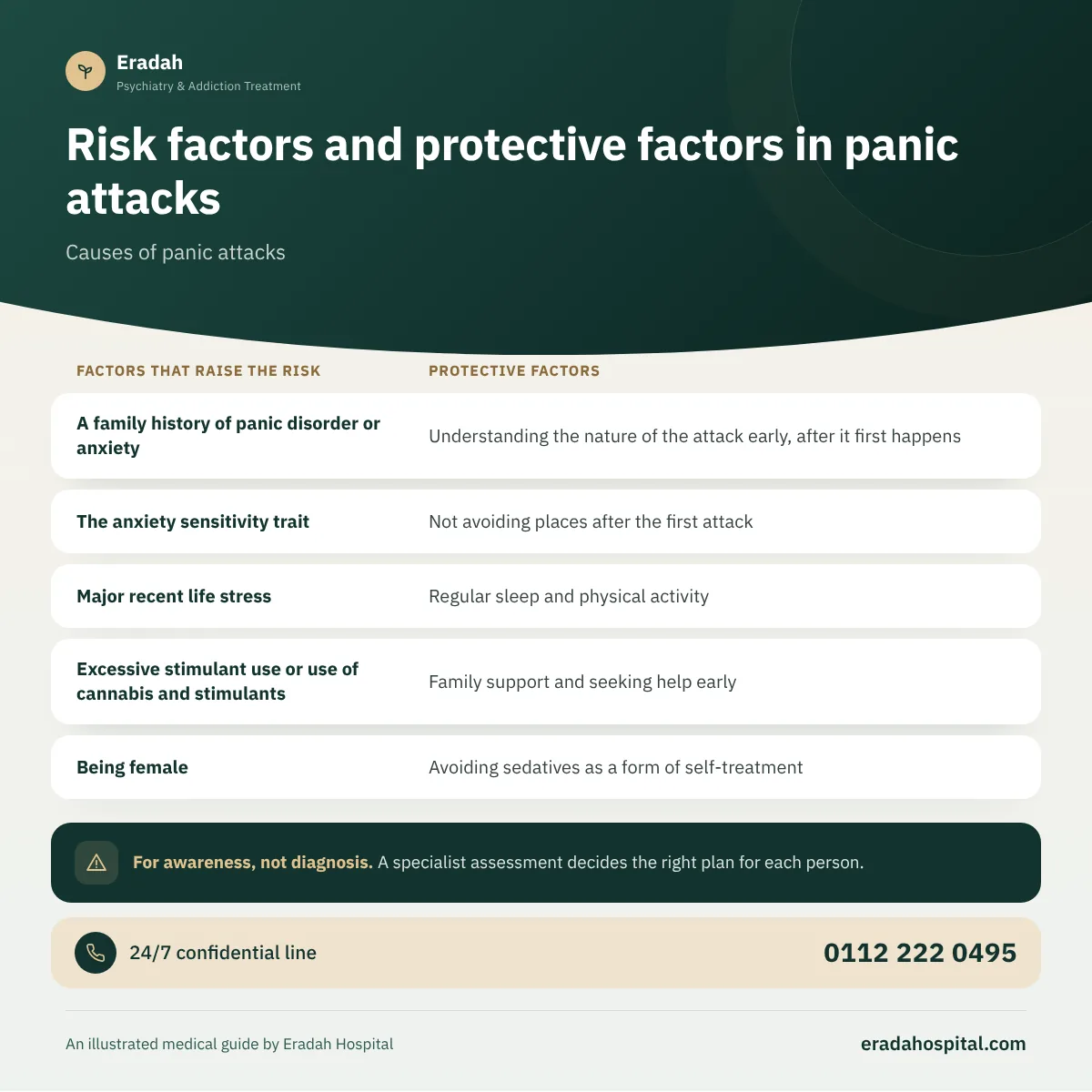
The most important protective factor is not avoiding: a person who returns to the place where the attack struck, once medical safety has been confirmed, greatly reduces the chance that the attack turns into a chronic disorder.