What happens if panic attacks are neglected for years?
Without treatment, panic changes from isolated attacks into a way of life organized around fear: constant anticipation, increasing avoidance, and a continual search for safety. The NHS notes that untreated panic disorder can get worse and raise the risk of agoraphobia, other phobias and substance misuse.
- After the first attacksAnticipation and fear
Constant worry about the next attack, and repeated emergency visits.
- Within monthsAvoidance begins
Giving up exercise, coffee or public transport, and going out only with a companion.
- In the longer termLife narrows
Agoraphobia, declining performance at work, isolation, and possibly depression or dependence on sedatives.
How does panic lead to agoraphobia and isolation?
Each time a person avoids a place for fear of an attack, they feel immediate relief, so the brain learns that avoidance “saved” them. With repetition, the list of off-limits places grows: the market, then public transport, then work, then going out alone. In severe cases a person can become housebound for years.
This is one of the most painful complications, because it takes away a person’s independence and places on the family the burden of constant accompaniment. But it is also treatable with gradual exposure under the supervision of a specialist.
In our communities, this avoidance may be misunderstood as pampering or an “excuse” to stay home, which deepens the patient’s shame and isolation. The truth is that they are living with real fear that deserves understanding and treatment, not blame.
Why do emergency visits and tests keep repeating?
StatPearls notes that most people with panic first reach emergency departments complaining of chest pain, palpitations or shortness of breath. This is understandable and appropriate for the first attack. The problem arises when the visits repeat without the patient ever being offered a psychological assessment.
- Repeated ECGs, blood tests and scans consume time and money.
- Temporary reassurance fades with the next attack.
- A feeling of not being believed when the patient hears “you are fine” while still suffering.
- A delay of years, at times, before the correct diagnosis.
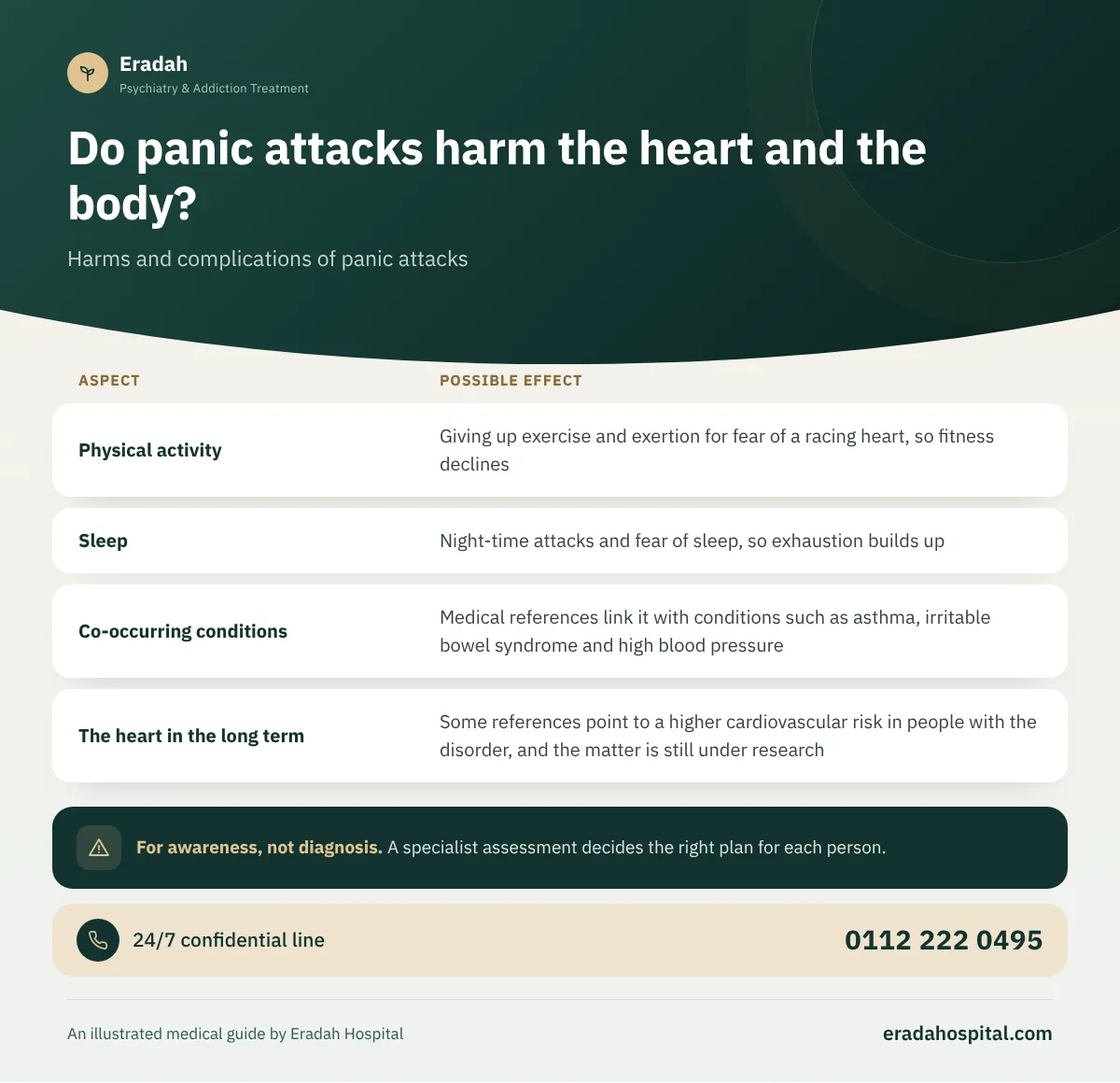
Do panic attacks harm the heart and the body?
A single attack causes no direct harm to a healthy heart. But living for years in a state of alert and avoidance has an indirect physical cost:
| Aspect | Possible effect |
|---|---|
| Physical activity | Giving up exercise and exertion for fear of a racing heart, so fitness declines |
| Sleep | Night-time attacks and fear of sleep, so exhaustion builds up |
| Co-occurring conditions | Medical references link it with conditions such as asthma, irritable bowel syndrome and high blood pressure |
| The heart in the long term | Some references point to a higher cardiovascular risk in people with the disorder, and the matter is still under research |
Does panic disorder lead to depression?
Depression often appears after months or years of panic, once a person has lost their activities and independence and feels helpless in the face of attacks they do not understand. Other anxiety disorders, such as generalized anxiety or social phobia, may also coexist with it. When they do, the plan needs to treat both sides together.
How does panic push people toward sedatives and alcohol?
Because the attack is terrifying and sudden, the person looks for anything that guarantees it will not come. This is where the danger of benzodiazepine sedatives such as Xanax and Rivotril shows itself: a person may carry them in a pocket “for emergencies” and end up using them daily. Some people also turn to alcohol before frightening situations.
StatPearls notes that rates of alcohol and substance use disorders are clearly higher among people with panic disorder than in the general population. Details are on the page about panic attacks and addiction.
How does panic affect work and family?
- Work: frequent absences, refusing to travel, attend meetings or commute, and sometimes leaving work altogether.
- Studies: avoiding lectures or crowded exam halls.
- Family: reliance on a constant companion, limits on going out and on family travel, and strain between spouses.
- Social life: declining invitations and gradually withdrawing from friends.
NIMH data show that nearly half of those affected within a year experience serious disruption at work, at home or in relationships, which shows that panic is not “just stress.”
The family’s finances are also affected indirectly: the costs of emergency visits and repeated tests, lost workdays, and at times losing a job or turning down better opportunities because they involve travel or commuting.
What about teenagers and pregnant women?
In teenagers, panic that is not understood can lead to missing school, giving up activities, withdrawing from friends, and sometimes trying cannabis or sedatives in search of calm, which makes the attacks worse. This is why a teenager needs a specialist assessment early, with the parents involved and without playing the problem down or blowing it out of proportion.
During pregnancy and after childbirth, attacks may become more intense in some women, and worry about the unborn baby or infant adds to their severity. No psychiatric medication should be started or stopped during this period without the doctor, who weighs the benefit of treatment against its risks for mother and child.
Is panic disorder linked to suicidal thoughts?
Medical references point to a higher risk of suicidal thoughts in people with panic disorder, especially when depression or substance use is present. Exhaustion from repeated attacks and isolation can produce real hopelessness, and this hopelessness deserves to be taken seriously and without blame.
If you are having thoughts about death or harming yourself, you are not alone and help works: call the mental health support line 16328, available around the clock, or ambulance (123), or go to the nearest emergency room. Panic is one of the conditions that respond best to treatment.
Can the complications of panic attacks be avoided?
- Seek a psychological assessment once the doctor has ruled out heart causes, rather than after years of emergency visits.
- Resist avoidance early, and return gradually to the places you fear with specialist support.
- Do not make a sedative a “permanent companion” without a plan from your doctor.
- Stay away from cannabis and stimulants, and cut down on caffeine.
- Treat any accompanying depression.
- Explain the nature of the attack to your family so they can support you without reinforcing avoidance.
Chest pain: panic attack or heart attack? When in doubt, call an ambulance on 123
- Pain, pressure or squeezing in the chest that spreads to the arm, jaw or back, especially with exertion
- The first attack of your life, or an attack different from your usual ones in form or duration
- Heart risk factors: older age, diabetes, high blood pressure, smoking, or family history
- Fainting, or shortness of breath that doesn't improve, bluish lips, or sudden weakness on one side of the body
- Talk of wanting to die, or severe hopelessness because of recurring attacks
No one can tell with certainty at home between a panic attack and a heart attack; if there is chest pain and you suspect it, treat it as an emergency: call an ambulance on 123, do not drive yourself, and stay with the person until help arrives. If a doctor has previously diagnosed panic attacks and the attack comes in the same usual pattern, help them breathe slowly and remind them that it will pass. If there are thoughts of self-harm, call the mental health support line 16328.
Ambulance 123 Mental health support line 16328