What is the link between panic attacks and addiction?
StatPearls notes that rates of alcohol dependence and substance use in people with panic disorder are clearly higher than in the general population. NIDA confirms that the relationship between anxiety and substances runs in both directions.
What is different in panic is that the patient is not seeking to calm a constant anxiety all day, but a “guarantee” against a sudden, terrifying attack. This fear of the unknown makes a substance that stops the attack quickly seem like a lifeline, so they cling to it.
When panic and addiction occur together it is called dual diagnosis, and it needs treatment that understands both conditions together.
How does the “emergency pill” turn into dependence?
The story often starts with an emergency room visit where the patient is given a sedative and calms within minutes. Afterward they keep a pill in their pocket, then take it before any situation they fear, then daily “to prevent.” Over time:
- The sedative’s effect weakens, so they need more (tolerance).
- Rebound anxiety and panic attacks appear between doses, especially with short-acting sedatives.
- They cannot leave the house without the pill, so the pill itself becomes a new source of anxiety if it runs out.
- Withdrawal symptoms appear when they try to stop, resembling or exceeding panic.
Which substances are most often misused with panic?
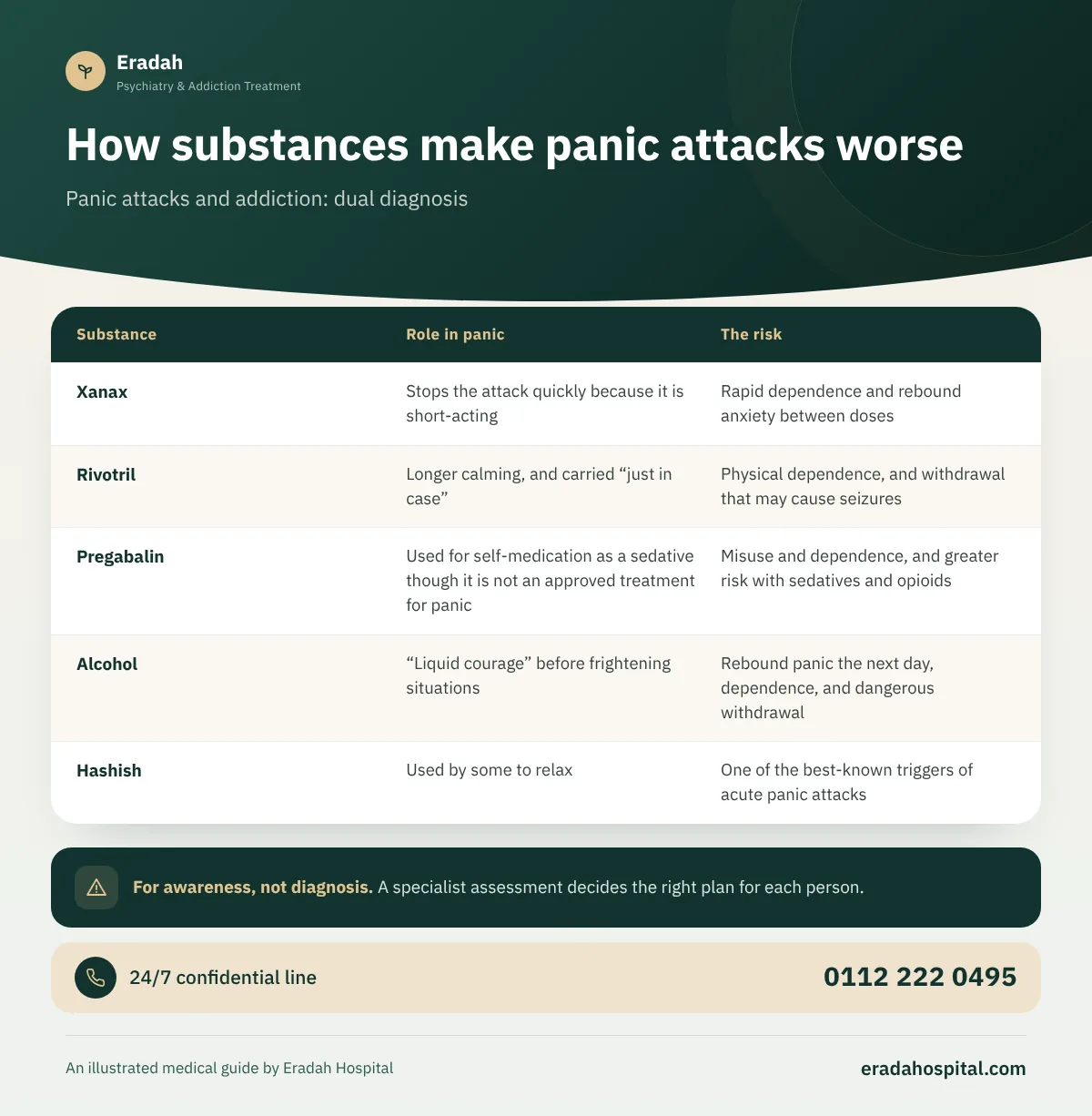
| Substance | Role in panic | The risk |
|---|---|---|
| Xanax | Stops the attack quickly because it is short-acting | Rapid dependence and rebound anxiety between doses |
| Rivotril | Longer calming, and carried “just in case” | Physical dependence, and withdrawal that may cause seizures |
| Pregabalin | Used for self-medication as a sedative though it is not an approved treatment for panic | Misuse and dependence, and greater risk with sedatives and opioids |
| Alcohol | “Liquid courage” before frightening situations | Rebound panic the next day, dependence, and dangerous withdrawal |
| Hashish | Used by some to relax | One of the best-known triggers of acute panic attacks |
How do substances trigger panic attacks?
Some substances are not just used to calm panic; they cause it in the first place. Many patients report that the first attack of their life came after a hashish joint or a stimulant pill:
- Hashish: especially high-potency types, may cause acute panic, palpitations and a feeling of unreality.
- Stimulants such as Captagon, crystal meth (shabu) and cocaine: raise the pulse and adrenaline sharply.
- Withdrawal from alcohol or sedatives: a rebound in nervous system activity that appears as severe anxiety and panic attacks.
- Too much caffeine and energy drinks: a known trigger in people with a predisposition.
That is why the doctor always asks about substances before diagnosing panic disorder; stopping the causative substance may stop or greatly reduce the attacks.
How do substances make panic worse in the long run?
- They prevent therapeutic learning: someone who stops every attack with a substance never discovers that an attack passes on its own.
- They increase physical sensitivity: repeated withdrawal raises nervous system activity and makes the alarm go off faster.
- They add new fears: fear of running out of the sedative or of withdrawal symptoms becomes another trigger.
- They complicate treatment: some substances interact with antidepressants and reduce the effectiveness of psychological therapy.
When does using a sedative for panic become a problem?
- You take the sedative daily “to prevent” and not when needed as the doctor specified.
- You have increased the amount or frequency on your own.
- You get it from more than one doctor or pharmacy, or without a prescription.
- You feel panic if the pill is not with you.
- Trembling, anxiety and insomnia appear when you are late with a dose.
- You mix it with alcohol, pregabalin or opioid painkillers.
These signs have nothing to do with weakness or bad character; they mean it is time for a specialist assessment that treats the dependence and the panic together.
How are panic attacks and addiction treated together?
- A comprehensive assessment: distinguishing true panic attacks from those caused by a substance or its withdrawal.
- Safe, gradual withdrawal: from sedatives or alcohol under medical supervision, as an outpatient or residentially depending on the case.
- Treating panic without causing dependence: cognitive behavioral therapy and exposure, and antidepressants chosen by the doctor.
- Learning to tolerate sensations: so that the patient can face an attack without a pill in their pocket.
- Relapse prevention: a plan for stressful situations, regular follow-up and family support.
StatPearls notes that the doctor may choose different medications for people with a co-occurring substance use disorder and monitor them closely, which is an individual medical decision.
It is important for the patient to know that the first weeks of withdrawal may bring a temporary increase in anxiety or attacks, that this is expected and can be managed with a clear plan and close support, and that it is not evidence that they “cannot live without the sedative.” As treatment continues, the nervous system gradually regains its balance.
How can the family help a person with panic who depends on sedatives?
- Do not take the sedative away suddenly or hide it; that may cause dangerous withdrawal.
- Do not share your own sedative medication with them, even in a “bad attack.”
- Talk first about the fear they live with, then about a safe treatment plan.
- Encourage them to have an assessment that treats both problems together, and go with them on the first visit if they wish.
- Seek family guidance so you know how to support them without reinforcing avoidance.
Dual diagnosis treatment for panic at Eradah
At Eradah we treat panic and dependence on sedatives or alcohol as one condition: medical and psychological assessment, safe supervised withdrawal, cognitive behavioral therapy and gradual exposure, and carefully considered medication follow-up that avoids drugs with potential for misuse as far as possible, with a relapse prevention program and support for the family, in complete confidentiality.
Chest pain: panic attack or heart attack? When in doubt, call an ambulance on 123
- Pain, pressure or squeezing in the chest that spreads to the arm, jaw or back, especially with exertion
- The first attack of your life, or an attack different from your usual ones in form or duration
- Heart risk factors: older age, diabetes, high blood pressure, smoking, or family history
- Fainting, or shortness of breath that doesn't improve, bluish lips, or sudden weakness on one side of the body
- Talk of wanting to die, or severe hopelessness because of recurring attacks
No one can tell with certainty at home between a panic attack and a heart attack; if there is chest pain and you suspect it, treat it as an emergency: call an ambulance on 123, do not drive yourself, and stay with the person until help arrives. If a doctor has previously diagnosed panic attacks and the attack comes in the same usual pattern, help them breathe slowly and remind them that it will pass. If there are thoughts of self-harm, call the mental health support line 16328.
Ambulance 123 Mental health support line 16328